In my last article, I introduced the
history of just a few of Toronto's historic bank buildings. Many are
gone, while several that still stand have been turned over to other
purposes, and are no longer temples (or at least, smaller chapels)
dedicated to the exchange and storage of funds. However, we are
fortunate than an elegantly built bank will often always still look
like a bank, even decades after it has stopped serving as one.
In this second article on the history
of banks in the city, I will carry on with the same format that I
have used for the first article. Of course, whole volumes could be
assembled on old banks in the city. What I've offered up here, even
in two articles, is not even the “tip of the iceberg”, and I
envision there being more entries to come, either more immediately or
at some point in the future.
THE BANK OF TORONTO
The Bank of Toronto was established in
1857. Both William Gooderham and his son, George, were
active in the early years of the Bank of Toronto. William Gooderham
was the family patriarch who led an entourage of 54 family members to
the Town of York in the summer of 1832. William Gooderham had been
encouraged to emigrate by James Worts, who was married to William's
sister. Together, the various members of the Worts and Gooderham
clans operated a windmill on
the east side of town at the Don River. Within a few years this
windmill evolved into the family run distillery which would become
the cornerstone of the families' fortunes and the Distillery District
that we know today.
 |
| THEN : William Gooderham, Sr., 1790 - 1881 |
 |
| THEN : The Worts and Gooderham windmill formed the basis of today's Distillery District. |
There was no denying the business
acumen of either William or his son George. In 1856, George became a
full partner in the family distillery business, along with his father
and his cousin James Worts. Financial newspapers of the era, like
the Monetary Times, credited George Gooderham with helping to
grow the family business. He had an excellent technical knowledge of
the business and was also a perfectionist.
 |
| THEN : George Gooderham, 1830 - 1905. |
The two Gooderhams, father and son, saw
the writing on the wall and had the foresight to invest in some of
the emerging enterprises of the mid-nineteenth century. The first was the construction of railways, which had been launched in Ontario when the first steam train to operate in the province ran between Toronto and Aurora in 1853. By 1870,
George Gooderham was a director of the Toronto, Grey and Bruce
Railway, which, along with the Toronto and Nipissing Railway, was
controlled by Gooderham and Worts and distributed all the freight for
the family firm.
 |
| THEN : The Toronto, the first locomotive to operate in Ontario, was steam powered and travelled from Toronto to Aurora in the Spring of 1853. |
Apart from the production of alcohol
and the running of railways, banking was the other major endeavour
for the Gooderham family. George Gooderham served as a director and
later a vice president of the Bank of Toronto for several years, and
as its president from 1882 until his death in 1905. Gooderham ran the Bank of Toronto in a
style similar to his other business entrances. Growth came slowly,
perhaps, but surely. New branches of the bank opened gradually, and
the mainstream of the bank's customers tended to be in industries
like distilling, brewing, and milling, as well as farmers and
merchants.
The first branch of the Bank of Toronto
to be opened outside of Ontario was one that began operation in
Montreal in 1860. As northern Ontario and the Prairie provinces
became more developed in the 1880s and 1890s, the Bank of Toronto
expanded a little more quickly. Like other banks, it was offering
loans to manufacturers and those who were harvesting natural
resources. The Bank of Toronto reached the west coast in 1899 when
it opened a branch in the mining town of Rossland, British Columbia.
 |
| THEN : A "branch" of the Bank of Toronto operates out of a tent near the Dome Mine in Timmins, in this photograph from 1913. |
During the First World War, Canadian
banks were solicited to help finance the expense of war, and the Bank
of Toronto became involved with the marketing of War Bonds to the Canadian public. A significant portion of the
staff of the Bank of Toronto gave military service during the war.
The 1920s were generally prosperous for the Bank of Toronto, and
although the bank's earnings declined during the Great Depression
through the 1930s, it didn't suffer any great losses. Like every
other chartered bank, the Bank of Toronto resisted the introduction
of a central Bank of Canada, but when this was established in the
1930s, the Bank of Toronto gave up their rights to print their own
currency.
 |
| THEN : Canadian troops celebrate their victory at Vimy in 1917. Images like this were incorporated into advertisements for War Bonds, like the one below. Canadian banks were involved in marketing War Bonds, as part of their campaign to help the Canadian Government finance the war. |
During the Second World War, the Bank
of Toronto, along with its competitors, was once again involved in
marketing war bonds, as well as rationing and the control of the
foreign exchange. The Bank of Toronto had little more than one
thousand employees during the war years, and nearly half that number
went into the armed forces.
In the six years that the war went on,
the Bank of Toronto more than doubled its assets. However, the bank
also faced much larger rivals, and began to contemplate a partnership
with another bank of equal size in order to take advantage of new
economic opportunities. So, on February 1, 1955, the Bank of Toronto
merged with the Dominion Bank, giving birth to the Toronto-Dominion Bank. In 2000, the Canada Trust Company was acquired by the Toronto-Dominion Bank, giving us the present day company of TD Canada Trust.
The very first branch of the Bank of
Toronto was constructed in 1856, with staff preparing for the
official public opening of the institution the following year. This
branch was located at 78 Church Street, just south of Adelaide
Street, and had a staff of three people. Rather remarkably, this building is still standing, and his now home to the Commissionaires.
 |
| THEN : The very first branch of the Bank of Toronto was operated out of 78 Church Street from 1856 until 1862. The building is shown here in 1956. |
 |
| NOW : 78 Church Street, now home to the Commissionaires, in 2014. |
Just a few years later, the Bank of
Toronto moved to new headquarters on the northwest corner of Wellington and Church streets. This building opened in 1862 and has become a rather notorious
example of lost buildings in Toronto. This beautiful Bank of Toronto building on the north side of Wellington Street would stand for just under a century, before being demolished in 1961, and becoming one of the first casualties of the so-called “urban renewal” of the 1960s.
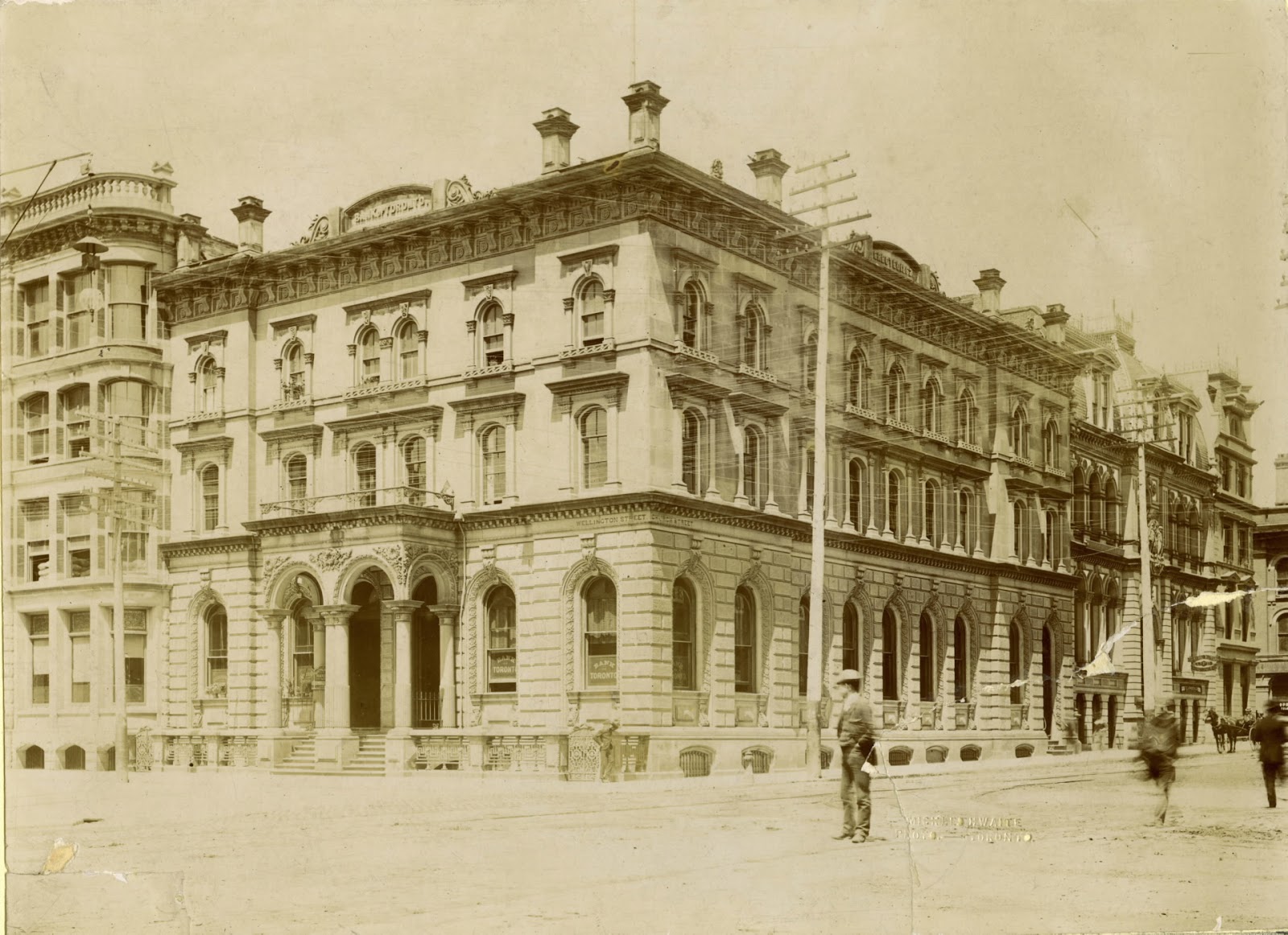 |
| THEN : The Bank of Toronto at the northwest corner of Wellington and Church streets is shown here in 1890. |
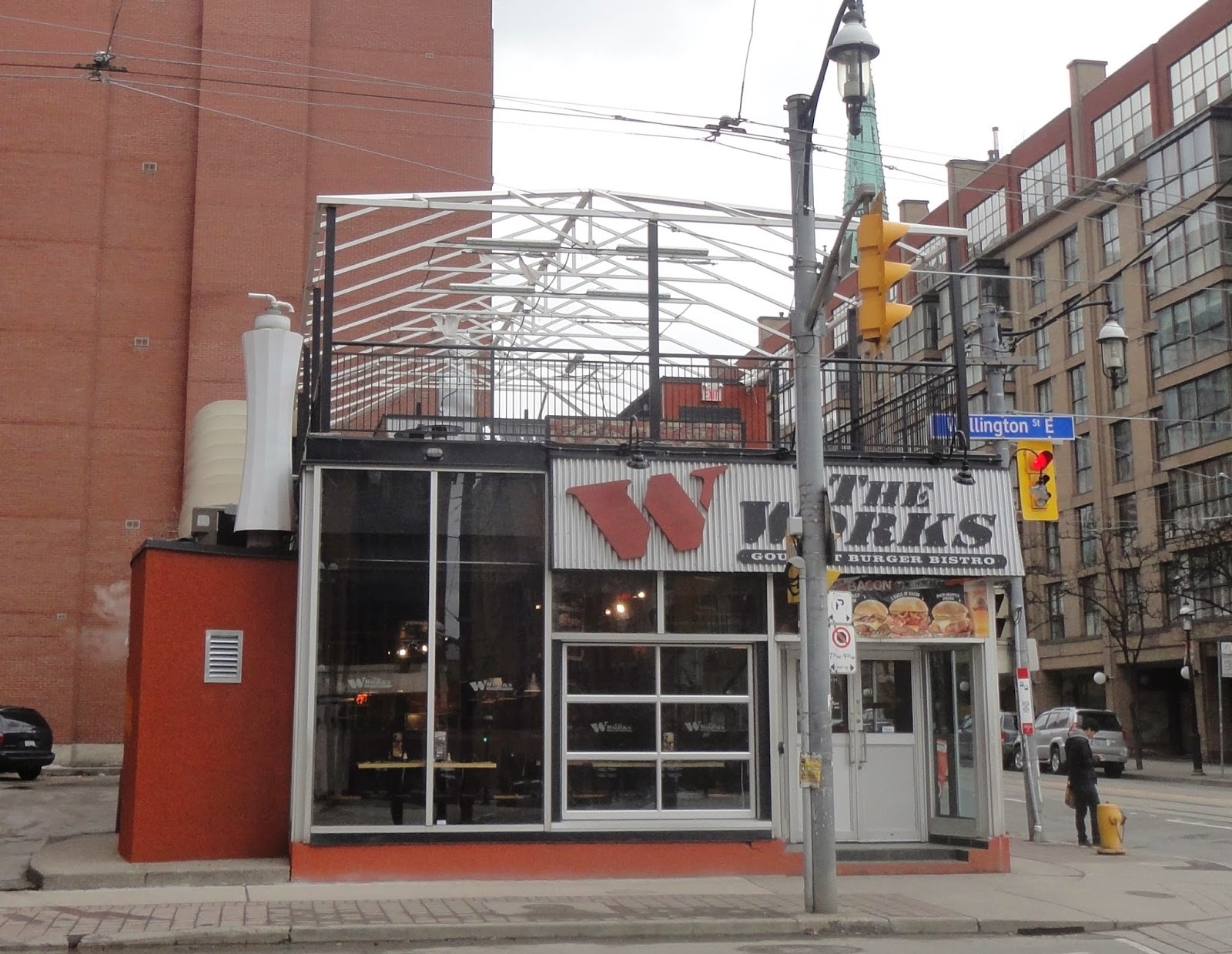 |
| NOW : What we have now, instead of the old Bank of Toronto building, is a stunning example of postmodern Toronto architecture ... |
Gooderham's office – now
more commonly known as the Flatiron Building – still stands across
the street, on the south side of Wellington Street. So, his office
stood across the street from the bank with which he was so involved,
and rumours abound of an underground tunnel that Gooderham could use
to sneak across the street and get into the bank's vaults. According
to some sources, anyway, the tunnel is still there, but access from
the tavern that is now in the basement of Gooderham's office has been
completely sealed off.
 |
| THEN : The Bank of Toronto building at the northwest corner of Wellington and Church streets is shown here in 1870. |
 |
| NOW : An accessible tunnel once ran from the Gooderham Building, on the left, under Wellington Street, to where the Bank of Toronto once stood on the right. Apparently, the entrance to the tunnels from the basement of the Gooderham building are all bricked up. Goodness only knows what one would find in the basement of "The Works". |
As early as 1901, the Bank of Toronto
began contemplating the construction of a new headquarters. The bank
purchased a large plot of land at the southwest corner of King and
Bay streets in 1902. With a frontage of 120 feet on King Street, and
134 feet on Bay Street, it was the largest parcel of land that had
been bought up for redevelopment up until that point in the city's
history. The lease on some of the buildings that stood at that
corner did not expire until 1911, so actual construction of the new
Bank of Toronto building did not begin until January of 1912.
An American architectural firm, Carrere
& Hastings, was chosen to design the new building. It was a time
when there was a great deal of nationalism in architectural design in
Canadian citizens, and the choice of an American firm probably caused
a stir. But Carrere & Hastings was at the top of the list of
respected American architectural companies, and their work on the
building would have brought the Bank of Toronto a lot of prestige, as
well as the security of knowing that their new headquarters would be
well designed and well built. The design of the new Bank of Toronto
building was inspired by the Bourse de Paris – the Paris Stock
Exchange building – that had been constructed over almost twenty
years from 1808 to 1826. The Bank of Toronto building took
considerably less time, and was completed in 1913.
 |
| THEN : The elegance and grandeur of the Bourse de Paris would serve as inspiration for the Bank of Toronto's new headquarters at King and Bay streets. |
 |
| THEN : The new Bank of Toronto headquarters were completed in 1913. |
The Corinthian columns of the building
evoked a sense of the Classical world that could be found in a number
of bank buildings from the time. A large plinth, taller than the
height of pedestrians passing by, held the columns above the level
of the traffic, and evoked a sense that the bank was built on a
strong foundation. The building looked like an imposing, geometric
monument that exuded self confidence. The elegance of the exterior
of the building hid the fact that there were five levels of offices
on the inside, and two full basements with space enough for vaults
and storage. Inside, at the centre of the building, was a vaulted
two storey banking hall. Marble, bronze and glass certainly made it
one of the most stunning commercial interiors at the time.
When the Bank of Toronto amalgamated
with the Dominion Bank in 1955, a decision was made to construct a
new building to house the combined offices of both of the former
banks. The 1913 Bank of Toronto building, and the current
Toronto-Dominion Centre was built in its place. Two towers were
built in the second half of the 1960s, with another four being built
between 1974 and 1991. The bronze tinted glass and black steel of
the buildings are perhaps the best example that Toronto has of the
“International Style” of corporate tower that was popular in
North America fifty years ago. On one hand, it is easy to imagine a
film about the world of banking, set in New York City in the 1960s,
being set in and around the complex. On the other hand, it's hard
not to miss the classical style of the old 1913 Bank of Toronto
building.
 |
| THEN : Topping off the 56-storey tower of the Toronto Dominion Centre, just prior to its completion in 1966. |
 |
| THEN : The original two towers of the Toronto Dominion Centre in 1966. The Royal York Hotel can still be seen to dominate Front Street in the background. The Toronto Stock Exchange building can be seen in the lower left hand corner of the photograph. Later additions to the Toronto Dominion Centre would eventually wrap themselves around the Toronto Stock Exchange building, and the old Art Deco façade now looks out from a wall of black glass. |
 |
| THEN : The original two Toronto Dominion Towers, circa 1967, just after they were completed. With "new" city hall in the background, and the Royal York and the Bank of Commerce building visible, I really think that this photograph points to a time when Toronto was delineated between the first and second halves of the twentieth century. The hotel and Bank of Commerce are still obvious giants, but the nuances of Revell's city hall and the soaring height of the new TD towers are like the opening chords of the modern glass and steel symphony. |
The first run of banknotes from the
Bank of Toronto were printed between 1856 and 1865. Few survive, so
they are quite valuable to collectors. However, a large number of
the banknotes from this period issued by the Bank of Toronto were
counterfeited. Banknotes from these years were issued in
denominations of $1, $2, $4, $5 and $10. Many of the banknotes were
overprinted with the location of branches, including locations in
Barrie, Cobourg, Collingwood, Montreal, Peterborough, Port Hope, and
St. Catharines. Like any other chartered bank, the signatures of
various bank officials appear on these banknotes – two names of
note were William Gooderham and James Worts.
 |
| THEN : $1 and $4 banknotes from the Bank of Toronto, dating from the 1856 to 1865 period. |
In 1876, the Bank of Toronto did a run
of only 25,000 banknotes, all with a face value of $4. No other
denominations were produced. They were either overprinted to show
branch locations in Collingwood or St. Catharines, or had no
overprint at all. J.G. Worts is pictured on the left and William
Gooderham is on the right. Because of the limited number that were
produced, these banknotes are considered to be rare and quite
valuable.
 |
| THEN : $4 banknote from the Bank of Toronto, dated 1876. J.G. Worts is portrayed on the left, and William Gooderham is on the right. |
For a little more than forty years
between 1887 and 1929, the Bank of Toronto did little to change the
appearance of their banknotes. Perhaps they felt that loyal
customers would be more secure having a recognizable mode of currency
from year to year. However, printing also cost less if the design
remained stagnant. The opening decades of the twentieth century were
years in which other banks modernized the appearance of their
currency, but banknotes issued by the Bank of Toronto retained a more
“retro” look. Overprints from various branches show a wide range
of locations all across Canada, signifying that the Bank of Toronto
was growing across the country.
 |
| THEN : Bank of Toronto banknotes from the period between 1887 and 1929. The $5 note portrays the Canadian Coat of Arms at the time, while the $10 note portrays what was then the Coat of Arms for Toronto. The $20 note contains a reference to the railroads, a cornerstone of the Gooderham family fortune, while the $50 banknote shows Toronto's 1899 City Hall. |
These Bank of Toronto banknotes from
either 1935 or 1937 show little variation at all from what had been
produced between 1887 and 1929.
 |
| THEN : Bank of Toronto banknotes from 1935 and 1937, looking like something out of the nineteenth century. |
THE DOMINION BANK
The Dominion Bank began in 1871, and
had a history that was in some ways similar to the Bank of Toronto.
It was founded on cautious and conservative principles, but spread
its branches of networks fairly quickly. In 1872 it became the first
bank in Canada to have two branches in the same city – right here,
in Toronto.
James Austin was
to the Dominion Bank what William and George Gooderham had been to
the Bank of Toronto. Born in Northern Ireland in 1813, he was
sixteen years old when his family came to Canada. He became a
printer's apprentice and spent a decade in that trade, both in Canada
and the United States. However, the cornerstone of his fortunes
would lay in other endeavours. He went into partnership with Patrick
Foy and together they established the Austin & Foy wholesale
company, which operated out of the Daniel Brooke building, which had
been built at the northeast corner of King and Jarvis streets in 1833
and which still stands today. The venture was a profitable one, but
Austin was drawn away by interests in other ventures. The
partnership was dissolved, and Austin was left with a decent sum of
money to invest elsewhere.
 |
| THEN : The Daniel Brooke building has stood at the northeast corner of King and Jarvis streets since 1833. The Austin & Foy Wholesale Company has been just one of the enterprises to inhabit this building, which is one of the few intrepid survivors from Georgian Toronto. |
With his establishment of the Dominion
Bank in 1871, he became a central figure in Canadian finance. He was
involved in several different insurance and mortgage companies. He
had also been one of the founding directors of Consumers' Gas, and by
1881 he had staked out further control of that company and became its
president.
In 1866, Austin had a new
family home built on top of Spadina Road, overlooking the escarpment.
The Eaton family were nearby neighbours, and of course, Sir Henry
Pellatt's notorious residence, Casa Loma, would eventually be built
across the street. The estate had been previously owned by the
Baldwin family, and noted Canadian political reformer Robert Baldwin
had died in the home that stood on the property. Austin had this
house replaced, but kept the estate name as Spadina. Austin ended up
selling off some portions of the eighty acres that he had purchased,
and the 1866 home was renovated and added to, but it still survives
today.
 |
| NOW : James Austin's estate of Spadina, as it looks today. Built in 1866 on the foundations of the Baldwin family estate, it now functions as a jewel in the crown of Toronto's museums. |
The last member of the
family to live in the house was Anna Kathleen Thompson, a
granddaughter of James Austin. In 1982, she negotiated to turn the
house over to the City of Toronto, and two years later, the house
opened as a municipal museum, and is still in operation as such
today. Renovated in 2010, the museum offers a number of unique
historical experiences, including an exhibit on the wardrobe and
costuming from the popular television series Downton
Abbey.
Find media coverage for the "Dressing for Downton" exhibit at Spadina here ...
... or visit here for official information!
 |
| NOW : The Austin family vault at St. James' Cemetery. |
Getting back to the Dominion Bank, it
spread through northern Ontario and western Canada, just like the
Bank of Toronto, and many other Canadian banks. The bank's target
clientele were employees of utility, resource and manufacturing
companies. The bank's history also mirrored that of the Bank of
Toronto when it got involved in War Bonds in the First World War, and
then rationing and foreign exchange in the Second World War.
 |
| THEN : An ad campaign for Victory Bonds from 1918. All major Canadian banks were expected to help finance the war effort by promoting investment in the Canadian government. |
The Dominion Bank didn't suffer too
greatly during the Great Depression, and the late 1930s and 1940s
were a very prosperous time for the bank as an institution. However,
in order to compete with other large banks, the Dominion Bank merged
with the Bank of Toronto in 1955. The two conservative institutions
with a very similar history made for a successful partnership that
still exists today.
The very first branch, which also
housed the corporate headquarters of the Dominion Bank, stood at 40
King Street East, opening there when the bank was established in
1871. The bank was actually renting these quarters from a retailer,
known as the Harris Store, and was paying a rental fee of $92.50 per
month. Within a few years, the bank outgrew this location, and in
1879, a new building was constructed at the southwest corner of King
and Yonge streets, at 1 King Street West. The location had
originally been home to a retail outlet, the Michie & Company
Grocers and Wine Merchants, but this would be demolished in order to
build the headquarters for the Dominion Bank. The cost of
construction was $40,000.
 |
| THEN : A photograph of the Dominion Bank building at 1 King Street West circa 1879, the year it was opened. |
Standing at a height of five stories,
the new building that was constructed for the Dominion Bank in 1879
was an early entry in the race for architects to build taller and
taller. The Beard Building stood at a height of seven storeys at the
southeast corner of King and Jarvis streets from 1894 until 1935, the
twelve storey Temple Building towered over Richmond and Bay streets
from 1896 until 1970, and the Trader's Bank Building, constructed in
1905 to an amazing height of fifteen storeys, still stands at the
northeast corner of Yonge and Colborne streets. But the five storey
Dominion Bank headquarters at King and Yonge streets was certainly
seen as a “skyscraper” when it went up in 1879.
 |
| THEN : The Beard Building, on the southeast corner, King and Jarvis streets, 1894 to 1935, stood seven storeys. |
 |
| THEN : The Temple Building, on the northwest corner of Richmond and Bay streets, 1896 to 1970, stood twelve storeys. |
 |
| NOW : The Trader's Bank Building, at the northeast corner of Colborne and Yonge streets, built in 1905 and still standing, soars to fifteen stories. All of these buildings, in turn, amazed Torontonians with their ever growing heights. They all came after the five storey Dominion Bank building, constructed in 1879. |
 |
| THEN : The Dominion Bank building in 1903, looking diagonally across the street, from the northeast corner of King and Yonge streets, towards the bank at the southwest corner. |
 |
| THEN : Looking east across King Street towards the Dominion Bank, on the corner of Yonge Street. When the bank replaced Michie & Company at the corner, that enterprise seems to have found a new home, two doors west (so, towards the camera) from the bank. |
That record would seen be toppled, of
course, and the ever growing success of the Dominion Bank led to the
construction of an even taller building. Work on the building began
in March of 1913, and the result was a twelve storey Beaux-Arts
skyscraper. When plans were unveiled for the new building,
detractors claimed that such a tall building would ruin the city's
skyline. However, the work of the architectural firm of Darling and
Pearson silenced all the critics when the new Bank of Dominion
building was completed in 1914.
Pearson and Darling would work on a
great many number of Toronto landmarks from the early 20th
century, including Flavelle House (now a part of the University of
Toronto's Faculty of Law), Convocation Hall and the Sanford Fleming
Building (both also located at the University of Toronto), wings of
both the Royal Ontario Museum and the Art Gallery of Ontario, and the
Bank of Commerce building, which still stands at King and Jordan
streets, and is a neighbour of the Dominion Bank building. The
architectural firm's work on the Dominion Bank building was acclaimed
as an attractive addition to Toronto's blossoming financial district.
 |
| NOW : The (former) Dominion Bank building at 1 King Street West, as it appears today. |
In addition to the building's soaring
height of twelve storeys, there were certainly other grand properties
to the building, too. The Grand Banking Hall, on the second floor,
boasted a forty-five foot high ceiling. The hall seems cavernous,
measuring 154 feet long and 68 feet wide. In a time when the bank
lobbies of today are only large enough to fit a few bank machines,
the banking hall of the 1914 Dominion Bank seems enormous indeed.
The massive nature of the building was also supported by an
excavation that went thirty-five feet beneath street level.
 |
| NOW : The grand banking hall at the Dominion Bank today. Like a number of historic venues, the bank has been converted to entertainment space. As familiar as we are with small little vestibules for automated banking machines, it's hard to remember a time when so much space was needed to efficiently process bank customers. |
The vault located in the basement soon
became a famous feature of the Dominion Bank. Located at the base of
a grand marble staircase that leads down from the main floor, the
vault was at one time considered to be one of the biggest and best in
Canada. It measures thirty-three square feet square, and has a
height of twenty-five feet. The vault is actually divided into two
levels. The upper one is known as the Safety Deposit Vault and the
lower one is known as the Treasury Vault. The circular door to the upper vault is over four feet thick, and has a circumference of over seven feet. Before the door could be installed, it was pulled down Yonge Street by a team of horses. This turned into something of a procession and was covered by local newspapers, which no doubt enhanced the bank's profile.
 |
| THEN : This photograph from 1914 shows the vault of the Dominion Bank being transported to the new bank headquarters at Yonge and King streets. |
 |
| NOW : The marble staircase that leads down from the refurbished main floor of the bank, downstairs to the Safety Deposit Vaults. |
 |
| NOW : The massive vault in the basement as it appears today. |
With the merger of the Dominion Bank
with the Bank of Toronto in 1955, many of the corporate functions of
the new Toronto-Dominion Bank were moved to what had been the Bank of
Toronto headquarters, just down the street at the southwest corner of
King and Bay streets. A branch of the bank did continue to occupy
the building at King and Yonge streets into the 1990s. Ownership
changed in 1999, when the old Dominion Bank Building at 1 King Street
West was bought up to form the nucleus of a new hotel and condominium
complex. By 2006, the adjacent glass and steel tower, nicknamed “the
Sliver”, was completed and the complex – commonly referred to as
the 1 King West Hotel - opened for business.
 |
| NOW : The Dominion Bank building and "the Sliver" at 1 King Street West. |
The Dominion Bank printed its first
currency in 1871, with another series following shortly after in
1873. Available denominations were $4, $5, $10, $20 and $100 bills.
The $4 bill shown here carried a portrait of Prince Arthur, who had
been born in 1850 and who would go on to become a Governor General of
Canada. His mother, Queen Victoria, is pictured on the $5 bill.
Like early banknotes from the Bank of Toronto, these often fell prey
to counterfeiters, so authentic banknotes are very rare today.
 |
| THEN : $4 and $5 banknotes from the Dominion Bank shortly after it opened. The $4 banknote features Prince Arthur, Duke of Connaught, who would serve as a Governor General of Canada. He had many connections with Toronto. Prince Arthur Road, which runs west from Avenue Road, just north of Bloor Street, is named for him. |
In a five year period between 1876 and
1881, the Dominion Bank printed a series of 110,000 banknotes with a
denomination of $4, 312,000 banknotes with a denomination of $5, and
105,000 banknotes with a denomination of $10. Like other banknotes
from the Dominion Bank, these are considered to be rare and valuable
today.
 |
| THEN : Banknotes issued from the Dominion Bank between 1876 and 1881. Generally speaking, the Dominion Bank issued banknotes that were more elaborate and vibrant than those of the Bank of Toronto. |
Through to the final years of the
nineteenth century, banknotes from the Dominion Bank continued to
display the signature of James Austin. He died in 1897 and his son
Albert William Austin (1857 to 1934) took over the family fortunes.
 |
| THEN : Signatures on the banknotes from the Dominion Bank at the end of the nineteenth century began to reflect a change in bank management, when Albert William Austin took over after his father's death in 1897. |
In 1931, the Dominion Bank issued a
banknote series in denominations of $5, $10, $20, $50 and $100. The
various denominations show a uniform type of design. A portrait of
Albert William Austin appears on the banknotes, along with one of
Clarence A. Bogert. Austin was the president of the bank from 1925
until 1933, and Bogert was president from 1933 until 1934. $5 bills
were the most commonly printed, with one million of them going into
circulation. 600,000 of the $10 bills were printed, 46,000 of the
$20 bills were printed, 8,800 of the $50 bills were printed, and only
6,800 of the $100 bills were printed. This gives you an idea as to
the relative scarcity of each of them, and a sense of the
corresponding numismatic value.
 |
| THEN : The 1931 series of banknotes from the Dominion Bank, featuring the portraits of Albert Austin (left) and Clarence Bogert. |
Although the $5 and $10 banknotes
issued by the Dominion Bank are more common than other issues, they
were still designed in a very attractive manner. Austin and Bogert
have disappeared off the banknotes in favour of Clifton Carlisle, the
new bank president, and Dudley Dawson, the vice-president. These
banknotes, as well as those produced in 1938, were slightly smaller
than those previously issued by the Dominion Bank.
 |
| THEN : The $5 and $10 banknotes issued by the Dominion Bank in 1938, featuring Clifton Carlisle and Dudley Dawson. |
The 1938 $5 and $10 banknotes featured
portraits of Robert Rae and Clifton Carlise.
 |
| THEN : The 1938 $5 and $10 banknotes featuring Robert Rae and Clifton Carlisle. |
_____________________________________________
Here's a throwback to an advertisement
produced by Canada Trust, before they amalgamated with
Toronto-Dominion. It showcases a brand new technology in banking –
the ATM. Johnny Cash made a cameo appearance to help Canada Trust to
convince bankers that the “Johnny Cash cash machine” was a safe,
secure and convenient way to do banking.
_____________________________________________
Don't go away! An upcoming article
will relate the history of institutions like the Royal Bank and the
Bank of Nova Scotia.