Showing posts with label Mackenzie. Show all posts

Saturday, June 30, 2018

# 66 ~ Toronto's Original "Canada Day" in 1867


Well, after a long hiatus of over a year, I've decided to put up another post here in my collection of anecdotal tales of Toronto's history. The patriotic inspiration for this was the fact that another Canada Day is upon us. I'm only one year overdue for posting in time for Canada's 150th, which took place last year, but hopefully any reader will find this almost as informative and entertaining for Canada's 151st. 


The title of this post, referencing "Canada Day" is of course misleading. Traditionally, July 1st had most commonly been known as "Dominion Day". This alluded to the British North America Act, which made reference to the country as a Dominion. There were suggestions to change the name of the holiday to "Canada Day" as early as the 1940s, but it wasn't officially changed until 1982. Although some traditionalist Tories and historical diehards may still refer to the day as Dominion Day, most people these days of course refer to July 1st as Canada Day.

____________________


____________________

So, to begin, back in 1861, a few years before Confederation, Toronto had a population of 65,000. We were the most inhabited city in the Province. Only Montreal, with its population of 90,000 people, was bigger. And with Canadian Confederation, we were set to become the capital of the brand-new Province of Ontario. An article in the Globe newspaper, operated by George Brown, one of the Fathers of Confederation, laid out the festivities held in Toronto to celebrate the creation of Canada, on Monday, July 1st, 1867.

The article reported how bells were rung at St. James Cathedral at midnight, as June 30th became July 1st, to “convey the joyful news to the city that the important era had arrived”, as the newspaper put it. The article went on, “Toronto has bestirred herself to make the holiday befitting the occasion … sufficient is announced to secure that the day shall be remembered among us as an eventful one in our history.” 

The old Cathedral Church of St. James had been destroyed by fire in 1849, and the main body of the church was re-opened to the public in 1853. As the photograph of the cathedral in 1867 shows, the spire was not yet complete, and wouldn’t be completely finished until 1874. But enough of the spire had gone up to house the bells, which had arrived in Toronto in 1865, two years before Confederation.

The Cathedral Church of St. James, at the northeast corner of King and Church streets, in 1867.


The first set of bells for the Cathedral were lost in a shipwreck off Rimouski, Quebec. A new set of nine bells were imported from the United States, and made the final leg of their journey along King Street by horse-drawn carriage in 1865. When they were first rung at Christmas that year, an article in the Globe newspaper wrote how “the heart of many an old countryman was warmed again by those old familiar sounds which delighted him in years gone by in his native land.” These same bells are still used 153 years later, in 2018.


Transporting the new bells for the Cathedral Church of St. James along King Street, Toronto, 1865.


A professional bell ringer, one Mr. Rawlinson by name, was on duty at the Cathedral on July 1, 1867. The Daily Leader newspaper had a little bit more to say about the historic ringing of the bells on that day. “The new Dominion was hailed last night as the clock struck twelve by Mr. Rawlinson ringing a merry peal on the bells of St. James’ Cathedral, the effect of which was very fine, in the otherwise solemn stillness of the night. Even at that late hour large numbers of persons were brought into the streets by the chiming of the bells and thousands there remained at their open windows to enjoy the pleasures of listening to the first musical performance of the Province of Ontario. The bells had scarcely commenced chiming when the firing of small arms was heard in every direction.”

The small arms fire was thanks to a detachment of the 10th Battalion, Royal Regiment of Toronto Volunteers. They assembled outside their drill shed and hoisted the Royal Union Flag, as well as their own Regimental Colours. The Royal Union was given a 21-gun salute at about 4 o’clock in the morning, no doubt to the great delight of the neighbours. The Royal Regiment of Toronto would eventually become the Royal Regiment of Canada. 

At six o’clock in the morning, a large ox was put on a spit at the foot of Church Street. One Captain Woodhouse, who commanded a ship called Lord Nelson, was in charge of the patriotic barbecue. The animal had been purchased from a butcher named Joseph Lennox, up in Yorkville. The Globe noted that the ox would take most of the day to roast, and leftovers would be distributed amongst the city’s poor. 

The Daily Telegraph newspaper also noted that parts of the ox were given to two different charities for children. The Protestant Orphan’s Home had opened in 1854, on Sullivan Street, between Queen and Dundas streets. It struggled to accommodate the flood of immigrant children to Toronto, or those who had lost their parents to cholera and the other lethal diseases that swept through Toronto at the time.


Protestant Orphans Home, Sullivan Street, Toronto

The House of Providence stood on Power Street, south of Queen Street. Opened in 1857, it was operated by the Sisters of St. Joseph and the Roman Catholic Church. Nearly always full, the institution would eventually quadruple in size to provide for about 700 residents, including the unemployed, orphans, the elderly, immigrants and widows. Some stayed for a few days, while others were there for years. The House of Providence lasted for over a century before it was demolished in 1962 to make way for the Richmond Street exit from the Don Valley Expressway.


House of Providence, Power Street

Toronto’s church-going faithful also sought out their own edification when Canada became a country on July 1st, 1867. Some assembled at 9:30 in the morning, in the lecture room of the Mechanics Institute at Church and Adelaide streets. They were there for a meeting of the Toronto Branch of the Evangelical Alliance, and “Christian persons of all denominations” were “invited to attend at that hour to invoke the divine blessing of the new Dominion”. 

The Toronto Mechanics’ Institute had been built in 1853. Paying members could attend lectures and courses and use the library. In 1883, the institute was given financial support by city council, at a time when no other city in Canada had a completely free public library. So, the Mechanics’ Institute became the nucleus of the first public library system in the country. The building was demolished in 1949.


The Toronto Mechanic's Institute, at the northeast corner of King and Adelaide streets


Oliver Mowat was the most notable speaker at the religious rally held at the Mechanics’ Institute on July 1st, 1867. He was vice-chancellor of Evangelical Alliance, a Father of Confederation, and a rival of Sir John A. Macdonald. Mowat wanted strong provincial autonomy, where Macdonald envisioned a very centralized federal government for the country. Mowat served as Ontario’s third premier for 24 years, from 1872 until 1896. He then served as Ontario’s eight lieutenant-governor, from 1897 until 1903. 

Mowat was Ontario’s first great leader, and made the province the richest in Canada. It was under Mowat’s leadership that Ontario’s agriculture was modernized, industry was expanded, areas like education and science were cultivated, urban social problems were addressed, and electoral reforms like voting by secret ballot were introduced. If Macdonald was the “Father of Canada”, then Mowat was the “Father of Ontario”.


Sir Oliver Mowat (born July 22nd, 1820, died April 19, 1903)


But, back to Toronto during the celebrations of Canadian Confederation. They continued all day long. A military review and parade was held on public commons along Spadina Avenue, south of College Street. The afternoon saw a picnic and festival in aid of the new St. Patrick’s School House, and a church on Dummer Street. The Horticultural Society put on an evening concert and dance, with music supplied by two military bands.


The Public Commons, Spadina Avenue, south of College Street, hosted a military review and parade on July 1st, 1867.


Fireworks were set off at Queen’s Park at about 9 o’clock that night, and the park itself was illuminated by lantern light. The area was still mostly a public park at this point, with the parliament buildings still down at Front Street. Today’s legislative assembly wasn’t built on this spot until 1893, and the only building in the park was King’s College, which had been abandoned in 1859 in favour of University College.

The Daily Telegraph newspaper wrote up a good review of Toronto’s first ever July 1st fireworks display, which were set to the tunes offered by two military bands. The paper said, “The great event of the day … was the display of fireworks in the Queen’s Park during the evening. It drew together an immense crowd. The display was the finest of the kind ever witnessed in Toronto and gave universal satisfaction. Several of the pieces were very beautiful and appropriate.”

Monday, July 1st, 1867 was a public holiday across the new Dominion. Businesses were closed, and Toronto celebrated with public musical recitals, choirs, military parades, pageants and picnics, and topped it all of with night time fireworks. At the heart of it all, it doesn’t really sound too different from how we celebrate July 1st these days. 

Sure, those partygoers from 151 years ago wouldn’t recognize the Maple Leaf Flag, and they’d probably be more than a bit startled with what we can do with modern day fireworks. They’d have no idea what a “Canada Day” actually was. But I found it curious that, in spirit, anyway, a lot of our public observances are the same as they were 151 years ago now.


____________________


____________________

However you are commemorating Canada Day this year, I hope it's a fun and relaxing one. A simple internet search will reveal a number of "Top Ten" lists of special concerts, fireworks displays, markets, food festivals and activities that are available over this long weekend. As usual, my choice is mostly for the historical, and three of the City of Toronto's historic sites are putting on special events. These are Fort York National Historic Site, Mackenzie House Museum and the Scarborough Museum.


Canada Day at Fort York National Historic Site

"In addition to flag raising and flag lowering ceremonies, the Fort York Summer Guard, dressed as members of the Canadian Regiment of Fencible Infantry (circa 1815) will perform demonstrations of musketry, artillery and fife and drum music. Children can enjoy a drill activity, music classes, and a scavenger hunt. The Fort's volunteer historic cooks will demonstrate period-specific cooking methods and recipes in the historic kitchen."


Celebrate Canada Day at Fort York National Historic Site


Canada Day at Scarborough Museum

"Looking for a unique and memorable Canada Day? Scarborough Museum hosts their annual celebration in Thomson Memorial Park. Demonstrations include historic blacksmithing, spinning, weaving and leather working. Don't forget to check out the Scarborough Historical Archives tent and browse through archival aerial photographs, maps, and lots of information not he history of Scarborough. The museum's annual pie eating contest is also back by popular demand. Finally, enjoy celebratory Canada Day historic treats and stroll through the vendor markets."


Celebrate Canada Day at the Scarborough Museum


Canada Day at Mackenzie House Museum

Celebrate Canada's birthday with a visit to Mackenzie House, the home of Toronto's first mayor! Visitors can use the 1845 press to print their own Maple Leaf postcard.
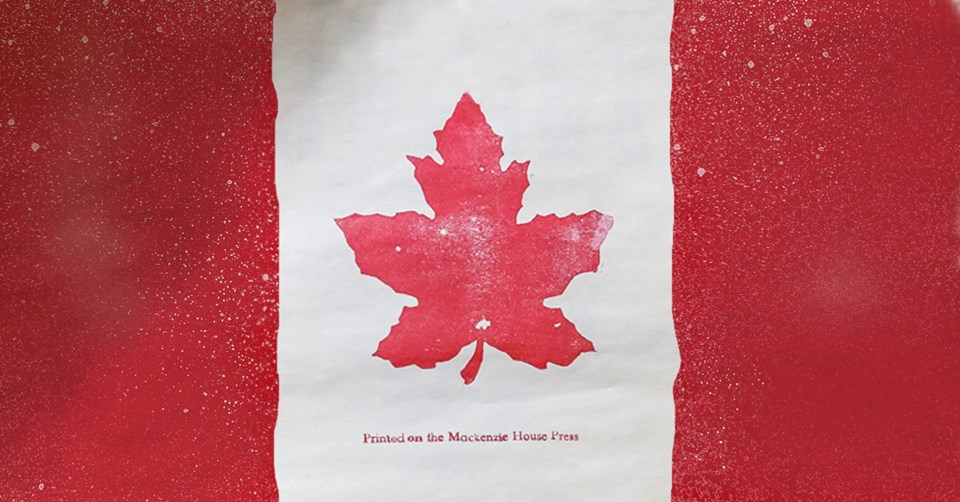

Celebrate Canada Day at Mackenzie House Museum


____________________


For frequently updated historical photographs of Toronto, follow me on Instagram!

My Instagram ID is "fiennesclinton"

Friday, March 6, 2015

# 47 ~ Toronto's Birthday, Then and Now


March 6th, 2015, marks the 181st anniversary of the Incorporation of the City of Toronto, from the old Town of York.  

The story is a pretty basic part of Toronto's history.  The old Town of York had been established by John Graves Simcoe back in 1793.  When the Province of Upper Canada (now Ontario) was created back in 1791, Simcoe was appointed as the province's first lieutenant-governor.  He set sail with his wife, Elizabeth, who was an incredible woman.  It was custom at the time for a woman of her social position to stay at home, back in England, while her husband fulfilled whatever position he was posted to.  But, it is due to her rugged determination to travel with her husband, that we know so much about early history in Toronto and southern Ontario.  She was a keen diarist and painter, and her writings and illustrations illuminate what society and nature were like in the dwindling years of the 18th century.

York would eventually become the provincial capital, replacing Newark (now Niagara-on-the-Lake). Although the provincial government met in York pretty consistently from 1796, there was no actual government to run the town.  The difference between "town" and "city" was an important one.  It would be forty years before there was enough of a population to qualify the Toronto region as a city.  A clutch of bureaucrats, known as the Home District Council, settled matters pertaining to the Town of York.  In many cases, matters may have been sent to the Executive Council of Upper Canada, or even the lieutenant-governor, if the Home District Council could not form a decision.  Looking back, it seems like a case of splitting hairs, as whoever was on the Home District Council probably served on the Executive Council, too.  In some cases, certain matters may have been passed back to the Colonial Office, in England.  This was of course a time when communication between the Toronto region and England could take two months, at least - one way.  So, it may take six months for any political decree to return from England.


"FAMILY COMPACT"
Tories versus Reformers

A lot of local and provincial affairs were dictated by a small cluster of a few dozen wealthy and powerful men.  Nicknamed the "Family Compact", they were the politicians, judicial figures, bankers and government appointees who held sway.  Through the 1820s and 1830s, there was a growing Reform Movement  - a group of individuals who began to oppose the Family Compact.

Several of these prominent Reformers began to petition the provincial government in 1833.  They demanded that the Town of York become incorporated into a city, which would mean a broadened electoral system, and therefore, an increase in democracy.  The Tory-controlled provincial Parliament sought a way to lessen the chances that Reformers would get elected.  The bill to incorporate into a city passed on March 6, 1834.  The old Town of York passed away, and was now the City of Toronto.

This is often heralded as a great triumph for democratic elections.  But who could vote?   Women did not have the franchise in Canada, at this point.  The provincial Tories had set the bar high in terms of qualifications for voting for an alderman.  There were conditions stipulating that only those who owned a certain amount of land could qualify to have a full vote.  Out of an adult male population of 2,929, only 230 of these grown men could vote.  No one from the general population could vote directly for the mayor.  He (and of course, it would be a "he"), was chosen, or appointed by the elected aldermen, from among their own number.


TORONTO'S FIRST MAYOR

Late in 1833, not too long before Toronto's first election was called, there was a brewing labour dispute.  The Tories of the Family Compact had alienated a large number of the city's construction tradesmen, who went on strike.  This created a sympathy for labour and Reform, and led to a landslide victory in our first municipal elections.  Reform candidates chose William Lyon Mackenzie from their own number.  Mackenzie needs little introduction in Toronto historical circles - unless, of course, the introduction serves to dispel some of the rumours about him!  For a lot of greater detail about Mackenzie I would refer you to his entry at the Dictionary of Canadian Biography.  


THEN : Proclamation of the new City of Toronto, 1834.


WHAT'S IN A NAME?

The Town of York was named for Frederick Augustus, the Duke of York and Albany, and second son of King George III.  He was also remembered in Frederick Street - one of the streets to make up the early town.  The Duke of York was principally a military figure who had led British troops to victory just prior to the naming of our Old Town.


THEN : Prince Frederick, Duke of York and Albany, circa 1793 - the same year that our town was named after him.


As plans were being set for the incorporation of Toronto, there was great debate as to whether we should keep the ancient aboriginal name from which "Toronto" stems, or hold fast to the British sounding name of York.  John Graves Simcoe had been fond of renaming settlements with sold English sounding appellations, and there were those in the 1830s who felt strongly that the name "York" should remain.  Others suggested reverting to "Toronto".  The name of our current city has been so strongly corrupted from the traditional aboriginal tongue, that it's hard to tell exactly where it comes from.  For years, it was accepted that it came from an aboriginal word for an area near the mouth of the Humber River, where aboriginal people used to gather, trade and communicate.  This belief set the definition of the word as "Place of Meeting".

In the last decade, it has been conjectured that the word derives from an aboriginal term that describes a method of fishing, where sticks are plunged into the waters to form fishing weirs.  This definition would have Toronto mean "Where Sticks Grow In The Water".

Obviously, despite debate, the name "Toronto" won out.  The name York lives on in today's Royal York Hotel, York University, and in other institutions.  Back then, we also had York Township, York County, and according to folklore, one of the big reasons we opted for Toronto over York was because we were nicknamed "Little York", in a rather demeaning fashion, after the big New York that lay south of the border.


That's the basics.  Our city governance has grown and changed a lot in the past 181 years.  I wanted to leave you with a number of illustrations that shows you what Toronto looked like during it's 40 year life as the Old Town of York.


THEN : Ships in the harbour fire a gun salute to commemorate the victory of the Duke of York at the Battle of Famars, and the naming of Toronto as York, on August 24th, 1793.  This was one of the many paintings made by Elizabeth Gwillim Simcoe that illustrate life in our early province.  


THEN : This map of York, the surrounding region and the harbour was made in 1793 by surveyor Alexander Aitken, for Lieutenant Governor John Graves Simcoe.


THEN (AGAIN) : I've taken the liberty of editing the above map to highlight the position of Fort York, and the Old Town of York.  The town took up 10 blocks, from today's Jarvis Street east to Parliament Street, and from Front Street up to Adelaide Street.  Also marked is today's Queen Street, which was the first Concession Road north of the town.  The street was originally dubbed "Lot Street" as all the park or farm lots were measured north from there.


THEN : A view of the harbour at York, looking west from the military blockhouse at the base of Berkeley Street in 1812. 


THEN : "Plan of the Harbour, Fort and Town of York, the Capital of Upper Canada, March 16th, 1816"

THEN : Looking north across the harbour from the Gibraltar Point Lighthouse in 1817.  The lighthouse had been built by 1808, and despite its remote location it is one of the more well known of Toronto's Georgian remnants.

THEN : A map of the Town of York from 1818.  By this time, the area between Yonge Street west to Bathurst Street had started to be filled in.  Here you can see which early luminaries got which properties.  At the time this was still largely farmland and countryside, but imagine the property taxes today!  Also, some street names have changed over the years.  Graves Street, which was named after John Graves Simcoe, was changed to Simcoe Street.

THEN : Another view across the harbour from Gibraltar Point.  This one dates from 1828.


SOME EARLY BUILDINGS FROM THE TIME OF THE TOWN OF YORK


THEN : Scadding Cabin, originally built in 1794, is credited as the oldest surviving building in Toronto today.  It was built for John Scadding, a pioneer and aide-de-camp to John Graves Simcoe.  Originally built near the Don River and Queen Street, it was taken apart and reassembled on the grounds of today's  Canadian National Exhibition.  It is maintained and operated by the York Pioneers Historical Society.


NOW : How Scadding Cabin looks these days.

THEN : Castle Frank is more than just the name for a subway station.  This was the "summer home" of John Graves and Elizabeth Simcoe.  Built in 1794, it stood in the wilds north of York, just south of today's Bloor Street, overlooking the Don River.  The Simcoes abandoned it when they returned to England.  When the Americans invaded York in 1813, they saw Castle Frank on a map.  Mistaking it for a real castle, worthy of plunder, they tramped through the woods only to find a rotting wooden cabin.  Castle Frank was accidentally destroyed in a fire in 1829.


THEN : The birthplace of noted Canadian politician, Robert Baldwin, was built on the northwest corner of King and Frederick streets, just prior to Baldwin's birth there in May of 1804.  Robert Baldwin would go on to lead the moderate reform movement in Canada and usher in "responsible government" in the 1840s and 1850s.  The Baldwin family only lived in the house for a few years, but a later inhabitant of note was William Lyon Mackenzie.  He lived here with several members of his family and several apprentices, too, but was down in New York State, evading his creditors, in 1826.  The sons of several of those Family Compact clans broke into his home, which was also where he printed his radical newspaper "The Colonial Advocate".  They did their best to bust up his operation and destroy his equipment.  This became known as "The Types Riot".  The subsequent trial (called "The Types Trial") saw Mackenzie awarded enough money to fight off insolvency and launch his political career.  Mackenzie later moved out of the house, and it was eventually destroyed by fire, by 1849.  Today a Starbuck's stands on the site.

THEN : These were the grand "Palaces of Parliament" that stood along Front Street, between Front and Berkeley streets.   Constructed in the 1790s, they lasted for less than 20 years, before being infamously torched by invading Americans.  A second set of parliament buildings were built on the same site, before they too were lost to fire - this time, accidentally.


THEN : An early sketch of the original St. Lawrence Market.  The original market was build on the north side of Front Street, running up to King Street (where today's "north market" stands).  The very first market opened in November of 1803.  Several incarnations and additions later, St. Lawrence Market is today a very popular destination with both locals and visitors to the city.  In this drawing you can see the town well, centre foreground, as well as the harbour, in the back of the picture.  The harbour, of course, extended south from Front Street at the time.  

THEN : The first church of St. James was constructed on the site of today's Cathedral Church of St. James in 1807.  After several fires, and restorations, we have the Victorian spire that we know today.  But this original church was a very simple wood frame building - and the only church in town in 1807.

THEN : Built in 1822 on Adelaide Street, at the top of Frederick Street, and nearly lost to demolition, Campbell House was saved and moved to the northwest corner of Queen Street and University Avenue.  The home of Sir William and Lady Hannah Campbell, the house was a jewel in the Crown of Georgian York.  We are blessed that it still survives.  Today it operates as a public museum, and if you've never been for a visit, you should!


THEN : This map was produced to mark the incorporation of the City of Toronto on March 6th, 1837.


THEN : A new city was seen as a reason to celebrate.  Here we see revellers gathered around the windmill owned by the Gooderham and Worts families - this windmill was the precursor to today's Distillery District.  Party goers would have gathered on the frozen over harbour - where the parking lot for the Distillery District is today - to skate, ride in sleighs and enjoy a bonfire.