
 |
| The Menin Gate Memorial to the Missing is a war memorial in Ypres, Belgium, dedicated to the soldiers of the British Empire, now the Commonwealth, who were killed during the fighting in Ypres, and whose graves are unknown. Unveiled on July 24, 1927, the memorial lists the names of 54,896 soldiers who were killed in the battle but whose remains were never found, or never identified. |
 |
| The interior of Menin Gate. |
_____________________________________
This is the ninth and final instalment in a series of posts leading up to the centenary of John McCrae's writing of In Flanders Fields, on May 3, 1915. I've planned for articles to be posted over the next several weeks, and to culminate with actives commemorating the centennial of McCrae's poem.
Images of John McCrae or the poppy, or recitals of the poem, In Flanders Field, are usually just relegated to Remembrance Day. We have come to associate certain images so much with November 11th, that they seem out of place during the rest of the year. As I publish these posts, I hope that you will find enough about Toronto's history, to make the articles of interest.
John McCrae wrote his poem during the Second Battle of Ypres, which took place between April 22nd and May 25th of 1915. The battle saw the first massed use of poison gas by German forces on the Western Front. It was a important engagement for Canadian troops ~ for the first time, a group of "colonial" soldiers defeated a European power, on European soil. Military experts often refer to how engagements like the Battle of St. Julien or Kitcheners' Wood helped to usher Canada into national adulthood.
However, instead of focusing on an analysis of military activity in Europe, my series of posts will mostly follow how the war was "fought" on the Toronto home front.
_____________________________________
The ninth and final part of my
presentation is entitled “Commemoration”.
It chronicles the way in which Toronto reacted to the news that the war
was finally over, and shows just a few of the monuments that were built around
the city to commemorate the conflict.
After four long years of fighting, the
war began to draw to a close, at the end of the Summer of 1918. The Central Powers finally started to
collapse. Bulgaria signed an armistice
on September 29, 1918. On October 30,
the Ottoman Empire capitulated. The
Austro-Hungarian Empire disintegrated after their armed forces were wiped out
at the Battle of Vittorio Veneto, at the end of October, 1918. Declarations of independence were proclaimed
throughout the old empire, in Budapest, Prague and Zagreb, and on November 3,
1918, Austria-Hungary sent out a flag of truce to ask for an armistice. On November 11th, 1918, at 5
o’clock in the morning, an armistice with Germany was signed in a railroad
carriage at Compiègne. The ceasefire
that ended the war would come into effect at 11 a.m. – the eleventh hour of the
eleventh day of the eleventh month.
 |
| Military delegates stand outside the "Armistice Train", at Compiègne, where signatories signed the cease fire. |

 |
| Newspapers the world over soon spread the news that the war was over. |
On the morning of November 11th,
1918 – Armistice Day – Torontonians awoke to the news that the war was
over. Several thousand of husbands,
sons, and fathers from the Toronto area had died in the war, but those who had
survived would eventually be returning home.
A photograph exists, of a Toronto family gathered in their bedroom, reading a headline of the war's end in the Toronto World newspaper. No record survives of which
family this was. Did they have a loved
one off at the front? If so, were they
killed in action? Or, could they look
forward to a homecoming in the weeks or months to come?
 |
| An unidentified Toronto family gathers together on the morning of November 11th, 1918, to read news that the war was over. |
On the morning of November 11th, 1918, rumours of
the war’s end were soon spreading through the city.
One can only imagine the infectious good news spreading out through the
streets, catching people unaware, as they headed off for what they might of
thought would be just another day, heading off to fight the war in factories or
fundraising.
This photograph, taken just a few moments after the previous one, shows the
jubilance starting to break out, as a number of children – and a few sailors -
have climbed up on top of the streetcar.
The news of the war’s end began to spread through the streets.

 |
| The above two photographs show jubilant crowds storming a Queen Street streetcar, as news of the Armistice swept through Toronto. In the second photograph, taken just moments after the first, a number of children and even a few sailors have climbed on top of the streetcar. |
It wouldn’t be too long before ecstatic
crowds were pouring out on to the streets of Toronto. There are a number of photographs in the Toronto Archives that show great groups of Toronto residents pouring into the streets to celebrate the war's end.
 |
| A throng of people gather together at Queen and Yonge streets, revelling in the news of the war's end. |
 |
| Here is a similar scene, also at Queen and Yonge streets. |
 |
| Just as they had at the outbreak of the war, in August of 1914, the people of Toronto massed outside City Hall, at Queen and Terauley (now Bay) streets, when the news of peace swept through the city. |
 |
| It wasn't long before impromptu parades, gatherings, and celebrations were taking place all over Toronto. Seen here is a spontaneous celebration on King Street West. |
 |
| Peace celebrations at King and Bay streets. |
 |
| Revellers on Queen Street. |
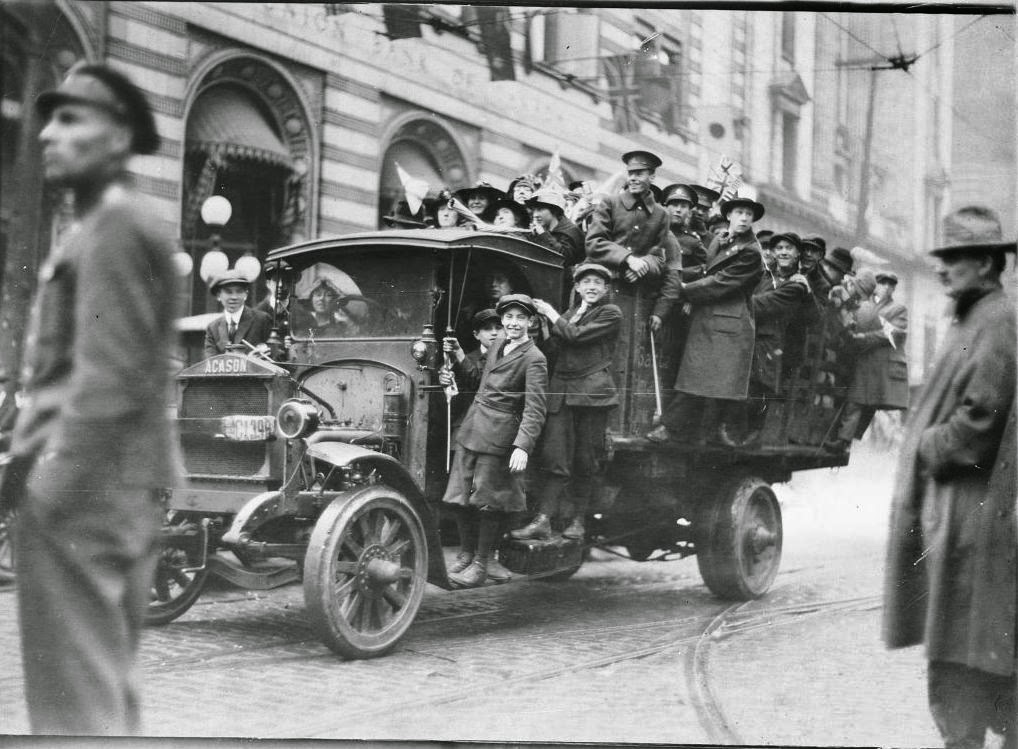
|
| Celebrations at Bay and King streets. |

 |
| This photograph of Armistice Day celebrations is notable for the Victory Loan banner in the background, as well as the flags of Allied countries which were strung up along the street. |
 |
| This photograph was taken from the third floor of City Hall and overlooks Queen and James streets. You'll note the "Buy Victory Bonds 1918" poster in the background. |

As Toronto celebrated the end of World
War One, the residents of the city looked forward to welcoming home those
soldiers that would be returning from overseas.
But in Toronto alone, there were thousands of soldiers that were being
mourned. The city would turn its
thoughts to appropriate ways to honour the memory of those who fought and died.
 |
| Banners like this one hung all over Toronto and across Canada to welcome back returning soldiers to the home front. It contains Canadian imagery, including the "Red Ensign", the Canadian Coat of Arms, and the beaver. |
Many of the modern ways in which we
commemorate Canada’s veterans originated in the aftermath of the Great
War. Today’s Remembrance Day, of course,
takes place each year on November 11th, with silence observed at 11
o’clock on that morning. This
observation can be traced back to when the Armistice that ended the Great War
came into effect – the eleventh hour of the eleventh day of the eleventh
month.
In Canada, Remembrance Day is a public
holiday and federal statutory holiday, as well as a statutory holiday in all
three territories and in six of the ten provinces – with Nova Scotia, Manitoba,
Ontario and Quebec being the exceptions.
Until 1930, the Armistice Day Act provided that Thanksgiving would be
observed on Armistice Day, which was fixed by statute on the Monday of the week
in which the 11th of November fell. In 1931, the federal parliament adopted an act to amend Armistice Day celebrations, providing that the day should be observed on November 11th, and should be called "Remembrance Day". This is when Thanksgiving became a separate holiday in Canada, distinguished from what became Remembrance Day.
The poppy has become a recognizable
symbol of military remembrance in Canada.
The use of the poppy was inspired by the poem “In Flanders Fields”,
written by Lieutenant Colonel John McCrae, a physician who had graduated from
medical school at the University of Toronto.
McCrae wrote the poem on May 3, 1915, after witnessing the death of his
friend, a fellow soldier, the day before.
The poem was first published on December 8, 1915. McCrae died at the end of January of 1918, of
pneumonia, while serving overseas.
The poppy was actually first used by
the American Legion to commemorate American soldiers who died in the Great
War. The poppy was later adopted by
military veterans’ groups in the United Kingdom, Canada, Australia, and New
Zealand. Today, the poppy is mainly used
in the United Kingdom and Canada to commemorate those who have been killed in
all conflicts since 1914. In addition to
the small poppies worn on clothing, poppy wreaths are also often laid at war
memorials.
 |
| John McCrae in 1912. |
 |
| A printed postcard bearing McCrae's poem, "In Flanders Fields". For Canadians, McCrae's poem would become the most well known piece of literature to come out of the First World War. |
 |
| An inscription of the complete poem in a bronze "book" at the John McCrae memorial at his birthplace in Guelph. |
All across Toronto, there are several
monuments, both large and small, dedicated to the memory of those who fought
and died in the Great War. Various
schools, businesses, banks and private organizations put up monuments all
across the city to commemorate military service during the conflict. What I have included here is only a small
inventory of those monuments that can be found throughout Toronto.
Toronto’s central Cenotaph would be
located on the front steps of the 1899 City Hall. Modelled on the cenotaph at Whitehall, in
London, Toronto’s cenotaph was made using granite cut from the Canadian
Shield. It was unveiled on November 11,
1925. Originally built to commemorate
Torontonians who died in the Great War, this cenotaph went on to also honour
those who died in the Second World War and the Korean War.
 |
| Before the cenotaph at City Hall was unveiled in 1925, the site was home to more makeshift commemorations every November 11th, as seen in this photograph from 1922. |
 |
| City Hall Cenotaph, Remembrance Day, 2012 |
 |
| Of note is the particularly solemn appearance of the two heraldic supporters on the city's coat of arms. They have their heads turned down in sombre reflection. |
What of areas like the Exhibition
grounds and the University of Toronto, which were used to train so many of the
soldiers who went to Europe to fight?
Today, there is little in the way of the commemoration at the grounds
of the Canadian National Exhibition. The
Stanley Barracks, which were used as a prison camp for enemy aliens still
stands, but there are no statues, cenotaphs or other commemorations to those
who trained on the grounds. Even the
historical plaque near the Stanley Barracks makes no reference to the
building’s use during the Great War.
 |
| The plaque commemorating the history of the Stanley Barracks. |
 |
| Recruits march past the Stanley Barracks, seen in the background, during the First World War. |
By contrast, there are several
commemorations marking the involvement of Torontonians during the Great War to
be found around the University of Toronto.
In a way, Hart House itself could be considered a monument to the First
World War. Construction had begun in
1911, and the unfinished building was used to house recruits before they were
shipped off to fight. The building was
finally completed, and the opening ceremonies took place on November 11th - Armistice Day - of 1919. With the war
such a recent memory at the time of the building’s completion, there are
several reminders of the conflict within its walls.
The chapel in Hart House is one of the
best examples of an emerging mode of design that was popular in 1919. Three of the stained glass windows in the
chapel are made up of fragments of glass that were retrieved by Canadian
soldiers. Taken from destroyed churches
in France and Belgium, they were brought home to Toronto and pieced together
into the windows in the Hart House chapel.
 |
| The chapel at Hart House. |
 |
| The three stained glass windows in the chapel at Hart House, which contain fragments of glass salvaged from churches in France and Belgium that were destroyed during the First World War. |


 |
| Detail of salvages stained glass, Hart House chapel. |
The Great Hall at Hart House is often
used for receptions and social gatherings, and also holds a commemoration of the
First World War. The west wall of the
Great Hall contains the heraldic shields of those universities that were within
the British Empire at the time of the First World War. On the east wall are the arms of those
universities that were in allied nations during the conflict. Countries like France, Russia, Italy, Japan
and America are all represented.
The centrepiece of this heraldic
collection is the coat of arms of His Late Majesty, King George V, who was king
during the First World War.
 |
| The Great Hall at Hart House. |
 |
| A small example of the heraldry displayed in the Great Hall at Hart House. These are representatives of Canadian universities, and are located amongst other coats of arms from universities that were in the nations of the British Empire during the First World War. The coat of arms of the University of Toronto is seen at top left. |
 |
| The coat of arms of King George V, Canada's sovereign during the First World War. |
The Soldiers’ Tower stands immediately
adjacent to Hart House and is amongst Toronto’s best known monuments that
honours those who died in the First World War.
After the war, University alumni raised almost $400,000 to construct the
tower. The cornerstone was laid in 1919,
by Canada’s Governor General, Victor Cavendish, the Duke of Devonshire. The building was completed five years later
in 1924, at a cost of $252,500. The
remaining funds that had been collected were given over to scholarships.
 |
| The Soldiers' Tower, University of Toronto. |
The names of 628 students
of the university who were killed in the First World War are etched on a
sheltered stone screen that stands adjacent to the tower’s base. Among them is the name of John McCrae, who
was a graduate of the University of Toronto.
Also etched into the stone is his poem, In Flanders Fields.
 |
| The names of 628 students of the University of Toronto who were killed during the First World War are carved on the memorial wall behind the arches. |
 |
| John McCrae's "In Flanders Fields" is also carved on the wall. A portion of it is shown here. Of course, as McCrae was a casualty of the First World War, his name can also be found amongst the war dead. |
The names of 557 students
and alumni who were killed in the Second World War would eventually be
inscribed in the stone archway at the base of the tower. Those remembered at the tower did not have to
be Canadian citizens – the only condition was that they had been students at
the University of Toronto. There are names
of those who served in various branches of the Canadian, American and British
forces, as well as an Australian soldier and a Dutch pilot.

 |
| These two walls, under the arch at the base of the Soldiers' Tower, record the names of 557 students from the University of Toronto who were killed during the Second World War. |
 |
 |
| Many of the university's casualties from the Second World War were, of course, Canadian. But both the British and American armies were thoroughly represented, too. Seen here is the name of Sergeant Major G. W. West, of the Australian Army, and Gunner R. Steensma, of the Netherlands Air Force. |
The tower features a dramatic 12-panel
stained-glass window that is partly a visual interpretation of John McCrae’s
“In Flanders Fields”, along with 8 smaller stained-glass windows that depict
men and women of the armed forces at wartime. A museum within the tower, called the Memorial Chamber, holds a
collection of medals, memorial books, portraits, photographs, flags and
miscellaneous memorabilia from the First and Second World Wars.

The clock of the tower was installed in
1927, and an initial 23 bells were also put into the tower’s carillon. A number of additional bells were added over
the years, and the tower now has 51 bells that are rung out for special
occasions and recitals during the course of the year. The Soldiers’ Tower serves as a home to the
University’s Remembrance Day ceremony each year.

 |
| Military service, the Soldiers' Tower, 1924. |
In addition to the Cenotaph at
Toronto’s 1899 City Hall, and the markers to be found at Soldiers’ Tower and
within Hart House, there are a number of smaller monuments and plaques that
commemorate the service of those who fought during the Great War. They are scattered throughout schools,
churches, community centres and civic areas all around Toronto. Most are smaller installations that are
unfortunately overlooked throughout most of the year.
As we mark the centenary of the start
of the First World War, Canada has lost much of its living memory of those who
fought in that conflict. But, it was a
conflict that went on to shape the last century profoundly. Revolution in Russia would launch Communism,
the Cold War, and usher in a whole new round of conflict throughout most of the
20th century. The overthrow of the
German monarchy, and the bitter treaty terms of the peace treaty that ended
the First World War, helped to set the stage for the rise of fascism in Europe
that ultimately led to the loss of so many lives in the Second World War. The breakup of Austria-Hungary and its empire
led to generations of strife in the Balkans and could said to have carried on
down through the conflicts in that region throughout the 1990s.
Canada played a part in all of these
conflicts, but even on occasions where Canadian troops went off to serve, their
service may, in retrospect, seem like something that took place on distant,
foreign shores. Hopefully, though, these nine articles have emphasized the important
relationship between fighting overseas and what took place at the home front.
_____________________________________
The Soldiers' Tower is organizing an event to commemorate the centenary of John McCrae's writing of In Flanders Field. The following information is taken from their website, which you can also visit here.
REMEMBERING JOHN McCRAE
On May 3, 1915 during the Second Battle of Ypres in the Great War, Lieutenant John McCrae wrote, In Flanders Fields. You are invited to join us 100 years later to commemorate the legacy of this remarkable alumnus and Canada's most famous poet.
SUNDAY MAY 3, 2015
Soldiers' Tower, 7 Hart House Circle
12 noon - 2:45 p.m., Soldiers' Tower Memorial Room will be open to visitors.
2 p.m. - 2:45 p.m. Carillon recital featuring Gordon Slater, Dominion Carillonneur (retired). The carillon recital is an outdoor event which will proceed rain or shine.
3 p.m. - 4:30 p.m. Slide show presentation about John McCrae by Linda Granfield, U of T alumna, noted author and expert on John McCrae; followed by reception in the Music Room of Hart House.
This public event is free, but seating is limited. RSVP to Kathy Parks at 416-978-3485, soldiers.tower@utoronto.ca
RSVPs ARE REQUIRED.
_____________________________________
The Soldiers' Tower is organizing an event to commemorate the centenary of John McCrae's writing of In Flanders Field. The following information is taken from their website, which you can also visit here.
REMEMBERING JOHN McCRAE
On May 3, 1915 during the Second Battle of Ypres in the Great War, Lieutenant John McCrae wrote, In Flanders Fields. You are invited to join us 100 years later to commemorate the legacy of this remarkable alumnus and Canada's most famous poet.
SUNDAY MAY 3, 2015
Soldiers' Tower, 7 Hart House Circle
12 noon - 2:45 p.m., Soldiers' Tower Memorial Room will be open to visitors.
2 p.m. - 2:45 p.m. Carillon recital featuring Gordon Slater, Dominion Carillonneur (retired). The carillon recital is an outdoor event which will proceed rain or shine.
3 p.m. - 4:30 p.m. Slide show presentation about John McCrae by Linda Granfield, U of T alumna, noted author and expert on John McCrae; followed by reception in the Music Room of Hart House.
This public event is free, but seating is limited. RSVP to Kathy Parks at 416-978-3485, soldiers.tower@utoronto.ca
RSVPs ARE REQUIRED.
Sponsored by the Soldiers' Tower Committee of the University of Toronto Alumni Association, and the Department of Alumni Relations, University Advancement.
_____________________________________


%2Bairplane.jpg)


