Showing posts with label King. Show all posts

Wednesday, April 29, 2015

# 56 ~ Toronto & The First World War, Part IX - Commemoration


The Menin Gate Memorial to the Missing is a war memorial in Ypres, Belgium, dedicated to the soldiers of the British Empire, now the Commonwealth, who were killed during the fighting in Ypres, and whose graves are unknown. Unveiled on July 24, 1927, the memorial lists the names of 54,896 soldiers who were killed in the battle but whose remains were never found, or never identified.


The interior of Menin Gate.


_____________________________________


This is the ninth and final instalment in a series of posts leading up to the centenary of John McCrae's writing of In Flanders Fields, on May 3, 1915.  I've planned for articles to be posted over the next several weeks, and to culminate with actives commemorating the centennial of McCrae's poem.

Images of John McCrae or the poppy, or recitals of the poem, In Flanders Field, are usually just relegated to Remembrance Day.  We have come to associate certain images so much with November 11th, that they seem out of place during the rest of the year.  As I publish these posts, I hope that you will find enough about Toronto's history, to make the articles of interest.

John McCrae wrote his poem during the Second Battle of Ypres, which took place between April 22nd and May 25th of 1915.  The battle saw the first massed use of poison gas by German forces on the Western Front.  It was a important engagement for Canadian troops ~ for the first time, a group of "colonial" soldiers defeated a European power, on European soil.  Military experts often refer to how engagements like the Battle of St. Julien or Kitcheners' Wood helped to usher Canada into national adulthood.  

However, instead of focusing on an analysis of military activity in Europe, my series of posts will mostly follow how the war was "fought" on the Toronto home front.

_____________________________________


The ninth and final part of my presentation is entitled “Commemoration”.  It chronicles the way in which Toronto reacted to the news that the war was finally over, and shows just a few of the monuments that were built around the city to commemorate the conflict.
After four long years of fighting, the war began to draw to a close, at the end of the Summer of 1918.  The Central Powers finally started to collapse.  Bulgaria signed an armistice on September 29, 1918.  On October 30, the Ottoman Empire capitulated.  The Austro-Hungarian Empire disintegrated after their armed forces were wiped out at the Battle of Vittorio Veneto, at the end of October, 1918.  Declarations of independence were proclaimed throughout the old empire, in Budapest, Prague and Zagreb, and on November 3, 1918, Austria-Hungary sent out a flag of truce to ask for an armistice.  On November 11th, 1918, at 5 o’clock in the morning, an armistice with Germany was signed in a railroad carriage at Compiègne.  The ceasefire that ended the war would come into effect at 11 a.m. – the eleventh hour of the eleventh day of the eleventh month. 


Military delegates stand outside the "Armistice Train", at Compiègne, where signatories signed the cease fire.


Newspapers the world over soon spread the news that the war was over.


On the morning of November 11th, 1918 – Armistice Day – Torontonians awoke to the news that the war was over.  Several thousand of husbands, sons, and fathers from the Toronto area had died in the war, but those who had survived would eventually be returning home.  A photograph exists, of a Toronto family gathered in their bedroom, reading a headline of the war's end in the Toronto World newspaper.  No record survives of which family this was.  Did they have a loved one off at the front?  If so, were they killed in action?  Or, could they look forward to a homecoming in the weeks or months to come?


An unidentified Toronto family gathers together on the morning of November 11th, 1918, to read news that the war was over.


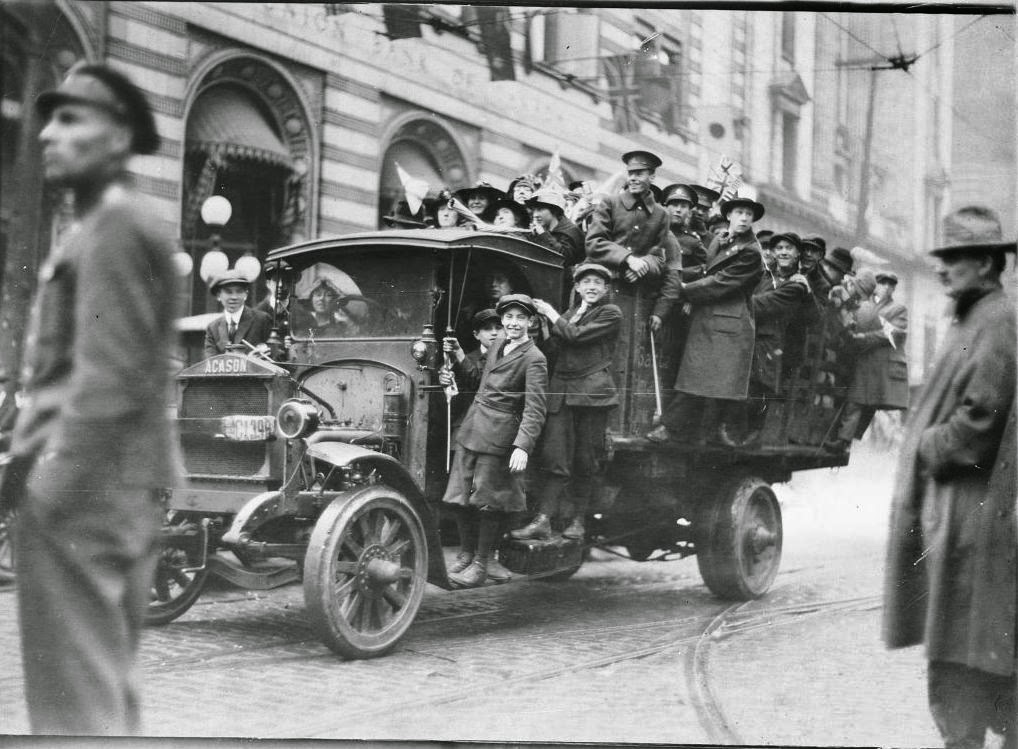
On the morning of November 11th, 1918, rumours of the war’s end were soon spreading through the city.  One can only imagine the infectious good news spreading out through the streets, catching people unaware, as they headed off for what they might of thought would be just another day, heading off to fight the war in factories or fundraising.
This photograph, taken just a few moments after the previous one, shows the jubilance starting to break out, as a number of children – and a few sailors - have climbed up on top of the streetcar.  The news of the war’s end began to spread through the streets.


The above two photographs show jubilant crowds storming a Queen Street streetcar, as news of the Armistice swept through Toronto.  In the second photograph, taken just moments after the first, a number of children and even a few sailors have climbed on top of the streetcar.

It wouldn’t be too long before ecstatic crowds were pouring out on to the streets of Toronto.  There are a number of photographs in the Toronto Archives that show great groups of Toronto residents pouring into the streets to celebrate the war's end. 


A throng of people gather together at Queen and Yonge streets, revelling in the news of the war's end.

Here is a similar scene, also at Queen and Yonge streets.

Just as they had at the outbreak of the war, in August of 1914, the people of Toronto massed outside City Hall, at Queen and Terauley (now Bay) streets, when the news of peace swept through the city.  

It wasn't long before impromptu parades, gatherings, and celebrations were taking place all over Toronto.   Seen here is a spontaneous celebration on King Street West.

Peace celebrations at King and Bay streets.

Revellers on Queen Street.


Celebrations at Bay and King streets.


This photograph of Armistice Day celebrations is notable for the Victory Loan banner in the background, as well as the flags of Allied countries which were strung up along the street.


This photograph was taken from the third floor of City Hall and overlooks Queen and James streets.  You'll note the "Buy Victory Bonds 1918" poster in the background.


As Toronto celebrated the end of World War One, the residents of the city looked forward to welcoming home those soldiers that would be returning from overseas.  But in Toronto alone, there were thousands of soldiers that were being mourned.  The city would turn its thoughts to appropriate ways to honour the memory of those who fought and died.


Banners like this one hung all over Toronto and across Canada to welcome back returning soldiers to the home front.  It contains Canadian imagery, including the "Red Ensign", the Canadian Coat of Arms, and the beaver.


Many of the modern ways in which we commemorate Canada’s veterans originated in the aftermath of the Great War.  Today’s Remembrance Day, of course, takes place each year on November 11th, with silence observed at 11 o’clock on that morning.  This observation can be traced back to when the Armistice that ended the Great War came into effect – the eleventh hour of the eleventh day of the eleventh month. 

In Canada, Remembrance Day is a public holiday and federal statutory holiday, as well as a statutory holiday in all three territories and in six of the ten provinces – with Nova Scotia, Manitoba, Ontario and Quebec being the exceptions.  Until 1930, the Armistice Day Act provided that Thanksgiving would be observed on Armistice Day, which was fixed by statute on the Monday of the week in which the 11th of November fell. In 1931, the federal parliament adopted an act to amend Armistice Day celebrations, providing that the day should be observed on November 11th, and should be called "Remembrance Day".  This is when Thanksgiving became a separate holiday in Canada, distinguished from what became Remembrance Day.
The poppy has become a recognizable symbol of military remembrance in Canada.  The use of the poppy was inspired by the poem “In Flanders Fields”, written by Lieutenant Colonel John McCrae, a physician who had graduated from medical school at the University of Toronto.  McCrae wrote the poem on May 3, 1915, after witnessing the death of his friend, a fellow soldier, the day before.  The poem was first published on December 8, 1915.  McCrae died at the end of January of 1918, of pneumonia, while serving overseas.
The poppy was actually first used by the American Legion to commemorate American soldiers who died in the Great War.  The poppy was later adopted by military veterans’ groups in the United Kingdom, Canada, Australia, and New Zealand.  Today, the poppy is mainly used in the United Kingdom and Canada to commemorate those who have been killed in all conflicts since 1914.  In addition to the small poppies worn on clothing, poppy wreaths are also often laid at war memorials.


John McCrae in 1912.

A printed postcard bearing McCrae's poem, "In Flanders Fields".   For Canadians, McCrae's poem would become the most well known piece of literature to come out of the First World War.


An inscription of the complete poem in a bronze "book" at the John McCrae memorial at his birthplace in Guelph.


All across Toronto, there are several monuments, both large and small, dedicated to the memory of those who fought and died in the Great War.  Various schools, businesses, banks and private organizations put up monuments all across the city to commemorate military service during the conflict.   What I have included here is only a small inventory of those monuments that can be found throughout Toronto. 

Toronto’s central Cenotaph would be located on the front steps of the 1899 City Hall.  Modelled on the cenotaph at Whitehall, in London, Toronto’s cenotaph was made using granite cut from the Canadian Shield.  It was unveiled on November 11, 1925.  Originally built to commemorate Torontonians who died in the Great War, this cenotaph went on to also honour those who died in the Second World War and the Korean War.


Before the cenotaph at City Hall was unveiled in 1925, the site was home to more makeshift commemorations every November 11th, as seen in this photograph from 1922.

City Hall Cenotaph, Remembrance Day, 2012

Of note is the particularly solemn appearance of the two heraldic supporters on the city's coat of arms.  They have their heads turned down in sombre reflection.


What of areas like the Exhibition grounds and the University of Toronto, which were used to train so many of the soldiers who went to Europe to fight?  Today, there is little in the way of the commemoration at the grounds of the Canadian National Exhibition.  The Stanley Barracks, which were used as a prison camp for enemy aliens still stands, but there are no statues, cenotaphs or other commemorations to those who trained on the grounds.  Even the historical plaque near the Stanley Barracks makes no reference to the building’s use during the Great War.

The plaque commemorating the history of the Stanley Barracks.

Recruits march past the Stanley Barracks, seen in the background, during the First World War.


By contrast, there are several commemorations marking the involvement of Torontonians during the Great War to be found around the University of Toronto.  In a way, Hart House itself could be considered a monument to the First World War.  Construction had begun in 1911, and the unfinished building was used to house recruits before they were shipped off to fight.  The building was finally completed, and the opening ceremonies took place on November 11th - Armistice Day - of 1919.  With the war such a recent memory at the time of the building’s completion, there are several reminders of the conflict within its walls.

The chapel in Hart House is one of the best examples of an emerging mode of design that was popular in 1919.  Three of the stained glass windows in the chapel are made up of fragments of glass that were retrieved by Canadian soldiers.  Taken from destroyed churches in France and Belgium, they were brought home to Toronto and pieced together into the windows in the Hart House chapel.

The chapel at Hart House.

The three stained glass windows in the chapel at Hart House, which contain fragments of glass salvaged from churches in France and Belgium that were destroyed during the First World War.


Detail of salvages stained glass, Hart House chapel.


The Great Hall at Hart House is often used for receptions and social gatherings, and also holds a commemoration of the First World War.  The west wall of the Great Hall contains the heraldic shields of those universities that were within the British Empire at the time of the First World War.  On the east wall are the arms of those universities that were in allied nations during the conflict.  Countries like France, Russia, Italy, Japan and America are all represented.

The centrepiece of this heraldic collection is the coat of arms of His Late Majesty, King George V, who was king during the First World War.  


The Great Hall at Hart House.

A small example of the heraldry displayed in the Great Hall at Hart House.  These are representatives of Canadian universities, and are located amongst other coats of arms from universities that were in the nations of the British Empire during the First World War.  The coat of arms of the University of Toronto is seen at top left.


The coat of arms of King George V, Canada's sovereign during the First World War.


The Soldiers’ Tower stands immediately adjacent to Hart House and is amongst Toronto’s best known monuments that honours those who died in the First World War.  After the war, University alumni raised almost $400,000 to construct the tower.  The cornerstone was laid in 1919, by Canada’s Governor General, Victor Cavendish, the Duke of Devonshire.  The building was completed five years later in 1924, at a cost of $252,500.  The remaining funds that had been collected were given over to scholarships.

The Soldiers' Tower, University of Toronto.


The names of 628 students of the university who were killed in the First World War are etched on a sheltered stone screen that stands adjacent to the tower’s base.  Among them is the name of John McCrae, who was a graduate of the University of Toronto.  Also etched into the stone is his poem, In Flanders Fields.

The names of 628 students of the University of Toronto who were killed during the First World War are carved on the memorial wall behind the arches.

John McCrae's "In Flanders Fields" is also carved on the wall.  A portion of it is shown here.  Of course, as McCrae was a casualty of the First World War, his name can also be found amongst the war dead.


The names of 557 students and alumni who were killed in the Second World War would eventually be inscribed in the stone archway at the base of the tower.  Those remembered at the tower did not have to be Canadian citizens – the only condition was that they had been students at the University of Toronto.  There are names of those who served in various branches of the Canadian, American and British forces, as well as an Australian soldier and a Dutch pilot.


These two walls, under the arch at the base of the Soldiers' Tower, record the names of 557 students from the University of Toronto who were killed during the Second World War.


Many of the university's casualties from the Second World War were, of course, Canadian.  But both the British and American armies were thoroughly represented, too.  Seen here is the name of Sergeant Major G. W. West, of the Australian Army, and Gunner R. Steensma, of the Netherlands Air Force.


The tower features a dramatic 12-panel stained-glass window that is partly a visual interpretation of John McCrae’s “In Flanders Fields”, along with 8 smaller stained-glass windows that depict men and women of the armed forces at wartime. A museum within the tower, called the Memorial Chamber, holds a collection of medals, memorial books, portraits, photographs, flags and miscellaneous memorabilia from the First and Second World Wars.  


The clock of the tower was installed in 1927, and an initial 23 bells were also put into the tower’s carillon.  A number of additional bells were added over the years, and the tower now has 51 bells that are rung out for special occasions and recitals during the course of the year.  The Soldiers’ Tower serves as a home to the University’s Remembrance Day ceremony each year. 


Military service, the Soldiers' Tower, 1924.


In addition to the Cenotaph at Toronto’s 1899 City Hall, and the markers to be found at Soldiers’ Tower and within Hart House, there are a number of smaller monuments and plaques that commemorate the service of those who fought during the Great War.  They are scattered throughout schools, churches, community centres and civic areas all around Toronto.  Most are smaller installations that are unfortunately overlooked throughout most of the year.

As we mark the centenary of the start of the First World War, Canada has lost much of its living memory of those who fought in that conflict.  But, it was a conflict that went on to shape the last century profoundly.  Revolution in Russia would launch Communism, the Cold War, and usher in a whole new round of conflict throughout most of the 20th century.  The overthrow of the German monarchy, and the bitter treaty terms of the peace treaty that ended the First World War, helped to set the stage for the rise of fascism in Europe that ultimately led to the loss of so many lives in the Second World War.  The breakup of Austria-Hungary and its empire led to generations of strife in the Balkans and could said to have carried on down through the conflicts in that region throughout the 1990s.

Canada played a part in all of these conflicts, but even on occasions where Canadian troops went off to serve, their service may, in retrospect, seem like something that took place on distant, foreign shores.  Hopefully, though, these nine articles have emphasized the important relationship between fighting overseas and what took place at the home front.

_____________________________________

The Soldiers' Tower is organizing an event to commemorate the centenary of John McCrae's writing of In Flanders Field.  The following information is taken from their website, which you can also visit here.

REMEMBERING JOHN McCRAE

On May 3, 1915 during the Second Battle of Ypres in the Great War, Lieutenant John McCrae wrote, In Flanders Fields.  You are invited to join us 100 years later to commemorate the legacy of this remarkable alumnus and Canada's most famous poet.

SUNDAY MAY 3, 2015
Soldiers' Tower, 7 Hart House Circle
12 noon - 2:45 p.m., Soldiers' Tower Memorial Room will be open to visitors.
2 p.m. - 2:45 p.m. Carillon recital featuring Gordon Slater, Dominion Carillonneur (retired).  The carillon recital is an outdoor event which will proceed rain or shine.
3 p.m. - 4:30 p.m.  Slide show presentation about John McCrae by Linda Granfield, U of T alumna, noted author and expert on John McCrae; followed by reception in the Music Room of Hart House.

This public event is free, but seating is limited.  RSVP to Kathy Parks at 416-978-3485, soldiers.tower@utoronto.ca

RSVPs ARE REQUIRED.

Sponsored by the Soldiers' Tower Committee of the University of Toronto Alumni Association, and the Department of Alumni Relations, University Advancement.

_____________________________________


Saturday, March 15, 2014

# 44 ~ Old Banks of Toronto, Then and Now, Part One


There are certain types of institutions that have traditionally been built to impress. Churches, schools and university buildings, government buildings, train stations and hotels are often built with a sense of grandeur. They convey a sense of modernity, or tradition, or stability, power and strength. Banks could certainly be added to this list. Traditionally, they were built to express affluence, and influence, and to reassure us that our money was stored up in a safe place. Later, from the mid-twentieth century, the race was on in Toronto as well as in many other cities to build higher and higher. The skyscraper boom of the second half of the twentieth century saw banking towers soaring ever taller. These building became more and more contemporary, and they literally gave rise to the era of glass and steel that overtook the more classical look of bank buildings in the nineteenth century.
 
The various styles of bank buildings throughout Toronto over the last century and a half has always been a subject of interest on my walking tours. So, with no particular anniversary or special event in mind, I thought that I would post a synopsis of some of my favourite bank buildings in our municipal history. Some of them represent the lost splendour of our city, while others still survive today.
 
Perusing the list, the reader will note that many of these banks have unfamiliar names. A lot of these banks began in local townships and spread, only to be swallowed up by larger banks throughout the twentieth century. The five major banks in Canada today – TD Canada Trust, the Bank of Montreal, the Bank of Nova Scotia, the Royal Bank, and the Canadian Imperial Bank of Commerce – have absorbed the assets of these smaller banks over the past century.
 
Also of note is the fact that these smaller banks all produced their own currency. Banknotes in various denominations were all printed by these separate banks, and they often held the portraits and signatures of the various bank presidents and vice-presidents. After the Bank of Canada was established in 1934, it began issuing currency on behalf of the Canadian government. Over the next decade, these smaller chartered banks were forced to give up the issuing of their own currency. So, the history of a Canadian currency centrally issued by the Bank of Canada only dates back about eighty years.

_________________________________________________________
 
THE BANK OF UPPER CANADA
Northeast corner of Adelaide and George streets
Opened in 1827
Still standing
 
When the first branch of the Bank of Upper Canada opened in 1827, it had the distinction of being the first purpose built, operational bank in the province. After the Bank of Montreal had opened in Lower Canada, the moneyed classes in Upper Canada wanted a bank here, too. There was debate as to whether the first branch should be built in Kingston, or in the provincial capital at York. We won out, and the bank's first purpose built branch was opened at George and Adelaide streets.
 
THEN : The Bank of Upper Canada, at the northeast corner of George and Adelaide streets, is shown here in 1872.
 
 
The Bank of Upper Canada had actually been chartered in 1821, and the first president of the bank was William Allan, one of the most prosperous merchants and prolific holder of public offices in the history of the Town of York. Allan ran his mercantile business out of a building at King and Frederick streets, and lived above it. When the bank was chartered in 1821, he simply ran the bank out of this building, too, until the actual bank building was constructed six years later. During Allan's tenure as postmaster, the post office was run out of this same building, too. Allan's home must certainly have seen a lot of traffic.
 
 
THEN : William Allan (circa 1770 to 1853) was a pioneer in York and was one of the most wealthy and influential people Toronto's early history.  He served as the first president of the Bank of Upper Canada.


The Bank of Upper Canada held a monopoly in the province for several years, but eventually, other banking institutions came along. Through the 1840s and 1850s, the Bank of Upper Canada increasingly relied on the accounts that it held on behalf of the government. After an economic collapse in 1857, and the government's withdrawal of its account in 1864, the Bank of Upper Canada faltered, and its closed its doors forever in 1866. Fortunately, the building has survived, and is now rented out as office space.
 
 
THEN : The Bank of Upper Canada building in 1977.  This photograph looks east from George Street.  The bank is in the foreground, the old De La Salle addition is in the middle, and the 1833 Post Office is at the far end.  In 1978, the year after this photograph was taken, a fire blazed through the then deserted complex.  Fortunately, the entire block of buildings was salvaged by private means, and thrives today. 
 
 
When the bank was still in operation, especially through the late 1820s and 1830s, the province's liberal leaning reformers took a harsh view on its operations. They criticized it for being a monopoly and a tool of the government. I have often wondered if the participants of the “Occupy Toronto” movement realized that they were just one block away from the capitalist tyranny that they were protesting, when they began their camp out in St. James Park in the Autumn of 2011.
 
 
NOW : A relatively recent photograph of the Bank of Upper Canada.
 
 
Like other chartered banks, the Bank of Upper Canada issued its own currency. The bank minted coins and printed banknotes. Although the bank was headquartered in Toronto, some banknotes were stamped with the locations of the branches at which they were printed. These include Belleville, Brockville, Goderich, Hamilton, Kingston, London, Montreal, Ottawa, Quebec, Sarnia, St. Catharines, Stratford and Windsor.
 
 
THEN : A one dollar banknote issued by the Bank of Upper Canada.
 

THEN : Coinage from the Bank of Upper Canada.
 
For more history (and photographs) related to the Bank of Upper Canada, please see my post from December of 2010.

_________________________________________________________
 

THE BANK OF BRITISH NORTH AMERICA
Northeast corner of Wellington and Yonge streets
Opened in 1845
Demolished in 1871
Rebuilt and reopened in 1875


The Bank of North America was chartered in London, England in 1835. Branches eventually spread to Halifax, St. John's, Montreal, Quebec City and Toronto. The branch at Wellington and Yonge streets was the first to open in Toronto. From its opening in 1845 until its demolition in 1871, it was a greatly admired architectural landmark in Toronto.  


THEN : The Bank of British North America building, on the northeast corner of Wellington and Yonge streets, in 1856.

There were two features of the building that would have reminded passersby of the Bank of England in London. The first was the Royal Arms over the main entrance, carved by a sculptor named John Cochrane. The second was a scallop shell mounted on top of the parapet over the main entrance. This element, which suggested the “gold digger's profession”, was designed by noted English architect Sir John Soane.

THEN : The Bank of British North America in 1867.

This first Bank of British North America building was demolished in 1871, and the current building on the location was opened in 1875. It was designed by noted Toronto architect Henry Langley. Although the Bank of British North America was bought up by the Bank of Montreal in 1918, the 1875 building also housed a branch of the Canadian Imperial Bank of Commerce at some point in its history. Today, the main floor of the building is occupied by the Irish Embassy Pub, an authentic and very popular Irish public house and restaurant.
 
THEN : Looking north up Yonge Street to Wellington Street and beyond in 1890.  The Bank of British North America is prominently featured on the right side of the photograph.
 
THEN : This photograph appeared in the Toronto World newspaper on December 29, 1912.  Entitled "Toronto Bank Managers", the caption read, "Millions of dollars in other people's money.  In the daily routine of the bank messengers is the conveyance of cheques, drafts, and other business instruments from the various banking offices to the Toronto Clearing House, which is located in the Bank of British North America Building at the corner of Yonge and Wellington Streets.  The daily clearings of the city run in the neighbourhood of seven million dollars."
That seems like a pretty nice neighbourhood ...

 
THEN : The Bank of British North America building in 1912.


NOW : The Bank of British North America building today.

The Bank of North America issued its own banknotes from 1852 until 1911. Although the last notes were issued in 1911, they were in circulation for several years after that date. Of course, many of these banknotes from smaller chartered banks have become collectors items for numismatists. Shown here are a number of banknotes issued by the Bank of British North America.

A series of banknotes was issued by the Bank of British North America on May 1, 1884. This bank's currency was issued either from Montreal or Victoria, with the name of either of the two locations engraved on the banknote. The ones issued from Victoria are less common, and therefore more valuable.
 
THEN : Bank of British North America $5 banknote from 1884.


The 1886 issue of five dollar banknotes from the Bank of British North America featured portraits of both Queen Victoria and her eldest son, the Prince of Wales (later King Edward VII). In this case, notes issued from Montreal had blue serial numbers and those issued from Victoria had red serial numbers.
 
THEN : Bank of British North America $5 banknote from 1886.


A ten dollar bill issued by the Bank of British North America in July of 1889. By this point the bank's notes were being issued by the British American Bank Note Company in either Ottawa or Montreal.
 
 
THEN : The Bank of British North America $10 banknote from 1889.


Banknotes in denominations of five dollars, ten dollars, twenty dollars, fifty dollars and one hundred dollars were issued by the Bank of British North America in July of 1911. The five dollar banknote featured King George V, and the ten dollar banknote featured his consort, Queen Mary.
 
THEN : The Bank of British North American $5 banknote from 1911.
 
THEN : The Bank of British North America $10 banknote from 1911.


Today, only the current Sovereign appears on Canadian currency, with Queen Elizabeth II appearing on the obverse of all our coinage and on our twenty dollar bills. However, in times past, other members of the Royal Family, both living and dead, could make appearances on banknotes. With this series of currency, King Edward VII, who died in 1910, appeared on the twenty dollar bill. His consort, and later, widow, Queen Alexandra, who lived until 1925, appeared on the fifty dollar bill. Queen Victoria appeared on the one-hundred dollar bill.


_________________________________________________________
 

THE BANK OF MONTREAL
Northwest corner of Front and Yonge streets
Opened in 1845
Demolished in 1885
Rebuilt and reopened in 1886


The Bank of Montreal was chartered as a legal entity on June 23, 1817. The first location of the bank opened in a rented house in Montreal on November 3, 1817. Thus the Bank of Montreal became the first, and today the oldest, operating bank in Canada. Bank institution numbers are given out for the purpose of arranging bank transfers and automated payments, and the institution number for the Bank of Montreal is 001, reflecting its role as Canada's first bank. Also, the headquarters of the Bank of Montreal in Toronto, at the northwest corner of King and Bay streets, is known as First Canadian Place – another reference to it being the first chartered bank in our country. It seems appropriate that this is the tallest banking building (and second tallest building, overall) in Toronto.


NOW : First Canadian Place, the headquarters of the Bank of Montreal, still towers over all the rest, at the northwest corner of King and Bay streets.


Historic buildings associated with the Bank of Montreal can be found throughout Toronto and across Canada. Perhaps the most “famous” historical bank building in Toronto is the Bank of Montreal building located on the northwest corner of Yonge and Front streets. The current incarnation of this building was erected built between 1885 and 1886 by architects Darling and Curry, and was designed in the Beaux Arts style. It was this building that served as the Bank of Montreal's head office in Toronto until 1949, it remained an active branch of the bank until 1982.
 

THEN : The Bank of Montreal building at Yonge and Front Streets in 1890, just four years after it was built.


One of the most prominent reasons that this bank building has become an icon in Toronto is that it became the new home for the Hockey Hall of Fame in 1993. With more than 300,000 visitors attracted to the Hockey Hall of Fame each year, the 1885 Bank of Montreal building hosts vast numbers who may or may not be aware of its financial heritage. When visitors enter the Hall of Fame's Great Hall, they may be unaware that in its heyday, it was one of the largest banking halls in Canada. The stained glass dome soars at a height of 45 feet, or nearly fourteen metres, and sets the record for the largest in Canada. Scattered throughout the building are classical references and allegories that are subtle attempts to make those who did business here feel that their money was stored safely. The stained glass of the dome is no exception. In the central panels one can see images of a number of dragons guarding their hordes of gold – surely, this is indicative of how well the Bank of Montreal would guard an investor's savings. The eight circles near the centre of the dome represent Canada and what where then the seven provinces within it.
 
NOW : There have been changes to the 1886 Bank of Montreal building, but fortunately, the stained glass dome in the Great Hall is one of the many features that has survived.

Throughout the rest of the building can be found a number of elements of the former bank. The old boardroom still exists, as does the bank manager's private apartment, from a time when a bank's manager was often given accommodation at the local branch. Other carvings and symbols allude to transportation, communication, music and art, agriculture, and industry.
 

THEN : This photograph from 1955 shows an allegorical god-like figure looking out from the Bank of Montreal over Front Street.  Many traditional bank buildings featured classical Greek and Roman allegories like this one.  They represented industry, or commerce, technology, transportation, communication or agriculture.  Also, they exuded an idea that the banks they covered had existed for a very long time, and therefore made safe investments. 


THEN : Looking east down Front Street in 1930.  Here we see the 1886 Bank of Montreal building set between two lost Toronto treasures.  On the left (west) was the warehouse of one A. R. McMaster, which was originally constructed in 1871.  The original warehouse was lost to the Great Fire that swept through Toronto in 1904.  It was rebuilt after the fire to proportions that were twice the size of the original - the result was the building that we see in this photograph.  It speaks to our old grandeur that even warehouses were constructed with such elegance.  In the centre of this photograph is the Bank of Montreal building that still stands today.  On the right in the photograph is the Toronto Board of Trade building, a striking, seven foot structure that once towered over the base of Yonge Street.  In addition to housing the Board of Trade, the building was also home to the Toronto Transit Commission.  It was opened in 1892 and demolished in 1958.  Today, both buildings that bracketed the Bank of Montreal in this photograph no longer exist.


THEN : The 1886 Bank of Montreal building in 1982.  This was the last year that it served as a functional bank branch.  It was then closed to the public and more or less abandoned until the Hockey Hall of Fame opened on the premises in 1993.


NOW : The Bank of Montreal building in its current incarnation as the Hockey Hall of Fame.


As iconic as the 1885 Bank of Montreal building, which now houses the Hockey Hall of Fame, may be, it is not the original Bank of Montreal building to stand on this site. An earlier bank building had opened in 1845. This 1845 Bank of Montreal building was reminiscent of a villa in London and had large living quarters for the bank manager on the second and third storeys of the building.
 

THEN : The 1845 Bank of Montreal building is shown here in 1867.  When the bank was built, the blocks north and west of Front and Yonge streets were still residential, and were home to some of the more financially established families in Toronto.

 
The 1845 bank was designed by Kivas Tully, a prominent Canadian architect of Irish birth. Tully was responsible for the construction of the “old” Trinity College building that once stood in Trinity Bellwoods park. In addition, he built the Customs House, a headquarters for customs officials and tax collectors. This Customs House was built in 1845, the same year as Tully's Bank of Montreal building, and in fact the two buildings were neighbours.

THEN : The Bank of Montreal can be seen in the foreground of this photograph from 1880.  The building in the background is the Customs House, which had been built in 1873.  This 1873 Customs House replaced an earlier one, designed by Kivas Tully, who had also designed the bank building,  Additionally, both the early bank and early Customs House were both opened in 1845.


A series of banknotes were printed for the Bank of Montreal in 1862. Many of these banknotes had a branch location stamped on them. Variations on these stamps included branches in Brantford, Goderich, Kingston, London, Montreal, Picton, Quebec and Whitby. Banknotes in this series were printed in denominations of one dollar, two dollars, five dollars and ten dollars. 
THEN : A $1 banknote from the Bank of Montreal, dated August of 1862, and stamped from the bank's branch in Goderich. 

THEN : A $5 banknote from the Bank of Montreal, printed in 1862 and marked with the stamp for the bank's branch in London.

The Bank of Montreal printed some very unique banknotes in 1903. They were twice the size of banknotes that were issued by other banks in Canada during the same period.
 
THEN : $50 and $100 banknotes from the Bank of Montreal, printed in 1903.
 
The Bank of Montreal was one of those banks that continued to circulate their own currency even after the Bank of Canada was established in 1934. Seen here are examples of Bank of Montreal banknotes from 1935, 1938 and 1942. In 1942, the Bank of Montreal only produced five dollar notes, and it was the last year that the bank produced its own currency.
 

THEN : $5 and $20 banknotes from the Bank of Montreal, 1935.


THEN : $5 and $10 banknotes from the Bank of Montreal, 1938.


THEN : $5 banknote from the Bank of Montreal, 1942.


_________________________________________________________
 

THE CANADIAN BANK OF COMMERCE
Southwest corner of King and Jordan streets
Opened in 1890
Demolished in 1928
 
The Canadian Bank of Commerce began in Toronto on May 15, 1867. Founded by the Honourable William McMaster, it was chartered at least in part to offer competition for the Bank of Montreal.
An early branch of the Bank of Commerce had been located on the southeast corner of Yonge and Colborne streets. The building in which it was located had been used by a number of tenants. It had originally been built for a retail firm called Ross, Mitchell and Company. Later, the building was used by the Bank of Upper Canada, at the time of that bank's collapse in 1866. The next year, 1867, saw the building being used as the first headquarters for the newly created Bank of Commerce. To prepare for their move in, the Bank of Commerce had the building altered.
 

THEN : In this photograph from 1867, the early Canadian Bank of Commerce can be seen in the centre of the photograph.  It is the tallest building in the picture.  It stood at the southeast corner of Yonge and Colborne streets.  The building had previously been used for other purposes.  It was the last branch of the Bank of Upper Canada in 1866, and the next year, when this photograph was taken, it had just recently opened up as the Canadian Bank of Commerce.


NOW : The southeast corner of King and Jordan streets as it appears in 2014.  One can't feel that what we have now is rather less impressive and more anonymous than what we once had.


By the 1880s, the bank building at Yonge and Colborne streets had become overcrowded, and the Bank of Commerce sought out new headquarters.  They eventually bought up a lot at 25 King Street West, on the southwest corner of King and Jordan streets.  Construction of the bank's new headquarters began in 1889, and the building was opened for business in January of 1890.  The architect of the new building was none other than Richard Waite, from Buffalo, who was best known for his work on the Legislative Assembly at Queen's Park. 

THEN : This was the headquarters of the Canadian Bank of Commerce, that stood on the southwest corner of King and Jordan streets, from 1890 until 1928.  So, the street that runs up the right side of the photograph is King Street, and the street that runs up the left side of the photograph is Jordan street. 

 
When we picture the nearby intersection of King and Bay streets today, it's hard to imagine how these new headquarters for the Bank of Commerce dominated the neighbourhood at a total height of seven and a half storeys. The bank soared over the three and four storey buildings that surrounded it. A brand new method of building great towers was coming into use, with a great skeleton of steel and iron supporting the weight of the bricks of the building. The main tower of the building, at King and Jordan streets, held the various managerial offices related to the working of the bank. Two other towers, which were half a storey shorter, marked the main entrance and side entrance to the bank, and held the stairs and elevators to the bank's upper levels. Arched windows added to the very “vertical” look of the building. 
 
The interior of the building was certainly elaborate, executed as it was in various types of marble, polished metal, and woodwork. The banking hall gave out a sense of corporate majesty, and the rented office space on the upper floors of the building became one of the most fashionable business addresses in the city. The Bank of Montreal, which had been constructed on the northwest corner of Yonge and Front streets just a few years before, had captured the imagination of Torontonians as an architectural wonder. Waite's Bank of Commerce building was even more elaborate. It survived until 1928, when it was demolished to build an even grander – and more soaring – headquarters for the Bank of Commerce.
 
_____________________________________________
Another branch of the Canadian Bank of Commerce stood at the northwest corner of King and Jarvis streets.  In 1908, it was giving away this map of Toronto to bank customers.

THEN : A map of Toronto given out to customers at the Canadian Bank of Commerce in 1908.

 
This old branch still stands and is now used as a law office.  For "then and now" photographs, visit Urban Toronto at :
 
_____________________________________________
 
THE CANADIAN BANK OF COMMERCE
Southwest corner of King and Bay streets
Opened in 1931
Still standing
 
Through the years that the Bank of Commerce had its headquarters at King and Jordan streets, business had blossomed. By 1895, the Canadian Bank of Commerce had nearly sixty branches. Gold was discovered in the Yukon the following year, and the Canadian Bank of Commerce opened a branch in Dawson City. The next three decades saw a boom for the bank, which opened hundreds of branches around Canada and international branches throughout the Caribbean.
Business was so good that in 1931, the Canadian Bank of Commerce opened a brand new headquarters in Toronto. This new banking tower dominated the city's skyline, surpassing even the newly built Royal York Hotel in height. The bank opened up an outdoor observation deck on the thirty-second floor of the building, and for the first time, visitors could get an aerial view of Toronto as it was laid out around them.
THEN : This photograph from 1940 shows the Canadian Bank of Commerce tower that had opened in 1931.  The outdoor observation deck was near the very top of the buildings, and in a day before the CN Tower, it gave visitors the best panoramic view of they city that they could fine.  Look closely, and you'll notice four bearded faces on each side of the building to be visible in the photograph.  Four of these faces appeared on each side of the building - so, there are sixteen in total - and they are alternately scowling and smiling.  Sadly, the outdoor observation deck is no longer open to the public.
  
THEN : This photograph was taken circa 1931 and shows how the new Canadian Bank of Commerce building really dominated the city's skyline.

THEN : This photograph was taken in 1931 and looks northeast from the top of the Canadian Bank of Commerce tower.  The two churches on the right side of the picture are Metropolitan United Church and St. Michael's Roman Catholic Cathedral.  The turreted building on the lower left of the photograph is the Confederation Life Building.  The building behind it (with the advertisement for Heintzman and Company Pianos to the left) is Loew's Yonge Street theatre, better known today as the Elgin and Winter Garden theatre centre.
 
THEN : Looking south towards the harbour from the Canadian Bank of Commerce building, about the time that the building was constructed.
 

NOW : The Canadian Bank of Commerce tower today.
The Imperial Bank of Canada had started up in Toronto in 1875, and was actually established by Henry Stark Howland, a former vice-president of the Bank of Commerce. As of June 1, 1861, the Canadian Bank of Commerce and the Imperial Bank of Canada were joined together to form the Canadian Imperial Bank of Canada. This merger served as an impetus to expand the old headquarters for the Bank of Commerce. This expansion became the Commerce Court complex, which stretches south of King Street West between Bay Street and Jordan Street.
The Canadian Bank of Commerce issued what was, in my modest opinion, some of the most elaborate and attractive currency ever issued by a chartered bank. To me, the banknotes issued by the Bank of Canada over the last several decades have become less ornate and increasingly bland, and I feel myself longing for the day when currency looked more like some of the examples I have posted here.


THEN : This Canadian Bank of Commerce banknote series was printed between 1867 and 1871.  Banks were not obliged to stick with the standard denominations that we know today, although most of them did.  In this case we see that they issued a $4 banknote.


THEN : Canadian Bank of Commerce $10 banknote from 1907.


THEN : Canadian Bank of Commerce $100 banknote from 1917.


THEN : Banknotes issued by the Canadian Bank of Commerce in 1917, including $5, $10, $20, $50 and $100 denominations.


THEN : $5, $10 and $20 banknotes issued by the Canadian Bank of Commerce in 1935.


THEN : The Canadian Bank of Commerce also issued banknotes for circulation from their branches in the Caribbean.  These two banknotes were circulated from their branch in Bridgetown, Barbados.  The $5 banknote was issued in 1940 and the $100 banknote was issued in 1922.


THEN : These banknotes were issued by the Canadian Bank of Commerce from their branch in Kingston, Jamaica.  The topmost £1 banknote was issued in 1921.  The £1 and £5 banknotes were issued in 1938.


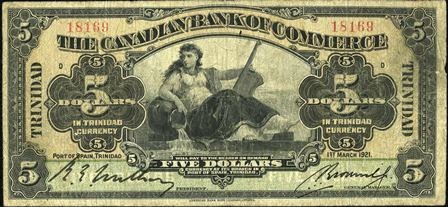
THEN : $5, $20, and $100 banknotes issued from the Canadian Bank of Commerce from their branch in Port of Spain, Trinidad in 1921.


THEN : $5 and $20 banknotes issued by the Canadian Bank of Commerce from their branch in Port of Spain, Trinidad in 1939.

______________________________________________________________
My review of some of Toronto's “lost banks” will continue in my next post.
Most of the written historical material in this article has been drawn from two valuable sources. One is “Lost Toronto”, by William Dendy, which is now sadly out of print. The other is “No Mean City”, by Eric Arthur. Both books are well known staples in the library of any enthusiast of Toronto's history. As always, most of the vintage photographs here are from either the City of Toronto archives or the archives of the Toronto Public Library. The information and photographs of old banknotes has come from a singular source – a website which can be found at http://canadacurrency.com. I have more or less shamelessly lifted the material from their website, but they are an agency that buys and sells old Canadian currency, and their website makes for a lot of fascinating browsing.

____________________________________________

You can learn more about Toronto's financial district by joining Muddy York Walking Tours on the 20th Century History Tour.

Muddy York Walking Tours 20th Century History Tour
Also, we are already planning some special events for Spring and Summer 2014.  Some will be paid events while others are free community events sponsored by the City of Toronto.  If you want insider information on some of upcoming events, please join our facebook page.

Muddy York Walking Tour Group on facebook

See you this summer!!