Showing posts with label Bay. Show all posts

Wednesday, April 29, 2015

# 56 ~ Toronto & The First World War, Part IX - Commemoration


The Menin Gate Memorial to the Missing is a war memorial in Ypres, Belgium, dedicated to the soldiers of the British Empire, now the Commonwealth, who were killed during the fighting in Ypres, and whose graves are unknown. Unveiled on July 24, 1927, the memorial lists the names of 54,896 soldiers who were killed in the battle but whose remains were never found, or never identified.


The interior of Menin Gate.


_____________________________________


This is the ninth and final instalment in a series of posts leading up to the centenary of John McCrae's writing of In Flanders Fields, on May 3, 1915.  I've planned for articles to be posted over the next several weeks, and to culminate with actives commemorating the centennial of McCrae's poem.

Images of John McCrae or the poppy, or recitals of the poem, In Flanders Field, are usually just relegated to Remembrance Day.  We have come to associate certain images so much with November 11th, that they seem out of place during the rest of the year.  As I publish these posts, I hope that you will find enough about Toronto's history, to make the articles of interest.

John McCrae wrote his poem during the Second Battle of Ypres, which took place between April 22nd and May 25th of 1915.  The battle saw the first massed use of poison gas by German forces on the Western Front.  It was a important engagement for Canadian troops ~ for the first time, a group of "colonial" soldiers defeated a European power, on European soil.  Military experts often refer to how engagements like the Battle of St. Julien or Kitcheners' Wood helped to usher Canada into national adulthood.  

However, instead of focusing on an analysis of military activity in Europe, my series of posts will mostly follow how the war was "fought" on the Toronto home front.

_____________________________________


The ninth and final part of my presentation is entitled “Commemoration”.  It chronicles the way in which Toronto reacted to the news that the war was finally over, and shows just a few of the monuments that were built around the city to commemorate the conflict.
After four long years of fighting, the war began to draw to a close, at the end of the Summer of 1918.  The Central Powers finally started to collapse.  Bulgaria signed an armistice on September 29, 1918.  On October 30, the Ottoman Empire capitulated.  The Austro-Hungarian Empire disintegrated after their armed forces were wiped out at the Battle of Vittorio Veneto, at the end of October, 1918.  Declarations of independence were proclaimed throughout the old empire, in Budapest, Prague and Zagreb, and on November 3, 1918, Austria-Hungary sent out a flag of truce to ask for an armistice.  On November 11th, 1918, at 5 o’clock in the morning, an armistice with Germany was signed in a railroad carriage at Compiègne.  The ceasefire that ended the war would come into effect at 11 a.m. – the eleventh hour of the eleventh day of the eleventh month. 


Military delegates stand outside the "Armistice Train", at Compiègne, where signatories signed the cease fire.


Newspapers the world over soon spread the news that the war was over.


On the morning of November 11th, 1918 – Armistice Day – Torontonians awoke to the news that the war was over.  Several thousand of husbands, sons, and fathers from the Toronto area had died in the war, but those who had survived would eventually be returning home.  A photograph exists, of a Toronto family gathered in their bedroom, reading a headline of the war's end in the Toronto World newspaper.  No record survives of which family this was.  Did they have a loved one off at the front?  If so, were they killed in action?  Or, could they look forward to a homecoming in the weeks or months to come?


An unidentified Toronto family gathers together on the morning of November 11th, 1918, to read news that the war was over.


On the morning of November 11th, 1918, rumours of the war’s end were soon spreading through the city.  One can only imagine the infectious good news spreading out through the streets, catching people unaware, as they headed off for what they might of thought would be just another day, heading off to fight the war in factories or fundraising.
This photograph, taken just a few moments after the previous one, shows the jubilance starting to break out, as a number of children – and a few sailors - have climbed up on top of the streetcar.  The news of the war’s end began to spread through the streets.


The above two photographs show jubilant crowds storming a Queen Street streetcar, as news of the Armistice swept through Toronto.  In the second photograph, taken just moments after the first, a number of children and even a few sailors have climbed on top of the streetcar.

It wouldn’t be too long before ecstatic crowds were pouring out on to the streets of Toronto.  There are a number of photographs in the Toronto Archives that show great groups of Toronto residents pouring into the streets to celebrate the war's end. 


A throng of people gather together at Queen and Yonge streets, revelling in the news of the war's end.

Here is a similar scene, also at Queen and Yonge streets.

Just as they had at the outbreak of the war, in August of 1914, the people of Toronto massed outside City Hall, at Queen and Terauley (now Bay) streets, when the news of peace swept through the city.  

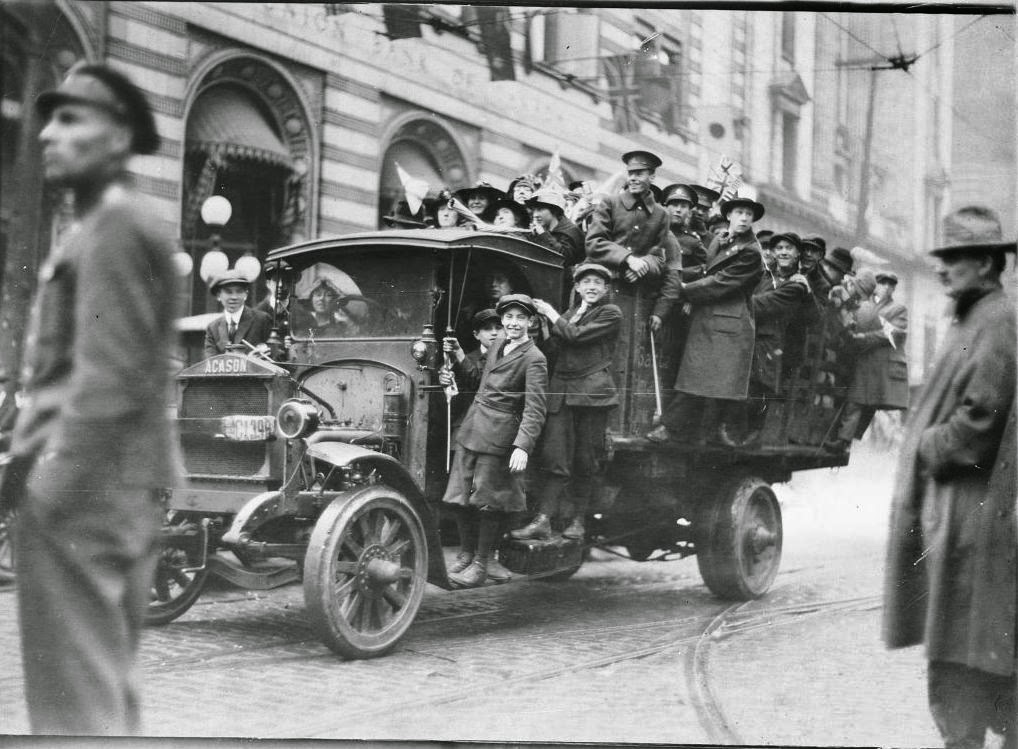
It wasn't long before impromptu parades, gatherings, and celebrations were taking place all over Toronto.   Seen here is a spontaneous celebration on King Street West.

Peace celebrations at King and Bay streets.

Revellers on Queen Street.


Celebrations at Bay and King streets.


This photograph of Armistice Day celebrations is notable for the Victory Loan banner in the background, as well as the flags of Allied countries which were strung up along the street.


This photograph was taken from the third floor of City Hall and overlooks Queen and James streets.  You'll note the "Buy Victory Bonds 1918" poster in the background.


As Toronto celebrated the end of World War One, the residents of the city looked forward to welcoming home those soldiers that would be returning from overseas.  But in Toronto alone, there were thousands of soldiers that were being mourned.  The city would turn its thoughts to appropriate ways to honour the memory of those who fought and died.


Banners like this one hung all over Toronto and across Canada to welcome back returning soldiers to the home front.  It contains Canadian imagery, including the "Red Ensign", the Canadian Coat of Arms, and the beaver.


Many of the modern ways in which we commemorate Canada’s veterans originated in the aftermath of the Great War.  Today’s Remembrance Day, of course, takes place each year on November 11th, with silence observed at 11 o’clock on that morning.  This observation can be traced back to when the Armistice that ended the Great War came into effect – the eleventh hour of the eleventh day of the eleventh month. 

In Canada, Remembrance Day is a public holiday and federal statutory holiday, as well as a statutory holiday in all three territories and in six of the ten provinces – with Nova Scotia, Manitoba, Ontario and Quebec being the exceptions.  Until 1930, the Armistice Day Act provided that Thanksgiving would be observed on Armistice Day, which was fixed by statute on the Monday of the week in which the 11th of November fell. In 1931, the federal parliament adopted an act to amend Armistice Day celebrations, providing that the day should be observed on November 11th, and should be called "Remembrance Day".  This is when Thanksgiving became a separate holiday in Canada, distinguished from what became Remembrance Day.
The poppy has become a recognizable symbol of military remembrance in Canada.  The use of the poppy was inspired by the poem “In Flanders Fields”, written by Lieutenant Colonel John McCrae, a physician who had graduated from medical school at the University of Toronto.  McCrae wrote the poem on May 3, 1915, after witnessing the death of his friend, a fellow soldier, the day before.  The poem was first published on December 8, 1915.  McCrae died at the end of January of 1918, of pneumonia, while serving overseas.
The poppy was actually first used by the American Legion to commemorate American soldiers who died in the Great War.  The poppy was later adopted by military veterans’ groups in the United Kingdom, Canada, Australia, and New Zealand.  Today, the poppy is mainly used in the United Kingdom and Canada to commemorate those who have been killed in all conflicts since 1914.  In addition to the small poppies worn on clothing, poppy wreaths are also often laid at war memorials.


John McCrae in 1912.

A printed postcard bearing McCrae's poem, "In Flanders Fields".   For Canadians, McCrae's poem would become the most well known piece of literature to come out of the First World War.


An inscription of the complete poem in a bronze "book" at the John McCrae memorial at his birthplace in Guelph.


All across Toronto, there are several monuments, both large and small, dedicated to the memory of those who fought and died in the Great War.  Various schools, businesses, banks and private organizations put up monuments all across the city to commemorate military service during the conflict.   What I have included here is only a small inventory of those monuments that can be found throughout Toronto. 

Toronto’s central Cenotaph would be located on the front steps of the 1899 City Hall.  Modelled on the cenotaph at Whitehall, in London, Toronto’s cenotaph was made using granite cut from the Canadian Shield.  It was unveiled on November 11, 1925.  Originally built to commemorate Torontonians who died in the Great War, this cenotaph went on to also honour those who died in the Second World War and the Korean War.


Before the cenotaph at City Hall was unveiled in 1925, the site was home to more makeshift commemorations every November 11th, as seen in this photograph from 1922.

City Hall Cenotaph, Remembrance Day, 2012

Of note is the particularly solemn appearance of the two heraldic supporters on the city's coat of arms.  They have their heads turned down in sombre reflection.


What of areas like the Exhibition grounds and the University of Toronto, which were used to train so many of the soldiers who went to Europe to fight?  Today, there is little in the way of the commemoration at the grounds of the Canadian National Exhibition.  The Stanley Barracks, which were used as a prison camp for enemy aliens still stands, but there are no statues, cenotaphs or other commemorations to those who trained on the grounds.  Even the historical plaque near the Stanley Barracks makes no reference to the building’s use during the Great War.

The plaque commemorating the history of the Stanley Barracks.

Recruits march past the Stanley Barracks, seen in the background, during the First World War.


By contrast, there are several commemorations marking the involvement of Torontonians during the Great War to be found around the University of Toronto.  In a way, Hart House itself could be considered a monument to the First World War.  Construction had begun in 1911, and the unfinished building was used to house recruits before they were shipped off to fight.  The building was finally completed, and the opening ceremonies took place on November 11th - Armistice Day - of 1919.  With the war such a recent memory at the time of the building’s completion, there are several reminders of the conflict within its walls.

The chapel in Hart House is one of the best examples of an emerging mode of design that was popular in 1919.  Three of the stained glass windows in the chapel are made up of fragments of glass that were retrieved by Canadian soldiers.  Taken from destroyed churches in France and Belgium, they were brought home to Toronto and pieced together into the windows in the Hart House chapel.

The chapel at Hart House.

The three stained glass windows in the chapel at Hart House, which contain fragments of glass salvaged from churches in France and Belgium that were destroyed during the First World War.


Detail of salvages stained glass, Hart House chapel.


The Great Hall at Hart House is often used for receptions and social gatherings, and also holds a commemoration of the First World War.  The west wall of the Great Hall contains the heraldic shields of those universities that were within the British Empire at the time of the First World War.  On the east wall are the arms of those universities that were in allied nations during the conflict.  Countries like France, Russia, Italy, Japan and America are all represented.

The centrepiece of this heraldic collection is the coat of arms of His Late Majesty, King George V, who was king during the First World War.  


The Great Hall at Hart House.

A small example of the heraldry displayed in the Great Hall at Hart House.  These are representatives of Canadian universities, and are located amongst other coats of arms from universities that were in the nations of the British Empire during the First World War.  The coat of arms of the University of Toronto is seen at top left.


The coat of arms of King George V, Canada's sovereign during the First World War.


The Soldiers’ Tower stands immediately adjacent to Hart House and is amongst Toronto’s best known monuments that honours those who died in the First World War.  After the war, University alumni raised almost $400,000 to construct the tower.  The cornerstone was laid in 1919, by Canada’s Governor General, Victor Cavendish, the Duke of Devonshire.  The building was completed five years later in 1924, at a cost of $252,500.  The remaining funds that had been collected were given over to scholarships.

The Soldiers' Tower, University of Toronto.


The names of 628 students of the university who were killed in the First World War are etched on a sheltered stone screen that stands adjacent to the tower’s base.  Among them is the name of John McCrae, who was a graduate of the University of Toronto.  Also etched into the stone is his poem, In Flanders Fields.

The names of 628 students of the University of Toronto who were killed during the First World War are carved on the memorial wall behind the arches.

John McCrae's "In Flanders Fields" is also carved on the wall.  A portion of it is shown here.  Of course, as McCrae was a casualty of the First World War, his name can also be found amongst the war dead.


The names of 557 students and alumni who were killed in the Second World War would eventually be inscribed in the stone archway at the base of the tower.  Those remembered at the tower did not have to be Canadian citizens – the only condition was that they had been students at the University of Toronto.  There are names of those who served in various branches of the Canadian, American and British forces, as well as an Australian soldier and a Dutch pilot.


These two walls, under the arch at the base of the Soldiers' Tower, record the names of 557 students from the University of Toronto who were killed during the Second World War.


Many of the university's casualties from the Second World War were, of course, Canadian.  But both the British and American armies were thoroughly represented, too.  Seen here is the name of Sergeant Major G. W. West, of the Australian Army, and Gunner R. Steensma, of the Netherlands Air Force.


The tower features a dramatic 12-panel stained-glass window that is partly a visual interpretation of John McCrae’s “In Flanders Fields”, along with 8 smaller stained-glass windows that depict men and women of the armed forces at wartime. A museum within the tower, called the Memorial Chamber, holds a collection of medals, memorial books, portraits, photographs, flags and miscellaneous memorabilia from the First and Second World Wars.  


The clock of the tower was installed in 1927, and an initial 23 bells were also put into the tower’s carillon.  A number of additional bells were added over the years, and the tower now has 51 bells that are rung out for special occasions and recitals during the course of the year.  The Soldiers’ Tower serves as a home to the University’s Remembrance Day ceremony each year. 


Military service, the Soldiers' Tower, 1924.


In addition to the Cenotaph at Toronto’s 1899 City Hall, and the markers to be found at Soldiers’ Tower and within Hart House, there are a number of smaller monuments and plaques that commemorate the service of those who fought during the Great War.  They are scattered throughout schools, churches, community centres and civic areas all around Toronto.  Most are smaller installations that are unfortunately overlooked throughout most of the year.

As we mark the centenary of the start of the First World War, Canada has lost much of its living memory of those who fought in that conflict.  But, it was a conflict that went on to shape the last century profoundly.  Revolution in Russia would launch Communism, the Cold War, and usher in a whole new round of conflict throughout most of the 20th century.  The overthrow of the German monarchy, and the bitter treaty terms of the peace treaty that ended the First World War, helped to set the stage for the rise of fascism in Europe that ultimately led to the loss of so many lives in the Second World War.  The breakup of Austria-Hungary and its empire led to generations of strife in the Balkans and could said to have carried on down through the conflicts in that region throughout the 1990s.

Canada played a part in all of these conflicts, but even on occasions where Canadian troops went off to serve, their service may, in retrospect, seem like something that took place on distant, foreign shores.  Hopefully, though, these nine articles have emphasized the important relationship between fighting overseas and what took place at the home front.

_____________________________________

The Soldiers' Tower is organizing an event to commemorate the centenary of John McCrae's writing of In Flanders Field.  The following information is taken from their website, which you can also visit here.

REMEMBERING JOHN McCRAE

On May 3, 1915 during the Second Battle of Ypres in the Great War, Lieutenant John McCrae wrote, In Flanders Fields.  You are invited to join us 100 years later to commemorate the legacy of this remarkable alumnus and Canada's most famous poet.

SUNDAY MAY 3, 2015
Soldiers' Tower, 7 Hart House Circle
12 noon - 2:45 p.m., Soldiers' Tower Memorial Room will be open to visitors.
2 p.m. - 2:45 p.m. Carillon recital featuring Gordon Slater, Dominion Carillonneur (retired).  The carillon recital is an outdoor event which will proceed rain or shine.
3 p.m. - 4:30 p.m.  Slide show presentation about John McCrae by Linda Granfield, U of T alumna, noted author and expert on John McCrae; followed by reception in the Music Room of Hart House.

This public event is free, but seating is limited.  RSVP to Kathy Parks at 416-978-3485, soldiers.tower@utoronto.ca

RSVPs ARE REQUIRED.

Sponsored by the Soldiers' Tower Committee of the University of Toronto Alumni Association, and the Department of Alumni Relations, University Advancement.

_____________________________________


Thursday, March 27, 2014

# 45 ~ Old Banks of Toronto, Then and Now, Part Two

 
In my last article, I introduced the history of just a few of Toronto's historic bank buildings. Many are gone, while several that still stand have been turned over to other purposes, and are no longer temples (or at least, smaller chapels) dedicated to the exchange and storage of funds. However, we are fortunate than an elegantly built bank will often always still look like a bank, even decades after it has stopped serving as one.
 
 
In this second article on the history of banks in the city, I will carry on with the same format that I have used for the first article. Of course, whole volumes could be assembled on old banks in the city. What I've offered up here, even in two articles, is not even the “tip of the iceberg”, and I envision there being more entries to come, either more immediately or at some point in the future.
 
 
THE BANK OF TORONTO
 
The Bank of Toronto was established in 1857.  Both William Gooderham and his son, George, were active in the early years of the Bank of Toronto. William Gooderham was the family patriarch who led an entourage of 54 family members to the Town of York in the summer of 1832. William Gooderham had been encouraged to emigrate by James Worts, who was married to William's sister. Together, the various members of the Worts and Gooderham clans operated a windmill on the east side of town at the Don River. Within a few years this windmill evolved into the family run distillery which would become the cornerstone of the families' fortunes and the Distillery District that we know today.
 
 
THEN : William Gooderham, Sr., 1790 - 1881
 
THEN : The Worts and Gooderham windmill formed the basis of today's Distillery District.


There was no denying the business acumen of either William or his son George. In 1856, George became a full partner in the family distillery business, along with his father and his cousin James Worts. Financial newspapers of the era, like the Monetary Times, credited George Gooderham with helping to grow the family business. He had an excellent technical knowledge of the business and was also a perfectionist.


THEN : George Gooderham, 1830 - 1905.
 
 
The two Gooderhams, father and son, saw the writing on the wall and had the foresight to invest in some of the emerging enterprises of the mid-nineteenth century. The first was the construction of railways, which had been launched in Ontario when the first steam train to operate in the province ran between Toronto and Aurora in 1853.  By 1870, George Gooderham was a director of the Toronto, Grey and Bruce Railway, which, along with the Toronto and Nipissing Railway, was controlled by Gooderham and Worts and distributed all the freight for the family firm.
 
 
THEN : The Toronto, the first locomotive to operate in Ontario, was steam powered and travelled from Toronto to Aurora in the Spring of 1853.
 
Apart from the production of alcohol and the running of railways, banking was the other major endeavour for the Gooderham family. George Gooderham served as a director and later a vice president of the Bank of Toronto for several years, and as its president from 1882 until his death in 1905. Gooderham ran the Bank of Toronto in a style similar to his other business entrances. Growth came slowly, perhaps, but surely. New branches of the bank opened gradually, and the mainstream of the bank's customers tended to be in industries like distilling, brewing, and milling, as well as farmers and merchants.

The first branch of the Bank of Toronto to be opened outside of Ontario was one that began operation in Montreal in 1860. As northern Ontario and the Prairie provinces became more developed in the 1880s and 1890s, the Bank of Toronto expanded a little more quickly. Like other banks, it was offering loans to manufacturers and those who were harvesting natural resources. The Bank of Toronto reached the west coast in 1899 when it opened a branch in the mining town of Rossland, British Columbia.
 
 
THEN : A "branch" of the Bank of Toronto operates out of a tent near the Dome Mine in Timmins, in this photograph from 1913.
 
During the First World War, Canadian banks were solicited to help finance the expense of war, and the Bank of Toronto became involved with the marketing of War Bonds to the Canadian public. A significant portion of the staff of the Bank of Toronto gave military service during the war. The 1920s were generally prosperous for the Bank of Toronto, and although the bank's earnings declined during the Great Depression through the 1930s, it didn't suffer any great losses. Like every other chartered bank, the Bank of Toronto resisted the introduction of a central Bank of Canada, but when this was established in the 1930s, the Bank of Toronto gave up their rights to print their own currency.
 
 
THEN : Canadian troops celebrate their victory at Vimy in 1917.  Images like this were incorporated into advertisements for War Bonds, like the one below.  Canadian banks were involved in marketing War Bonds, as part of their campaign to help the Canadian Government finance the war.


During the Second World War, the Bank of Toronto, along with its competitors, was once again involved in marketing war bonds, as well as rationing and the control of the foreign exchange. The Bank of Toronto had little more than one thousand employees during the war years, and nearly half that number went into the armed forces.
 
In the six years that the war went on, the Bank of Toronto more than doubled its assets. However, the bank also faced much larger rivals, and began to contemplate a partnership with another bank of equal size in order to take advantage of new economic opportunities. So, on February 1, 1955, the Bank of Toronto merged with the Dominion Bank, giving birth to the Toronto-Dominion Bank.  In 2000, the Canada Trust Company was acquired by the Toronto-Dominion Bank, giving us the present day company of TD Canada Trust.
 
 
The very first branch of the Bank of Toronto was constructed in 1856, with staff preparing for the official public opening of the institution the following year. This branch was located at 78 Church Street, just south of Adelaide Street, and had a staff of three people. Rather remarkably, this building is still standing, and his now home to the Commissionaires. 
 
THEN : The very first branch of the Bank of Toronto was operated out of 78 Church Street from 1856 until 1862.  The building is shown here in 1956.


NOW : 78 Church Street, now home to the Commissionaires, in 2014.
 
 
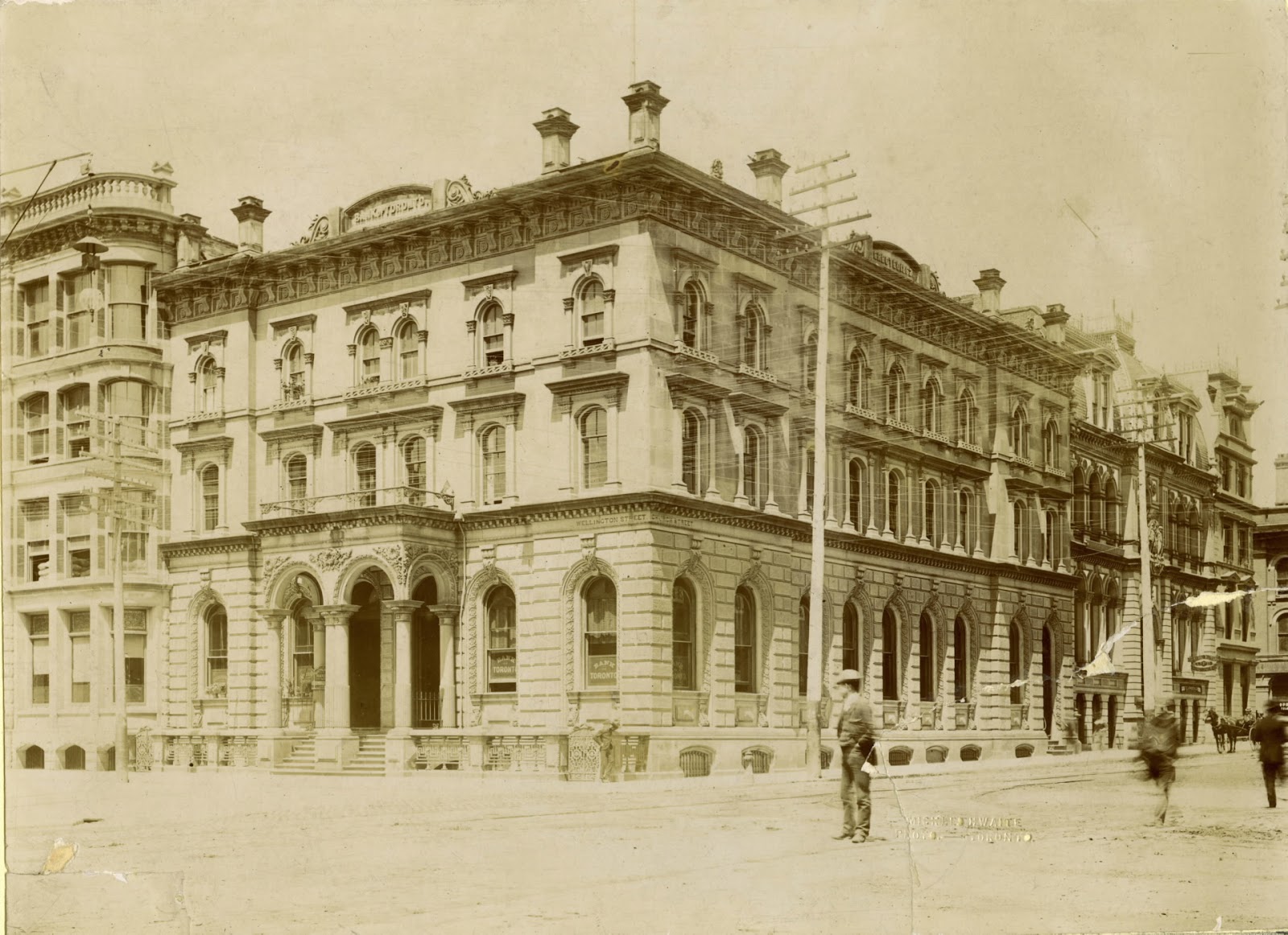
Just a few years later, the Bank of Toronto moved to new headquarters on the northwest corner of Wellington and Church streets.  This building opened in 1862 and has become a rather notorious example of lost buildings in Toronto.  This beautiful Bank of Toronto building on the north side of Wellington Street would stand for just under a century, before being demolished in 1961, and becoming one of the first casualties of the so-called “urban renewal” of the 1960s.


THEN : The Bank of Toronto at the northwest corner of Wellington and Church streets is shown here in 1890.


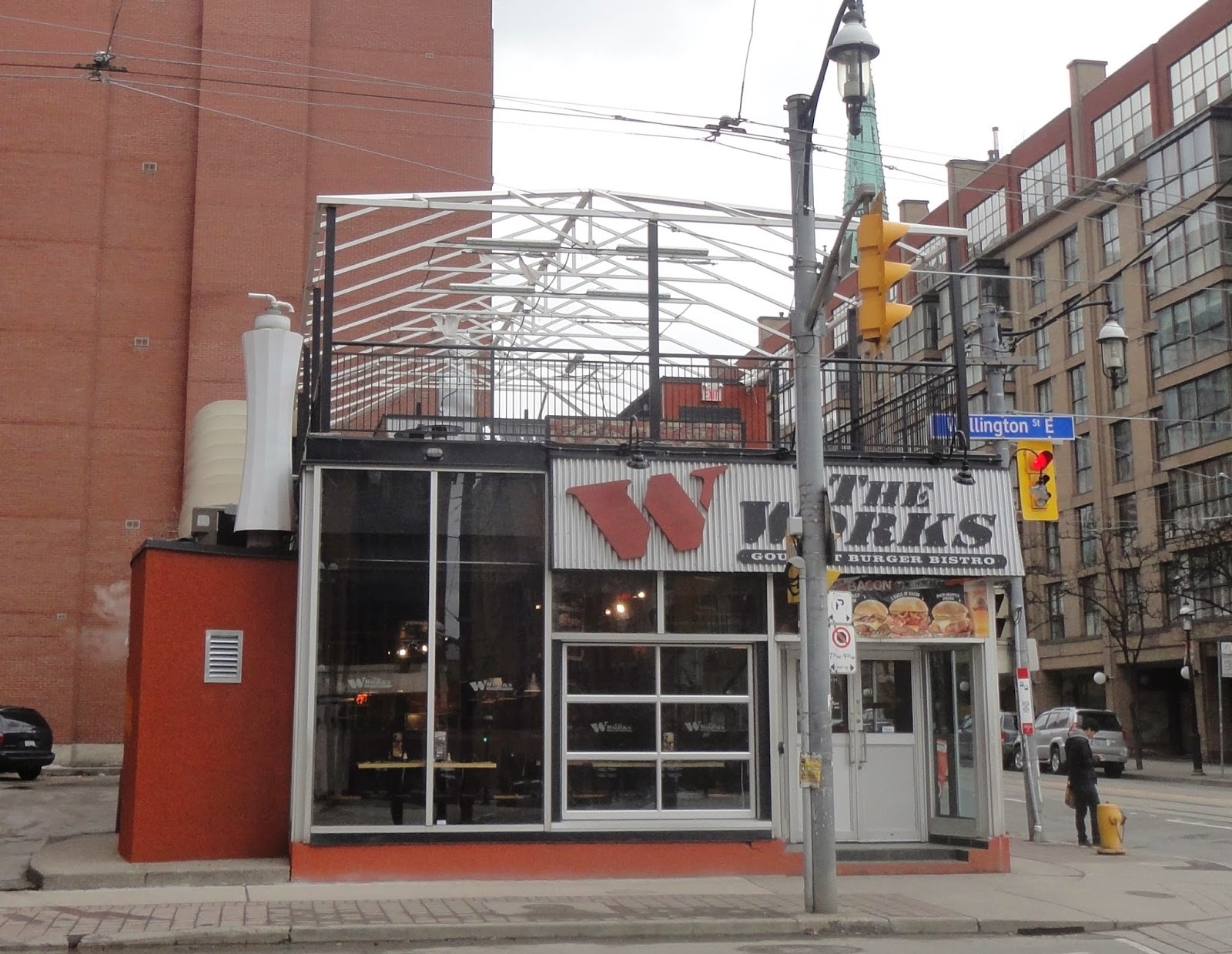
NOW : What we have now, instead of the old Bank of Toronto building, is a stunning example of postmodern Toronto architecture ...


Gooderham's office – now more commonly known as the Flatiron Building – still stands across the street, on the south side of Wellington Street. So, his office stood across the street from the bank with which he was so involved, and rumours abound of an underground tunnel that Gooderham could use to sneak across the street and get into the bank's vaults. According to some sources, anyway, the tunnel is still there, but access from the tavern that is now in the basement of Gooderham's office has been completely sealed off.


THEN : The Bank of Toronto building at the northwest corner of Wellington and Church streets is shown here in 1870.


NOW : An accessible tunnel once ran from the Gooderham Building, on the left, under Wellington Street, to where the Bank of Toronto once stood on the right.  Apparently, the entrance to the tunnels from the basement of the Gooderham building are all bricked up.  Goodness only knows what one would find in the basement of "The Works".
 

As early as 1901, the Bank of Toronto began contemplating the construction of a new headquarters. The bank purchased a large plot of land at the southwest corner of King and Bay streets in 1902. With a frontage of 120 feet on King Street, and 134 feet on Bay Street, it was the largest parcel of land that had been bought up for redevelopment up until that point in the city's history. The lease on some of the buildings that stood at that corner did not expire until 1911, so actual construction of the new Bank of Toronto building did not begin until January of 1912.
An American architectural firm, Carrere & Hastings, was chosen to design the new building. It was a time when there was a great deal of nationalism in architectural design in Canadian citizens, and the choice of an American firm probably caused a stir. But Carrere & Hastings was at the top of the list of respected American architectural companies, and their work on the building would have brought the Bank of Toronto a lot of prestige, as well as the security of knowing that their new headquarters would be well designed and well built. The design of the new Bank of Toronto building was inspired by the Bourse de Paris – the Paris Stock Exchange building – that had been constructed over almost twenty years from 1808 to 1826. The Bank of Toronto building took considerably less time, and was completed in 1913.
 
THEN : The elegance and grandeur of the Bourse de Paris would serve as inspiration for the Bank of Toronto's new headquarters at King and Bay streets.


THEN : The new Bank of Toronto headquarters were completed in 1913.


The Corinthian columns of the building evoked a sense of the Classical world that could be found in a number of bank buildings from the time. A large plinth, taller than the height of pedestrians passing by, held the columns above the level of the traffic, and evoked a sense that the bank was built on a strong foundation. The building looked like an imposing, geometric monument that exuded self confidence. The elegance of the exterior of the building hid the fact that there were five levels of offices on the inside, and two full basements with space enough for vaults and storage. Inside, at the centre of the building, was a vaulted two storey banking hall. Marble, bronze and glass certainly made it one of the most stunning commercial interiors at the time.

 
When the Bank of Toronto amalgamated with the Dominion Bank in 1955, a decision was made to construct a new building to house the combined offices of both of the former banks. The 1913 Bank of Toronto building, and the current Toronto-Dominion Centre was built in its place. Two towers were built in the second half of the 1960s, with another four being built between 1974 and 1991. The bronze tinted glass and black steel of the buildings are perhaps the best example that Toronto has of the “International Style” of corporate tower that was popular in North America fifty years ago. On one hand, it is easy to imagine a film about the world of banking, set in New York City in the 1960s, being set in and around the complex. On the other hand, it's hard not to miss the classical style of the old 1913 Bank of Toronto building.
 
THEN : Topping off the 56-storey tower of the Toronto Dominion Centre, just prior to its completion in 1966.


THEN : The original two towers of the Toronto Dominion Centre in 1966.  The Royal York Hotel can still be seen to dominate Front Street in the background.  The Toronto Stock Exchange building can be seen in the lower left hand corner of the photograph.  Later additions to the Toronto Dominion Centre would eventually wrap themselves around the Toronto Stock Exchange building, and the old Art Deco façade now looks out from a wall of black glass.

THEN : The original two Toronto Dominion Towers, circa 1967, just after they were completed. With "new" city hall in the background, and the Royal York and the Bank of Commerce building visible, I really think that this photograph points to a time when Toronto was delineated between the first and second halves of the twentieth century. The hotel and Bank of Commerce are still obvious giants, but the nuances of Revell's city hall and the soaring height of the new TD towers are like the opening chords of the modern glass and steel symphony.
 
 
The first run of banknotes from the Bank of Toronto were printed between 1856 and 1865. Few survive, so they are quite valuable to collectors. However, a large number of the banknotes from this period issued by the Bank of Toronto were counterfeited. Banknotes from these years were issued in denominations of $1, $2, $4, $5 and $10. Many of the banknotes were overprinted with the location of branches, including locations in Barrie, Cobourg, Collingwood, Montreal, Peterborough, Port Hope, and St. Catharines. Like any other chartered bank, the signatures of various bank officials appear on these banknotes – two names of note were William Gooderham and James Worts.


THEN : $1 and $4 banknotes from the Bank of Toronto, dating from the 1856 to 1865 period.

In 1876, the Bank of Toronto did a run of only 25,000 banknotes, all with a face value of $4. No other denominations were produced. They were either overprinted to show branch locations in Collingwood or St. Catharines, or had no overprint at all. J.G. Worts is pictured on the left and William Gooderham is on the right. Because of the limited number that were produced, these banknotes are considered to be rare and quite valuable.


THEN : $4 banknote from the Bank of Toronto, dated 1876.  J.G. Worts is portrayed on the left, and William Gooderham is on the right.
 
For a little more than forty years between 1887 and 1929, the Bank of Toronto did little to change the appearance of their banknotes. Perhaps they felt that loyal customers would be more secure having a recognizable mode of currency from year to year. However, printing also cost less if the design remained stagnant. The opening decades of the twentieth century were years in which other banks modernized the appearance of their currency, but banknotes issued by the Bank of Toronto retained a more “retro” look. Overprints from various branches show a wide range of locations all across Canada, signifying that the Bank of Toronto was growing across the country.


THEN : Bank of Toronto banknotes from the period between 1887 and 1929.  The $5 note portrays the Canadian Coat of Arms at the time, while the $10 note portrays what was then the Coat of Arms for Toronto.  The $20 note contains a reference to the railroads, a cornerstone of the Gooderham family fortune, while the $50 banknote shows Toronto's 1899 City Hall.
 
These Bank of Toronto banknotes from either 1935 or 1937 show little variation at all from what had been produced between 1887 and 1929.


THEN : Bank of Toronto banknotes from 1935 and 1937, looking like something out of the nineteenth century.
 
THE DOMINION BANK
The Dominion Bank began in 1871, and had a history that was in some ways similar to the Bank of Toronto. It was founded on cautious and conservative principles, but spread its branches of networks fairly quickly. In 1872 it became the first bank in Canada to have two branches in the same city – right here, in Toronto.
James Austin was to the Dominion Bank what William and George Gooderham had been to the Bank of Toronto. Born in Northern Ireland in 1813, he was sixteen years old when his family came to Canada. He became a printer's apprentice and spent a decade in that trade, both in Canada and the United States. However, the cornerstone of his fortunes would lay in other endeavours. He went into partnership with Patrick Foy and together they established the Austin & Foy wholesale company, which operated out of the Daniel Brooke building, which had been built at the northeast corner of King and Jarvis streets in 1833 and which still stands today. The venture was a profitable one, but Austin was drawn away by interests in other ventures. The partnership was dissolved, and Austin was left with a decent sum of money to invest elsewhere.


THEN : The Daniel Brooke building has stood at the northeast corner of King and Jarvis streets since 1833.  The Austin & Foy Wholesale Company has been just one of the enterprises to inhabit this building, which is one of the few intrepid survivors from Georgian Toronto.

With his establishment of the Dominion Bank in 1871, he became a central figure in Canadian finance. He was involved in several different insurance and mortgage companies. He had also been one of the founding directors of Consumers' Gas, and by 1881 he had staked out further control of that company and became its president.
In 1866, Austin had a new family home built on top of Spadina Road, overlooking the escarpment. The Eaton family were nearby neighbours, and of course, Sir Henry Pellatt's notorious residence, Casa Loma, would eventually be built across the street. The estate had been previously owned by the Baldwin family, and noted Canadian political reformer Robert Baldwin had died in the home that stood on the property. Austin had this house replaced, but kept the estate name as Spadina. Austin ended up selling off some portions of the eighty acres that he had purchased, and the 1866 home was renovated and added to, but it still survives today.


NOW : James Austin's estate of Spadina, as it looks today.  Built in 1866 on the foundations of the Baldwin family estate, it now functions as a jewel in the crown of Toronto's museums.
 
The last member of the family to live in the house was Anna Kathleen Thompson, a granddaughter of James Austin. In 1982, she negotiated to turn the house over to the City of Toronto, and two years later, the house opened as a municipal museum, and is still in operation as such today. Renovated in 2010, the museum offers a number of unique historical experiences, including an exhibit on the wardrobe and costuming from the popular television series Downton Abbey.

Find media coverage for the "Dressing for Downton" exhibit at Spadina here ...
... or visit here for official information!


NOW : The Austin family vault at St. James' Cemetery.
 
Getting back to the Dominion Bank, it spread through northern Ontario and western Canada, just like the Bank of Toronto, and many other Canadian banks. The bank's target clientele were employees of utility, resource and manufacturing companies. The bank's history also mirrored that of the Bank of Toronto when it got involved in War Bonds in the First World War, and then rationing and foreign exchange in the Second World War.


THEN : An ad campaign for Victory Bonds from 1918.  All major Canadian banks were expected to help finance the war effort by promoting investment in the Canadian government.


The Dominion Bank didn't suffer too greatly during the Great Depression, and the late 1930s and 1940s were a very prosperous time for the bank as an institution. However, in order to compete with other large banks, the Dominion Bank merged with the Bank of Toronto in 1955. The two conservative institutions with a very similar history made for a successful partnership that still exists today.
 
 
The very first branch, which also housed the corporate headquarters of the Dominion Bank, stood at 40 King Street East, opening there when the bank was established in 1871. The bank was actually renting these quarters from a retailer, known as the Harris Store, and was paying a rental fee of $92.50 per month. Within a few years, the bank outgrew this location, and in 1879, a new building was constructed at the southwest corner of King and Yonge streets, at 1 King Street West. The location had originally been home to a retail outlet, the Michie & Company Grocers and Wine Merchants, but this would be demolished in order to build the headquarters for the Dominion Bank. The cost of construction was $40,000.


THEN : A photograph of the Dominion Bank building at 1 King Street West circa 1879, the year it was opened.
Standing at a height of five stories, the new building that was constructed for the Dominion Bank in 1879 was an early entry in the race for architects to build taller and taller. The Beard Building stood at a height of seven storeys at the southeast corner of King and Jarvis streets from 1894 until 1935, the twelve storey Temple Building towered over Richmond and Bay streets from 1896 until 1970, and the Trader's Bank Building, constructed in 1905 to an amazing height of fifteen storeys, still stands at the northeast corner of Yonge and Colborne streets. But the five storey Dominion Bank headquarters at King and Yonge streets was certainly seen as a “skyscraper” when it went up in 1879.
 
 
THEN : The Beard Building, on the southeast corner, King and Jarvis streets, 1894 to 1935, stood seven storeys.


THEN : The Temple Building, on the northwest corner of Richmond and Bay streets, 1896 to 1970, stood twelve storeys.


NOW : The Trader's Bank Building, at the northeast corner of Colborne and Yonge streets, built in 1905 and still standing, soars to fifteen stories.  All of these buildings, in turn, amazed Torontonians with their ever growing heights.  They all came after the five storey Dominion Bank building, constructed in 1879.

 
THEN : The Dominion Bank building in 1903, looking diagonally across the street, from the northeast corner of King and Yonge streets, towards the bank at the southwest corner.
 
 
THEN : Looking east across King Street towards the Dominion Bank, on the corner of Yonge Street.  When the bank replaced Michie & Company at the corner, that enterprise seems to have found a new home, two doors west (so, towards the camera) from the bank.
 

That record would seen be toppled, of course, and the ever growing success of the Dominion Bank led to the construction of an even taller building. Work on the building began in March of 1913, and the result was a twelve storey Beaux-Arts skyscraper. When plans were unveiled for the new building, detractors claimed that such a tall building would ruin the city's skyline. However, the work of the architectural firm of Darling and Pearson silenced all the critics when the new Bank of Dominion building was completed in 1914.


  Pearson and Darling would work on a great many number of Toronto landmarks from the early 20th century, including Flavelle House (now a part of the University of Toronto's Faculty of Law), Convocation Hall and the Sanford Fleming Building (both also located at the University of Toronto), wings of both the Royal Ontario Museum and the Art Gallery of Ontario, and the Bank of Commerce building, which still stands at King and Jordan streets, and is a neighbour of the Dominion Bank building. The architectural firm's work on the Dominion Bank building was acclaimed as an attractive addition to Toronto's blossoming financial district.

 
NOW : The (former) Dominion Bank building at 1 King Street West, as it appears today.
In addition to the building's soaring height of twelve storeys, there were certainly other grand properties to the building, too. The Grand Banking Hall, on the second floor, boasted a forty-five foot high ceiling. The hall seems cavernous, measuring 154 feet long and 68 feet wide. In a time when the bank lobbies of today are only large enough to fit a few bank machines, the banking hall of the 1914 Dominion Bank seems enormous indeed. The massive nature of the building was also supported by an excavation that went thirty-five feet beneath street level.


NOW : The grand banking hall at the Dominion Bank today.  Like a number of historic venues, the bank has been converted to entertainment space.  As familiar as we are with small little vestibules for automated banking machines, it's hard to remember a time when so much space was needed to efficiently process bank customers.
 
The vault located in the basement soon became a famous feature of the Dominion Bank. Located at the base of a grand marble staircase that leads down from the main floor, the vault was at one time considered to be one of the biggest and best in Canada. It measures thirty-three square feet square, and has a height of twenty-five feet. The vault is actually divided into two levels. The upper one is known as the Safety Deposit Vault and the lower one is known as the Treasury Vault. The circular door to the upper vault is over four feet thick, and has a circumference of over seven feet.  Before the door could be installed, it was pulled down Yonge Street by a team of horses.  This turned into something of a procession and was covered by local newspapers, which no doubt enhanced the bank's profile. 


THEN : This photograph from 1914 shows the vault of the Dominion Bank being transported to the new bank headquarters at Yonge and King streets.
 
NOW : The marble staircase that leads down from the refurbished main floor of the bank, downstairs to the Safety Deposit Vaults.

NOW : The massive vault in the basement as it appears today.


With the merger of the Dominion Bank with the Bank of Toronto in 1955, many of the corporate functions of the new Toronto-Dominion Bank were moved to what had been the Bank of Toronto headquarters, just down the street at the southwest corner of King and Bay streets. A branch of the bank did continue to occupy the building at King and Yonge streets into the 1990s. Ownership changed in 1999, when the old Dominion Bank Building at 1 King Street West was bought up to form the nucleus of a new hotel and condominium complex. By 2006, the adjacent glass and steel tower, nicknamed “the Sliver”, was completed and the complex – commonly referred to as the 1 King West Hotel - opened for business.


NOW : The Dominion Bank building and "the Sliver" at 1 King Street West.
 
The Dominion Bank printed its first currency in 1871, with another series following shortly after in 1873. Available denominations were $4, $5, $10, $20 and $100 bills. The $4 bill shown here carried a portrait of Prince Arthur, who had been born in 1850 and who would go on to become a Governor General of Canada. His mother, Queen Victoria, is pictured on the $5 bill. Like early banknotes from the Bank of Toronto, these often fell prey to counterfeiters, so authentic banknotes are very rare today.


THEN : $4 and $5 banknotes from the Dominion Bank shortly after it opened.  The $4 banknote features Prince Arthur, Duke of Connaught, who would serve as a Governor General of Canada.  He had many connections with Toronto.  Prince Arthur Road, which runs west from Avenue Road, just north of Bloor Street, is named for him.


In a five year period between 1876 and 1881, the Dominion Bank printed a series of 110,000 banknotes with a denomination of $4, 312,000 banknotes with a denomination of $5, and 105,000 banknotes with a denomination of $10. Like other banknotes from the Dominion Bank, these are considered to be rare and valuable today.


THEN : Banknotes issued from the Dominion Bank between 1876 and 1881.  Generally speaking, the Dominion Bank issued banknotes that were more elaborate and vibrant than those of the Bank of Toronto.
 
 
Through to the final years of the nineteenth century, banknotes from the Dominion Bank continued to display the signature of James Austin. He died in 1897 and his son Albert William Austin (1857 to 1934) took over the family fortunes.


THEN : Signatures on the banknotes from the Dominion Bank at the end of the nineteenth century began to reflect a change in bank management, when Albert William Austin took over after his father's death in 1897.


In 1931, the Dominion Bank issued a banknote series in denominations of $5, $10, $20, $50 and $100. The various denominations show a uniform type of design. A portrait of Albert William Austin appears on the banknotes, along with one of Clarence A. Bogert. Austin was the president of the bank from 1925 until 1933, and Bogert was president from 1933 until 1934. $5 bills were the most commonly printed, with one million of them going into circulation. 600,000 of the $10 bills were printed, 46,000 of the $20 bills were printed, 8,800 of the $50 bills were printed, and only 6,800 of the $100 bills were printed. This gives you an idea as to the relative scarcity of each of them, and a sense of the corresponding numismatic value.


THEN : The 1931 series of banknotes from the Dominion Bank, featuring the portraits of Albert Austin (left) and Clarence Bogert.
 
Although the $5 and $10 banknotes issued by the Dominion Bank are more common than other issues, they were still designed in a very attractive manner. Austin and Bogert have disappeared off the banknotes in favour of Clifton Carlisle, the new bank president, and Dudley Dawson, the vice-president. These banknotes, as well as those produced in 1938, were slightly smaller than those previously issued by the Dominion Bank.


THEN : The $5 and $10 banknotes issued by the Dominion Bank in 1938, featuring Clifton Carlisle and Dudley Dawson.
 
The 1938 $5 and $10 banknotes featured portraits of Robert Rae and Clifton Carlise.


THEN : The 1938 $5 and $10 banknotes featuring Robert Rae and Clifton Carlisle.
 
_____________________________________________
Here's a throwback to an advertisement produced by Canada Trust, before they amalgamated with Toronto-Dominion. It showcases a brand new technology in banking – the ATM. Johnny Cash made a cameo appearance to help Canada Trust to convince bankers that the “Johnny Cash cash machine” was a safe, secure and convenient way to do banking.
 
_____________________________________________
 
 
Don't go away! An upcoming article will relate the history of institutions like the Royal Bank and the Bank of Nova Scotia.