Saturday, September 26, 2015

# 60 ~ "Play by the Bay", Part II - The Toronto Islands


This is the second of four articles that are taken from a presentation that I gave during the week of September 21st, 2015.  Given that we have reached the official end of summer, I presented a look back at some of Toronto's favourite summertime recreational spots - particularly, those located around the Toronto harbour.

The second stop on my "tour" of these recreational areas is the cluster of islands in Toronto’s harbour.   This area has served the city as a recreational area for generations.   History suggests that the prior to European settlement, the Mississauga people used the Toronto Islands as a place to let their sick convalesce. 

Once the old Town of York was established in 1793, British troops built a small fortification on the islands, across the harbour from Fort York, and early settlers used the islands as a place to fish and hunt.


The main painting in this image shows what Gibraltar Point would have looked like about 1820.  The lighthouse at Gibraltar Point was built in 1808.  If you look closely, you can catch a glimpse of a blue coated hunter searching for prey in the marshy grasslands.


Year round settlement on the Toronto Islands began in the early 1860s.  In 1867, the City of Toronto acquired the islands from the federal government and divided the land into lots, allowing for cottages, amusement areas and resort hotels to be built.  The west side of the island became a resort destination for the people of Toronto and the first summer cottage community was built there.

It was the Hanlan family who became one of the first year round inhabitants of the Toronto Islands back in the early 1860s.  In 1878, John Hanlan built a hotel on the northwest tip of the Toronto Islands and soon the area became known as “Hanlan’s Point”. 


Edward “Ned” Hanlan would become a world famous rower before retiring from athletics and taking over his father John’s hotel business.  He also represented the Toronto Islands on City Council for a few years near the end of the 1890s.


In a story similar to that of the Hanlan family, David Ward was an early settler on the eastern end of the Toronto Islands, and Ward’s Island would eventually take his name.  David Ward’s son, William E. Ward, built the Ward’s Hotel in the 1880s.  He also constructed a few other homes and tents that he rented to visitors.


This photograph from 1911 shows some of the tents that were available to rent on Ward's Island.  Just two years later, by 1913, the number of tents had increased to the point where the city felt it necessary to organize the community into streets, and the tents eventually evolved into a cottage community.


In contrast to the small homes and tents that were built on Ward’s Island, Toronto’s wealthiest families were building large Victorian summer homes on the lakefront at Centre Island.  Many of these were built in the last few decades of the nineteenth century.  The Toronto Islands were really developing as a summer suburb of the city.  


Here we see industrialist George Gooderham, left inset, at the helm of his yacht, which was harboured at the Royal Canadian Yacht Club.  His "cottage" on the Toronto Islands is also shown.


Toronto’s wealthy came in search of refuge from the crowded heat of the city, and joined the prestigious Royal Canadian Yacht Club, which had moved to its location on the harbour side of Centre Island in 1881.  The tall tower to the one side of the clubhouse, and the veranda that encircled the entire building, gave good vantage points to take in all the boating events in the harbour. 

Complete with dining space, lounges and residential rooms, there was no question that the yacht club was for the well to do.  The lighthearted, rustic look of the clubhouse’s wood and ivy gave an intentional contrast to the brick homes that club members were escaping from, back in the city.


The Royal Canadian Yacht Club's first clubhouse on the Toronto Islands was built in 1881.


Fire struck this 1881 clubhouse in 1904, and it was destroyed, but it was rebuilt quickly.  A new clubhouse, shown here, was finished by 1906.  This second clubhouse was a step away from its more rustic predecessor, and it was definitely more formal.  However, it only lasted a dozen years, before it fell prey to fire, too, in 1918.


The second clubhouse that the Royal Canadian Yacht Club had on the Toronto islands lasted from 1906 until 1918.


The burned out hulk of the second yacht clubhouse served until a slightly altered reincarnation of the building could be completed in 1922.  The fire had been devastating, though fortunately the club's trophies and silverware service had been saved.  However, the design of the second clubhouse had been so popular that the third clubhouse was built to resemble its immediate predecessor.  This third facility is the one that survives today.  It is Toronto's largest wooden building, and holds a ballroom, a dining room, and other social spaces.  This is not to be confused with the clubhouse across the harbour on the mainland, on St. George Street, just north of Bloor Street.


In 1894, a land reclamation project by the Toronto Ferry Company created space for an amusement park at Hanlan’s Point.  In 1897, the Hanlan’s Point Stadium was built alongside this amusement park.  The stadium was home to the Toronto Maple Leaf baseball team, and was modified and rebuilt several times over the years. 

In 1914, Babe Ruth hit his first professional home run from the stadium into the waters of Lake Ontario.  The Maple Leaf team moved to a new stadium on the mainland in the 1920s.


Hanlan's Point Stadium.


The residential community on the Toronto Islands reached its peak in the 1950s.  It extended all the way from Ward’s Island to Hanlan’s Point, and was made up of about 630 cottages and homes.  There were also such amenities as a movie theatre, a bowling alley, stores, hotels and dance halls.  However, the Gardiner Expressway would sound the death knell for a major part of this community. 

The expressway meant the demolition of a lot of recreational land along the city’s waterfront – including Sunnyside Amusement Park, as mentioned in my previous post.  The city’s government turned its eye towards the Toronto Islands, and looked to demolish the residential community in order to turn the area into more parkland for the city.  Demolition of the homes started in 1955.


To compensate for the demolition of homes, recreational attractions began opening on the islands.  A petting zoo called “Far Enough Farm” opened in 1959.  The Centreville Amusement Park opened in 1967, and was meant to be a replacement for the midway at Sunnyside, which had been demolished a dozen years earlier, in 1955.  

 Any island residents were encouraged to leave, and by 1963, all of those who were willing to leave their homes on the Toronto Islands had done so. Legal battles and protests to save the island homes were waged back and forth through the 1960s and 1970s.  Islanders either gained or lost ground depending on who held sway at Queen’s Park or City Hall.  Eventually, only 250 homes out of an original 630 were still standing.  These were all located on either Algonquin Island or Ward’s Island.


Island protestors call on Ontario's Premier Bill Davis for help.


Matters came to a head on July 28th, 1980, when a sheriff was sent to serve eviction notices to the remaining residents.  He was met at the Algonquin Island bridge by most of the island residents, and there was a showdown.  Residents managed to convince the sheriff to withdraw without serving the eviction notices.  In December of 1981, the Province of Ontario passed a law permitting the island residents to stay until 2005.  Then, in 1993, the Ontario Government passed the Toronto Islands Residential Community Stewardship Act, which enabled island residents to purchase a 99-year lease on their island homes. 


________________________________________


So, this gives you a sense of the history of the Toronto Islands, from the earliest days of European settlement to the cottages that stand there today.  Now, I’d like to share with you some historical photographs that I’ve chosen to give you an idea of what recreation on the Toronto Islands was like in years past.

The Toronto islands have always been a place where people come to relax and refresh.  I mentioned before that aboriginal peoples once crossed the harbour to recuperate on the islands.   The former Provincial Insane Asylum once kept a summer home for its patients on the islands.  Today, there is an island retreat for seniors.  In 1883, an institution known as the Lakeside Home for Little Children was located on the western end of the Toronto Islands, near Gibraltar Point.


The home was built as a summer retreat for poor children, mostly suffering from Tuberculosis in Toronto’s crowded inner city.  In 1891 John Ross Robertson, founder of the Evening Telegram newspaper who lost his own daughter to scarlet fever, built an enormous addition and surrounded the entire home with a veranda to overlook the lake.  

Every June these children, some still in their hospital beds, would be paraded in a long line of carriages from the Hospital for Sick Kids (then on College Street) down to the Island docks.  In September crowds would form once again to see their return.


This photograph shows being transported to the Lakeside Home in June of 1923.  You can make out the gritty, smog ridden skyline of the city in the background, and imagine what these young children were escaping from.

This photograph from 1927 shows some of the Lakeside Home's patients arriving on the islands.  Once across the harbour and away from Toronto, the scenery was much more "natural".


Fire struck the Lakeside Home in April of 1915, but fortunately, no one was injured and the building was repaired.  The home was a fresh air haven for thousands of children up until 1928 when a new country home operated by Sick Kids opened in Thistledown, Ontario.  The rambling mansion was used as emergency housing during the Second World War, and was eventually demolished in 1956.


It was John Ross Robertson, who operated the Evening Telegram newspaper, who had enabled the Lakeside Home for Little Children to open.


________________________________________


Long before Centreville opened in 1967, there were plenty of early amusements on the Toronto Islands to thrill children of all ages.  Many of these were located at the Amusement Park at Hanlan’s Point, before they were demolished in the late 1930s and 1940s to make way for the Island Airport.  The largest ride in the amusement park was the roller coaster.  The rollercoaster was located immediately next to the stadium at Hanlan’s Point, where Babe Ruth had hit his first professional home run in 1914.


Hanlan's Point Rollercoaster, with stadium in background.

Hanlan's Point Midway, circa 1908.


One of the rides on the midway was a sliding affair known as the “Hurgle Gurgle”, seen in the photograph, below.  Like most amusement parks, the one at Hanlan’s Point also featured games that could separate visitors from their money.  The prizes have changed over the years, though.  Also seen in the photograph is a ball pitch game to the right, which gave out cigars to players with good aim.


Handing out cigars on the midway has fallen out of fashion, but I don’t think that the name for this ride would be very popular today, either.  Shown below is the Hanlan's Point miniature train, which was dubbed “the Midget Railway”. 


“The Whip” was another popular ride.  It gave riders a good excuse to hold each other tight as it spun them around.  Apparently it didn’t spin them fast enough for the gentleman in this central photograph, taken in 1930, to lose his hat.


No amusement park is complete with a merry-go-round.  Shown below is the one that Hanlan’s Point boasted.


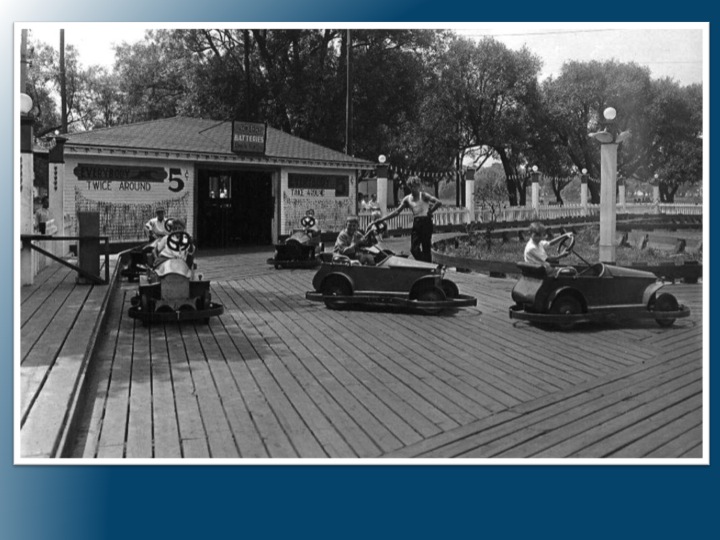
Games for the kids included this “Drive Yourself” ride, shown here in 1934.  Riders were allowed to go two laps for a nickel. 


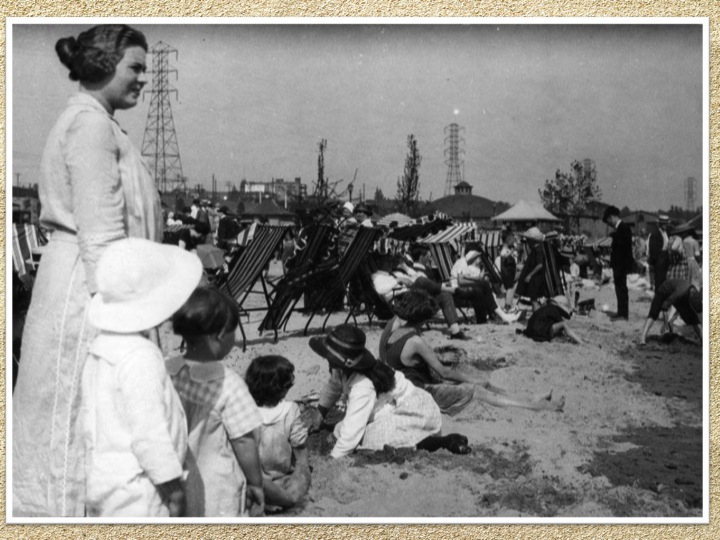
If you didn't have a nickel, or you didn't like the look of any of the rides at Hanlan's Point, there was still fun to be had, as we see in this photograph from 1911.


Hanlan's Point also featured a few indoor attractions, like this roller skating rink, shown here in 1934.


When swing was king during the Big Band Era, from the 1930s through to the early 1950s, no amusement park was complete without a dance hall.  They were just as integral a part of a summer’s recreation as the Ferris Wheel, the rollercoaster or the carousel.  Hanlan’s Point was no exception, and it featured the dance hall and flower garden.


Hanlan's Point Dance Hall & Flower Garden, 1928.


Hanlan's Point Dance Hall & Flower Garden, 1929.


There were, of course, water themed attractions on the Toronto Islands.  This photograph from 1908 shows a pavilion that was set up right next to the roller coaster at Hanlan’s Point.  The show featured two diving horses, named “King” and “Queen”.  The horses would travel up the ramp and then dive up from the top, into the water.  There is no way that animal rights activists would let this happen today.  The horses didn’t exactly travel up the ramp by their own volition.  The ramp actually contained an early model of escalator.  Once on the ramp, the horses had no alternative but to travel to the top, and when they reached the summit, they had no choice but to dive.

Diving Horses, Toronto Islands.

Some of the island’s aquatic activity was a little more humane.  The Durnan family had a long history on the Toronto Islands, and the boathouse that they owned rented out canoes and kayaks for island visitors to enjoy.  Although Durnan’s boathouse is long gone, there are still boat rentals on the Toronto Islands today.


Durnan's Boathouse, 1908.


James Durnan emigrated from Dublin to Toronto about 1830s.  He moved to the Toronto Islands, and served as the lighthouse keeper at Gibraltar Point from 1832 to 1853.  His son, George, took over and served as lighthouse keeper for over half a century, from 1853 until 1908. 


This photograph from 1907 shows George Durnan being interviewed by John Ross Roberston, owner of he Evening Telegram newspaper, back in 1907.  It as Robertson who had contributed to the Lakeside Home for Little Children.

________________________________________


To help the transition from Summer to Autumn a little easier, there is always hallowe'en to look forward to.  I've included this video from the CBC archives, chronicling the Gibraltar Point lighthouse and its legendary ghost story.  The clip is from 1958, so the sound is not the best.  However, this clip gives a glimpse into the early broadcasts from the CBC, which had only gone on the area a few years before this aired.  It also introduces a member of the Durnan family, as well as the very last official lighthouse keeper, Mrs. Dodds, who looked over the lighthouse from 1955 until 1958.  Have a look for panoramic sweeps of the Toronto skyline from the lighthouse, which shows how differently the city looked in 1958.

You can find the 1958 broadcast from the CBC here.


If you are looking forward to hallowe'en, it's never too early to sign up for one of our ghost tours.  This will be my 18th hallowe'en giving tours around Toronto.  We offer them most nights between Thanksgiving and Hallowe'en night, which falls on a Saturday night this year.

Some of the nights near the end of October are selling quickly, already.  You can find information on Muddy York Walking Tours at www.muddyyorktours.com


________________________________________


The amusement park at Hanlan’s Point was eventually lost, but when Centreville opened in 1967, it gave a whole new generation of Toronto kids happy memories of summers spent across the harbour.  This was my era – I can still wander through the grounds of Centreville today and wax nostalgic about discovering it for the first time, forty years ago.  Most of these photographs are from that vintage, taken through the 1970s.

Centreville, 1970s.

The swan ride remains a central fixture at Centreville.

 
The water flume ride still thrills & soaks visitors to Centreville.

The miniature trains at Centreville could be considered a replacement for the old railway ride at Hanlan's Point.


The vintage car ride at Centreville travels along a guided track, which allows for a little less freedom than the old miniature car ride at Hanlan's Point.


The same holds true for the miniature fire engine ride.


________________________________________


This photograph from 1972 shows how much the skyline has changed in 43 years.  There is no CN Tower, no Rogers Centre, and although a few financial towers have gone up, the Royal York Hotel is still a central part of the skyline.


The following video was produced by the Government of Ontario in the 1970s, to promote use of the Toronto Islands by the general public.


________________________________________


My "blog" on Toronto, Then & Now has developed out of the thousands of historical photographs of Toronto that I have collected over the years, in the course of giving illustrated talks and presentations.

If you have an interest in booking an illustrated talk, please get in touch.  I have many different subjects put together.  Just a few of these include :

- Toronto in the Georgian Era (1793 to 1834)
- Victorian Toronto (1837 to 1901)
- Demolished Toronto
- A History of Old Homes & Estates in Toronto
- A History of Cinema & Entertainment in Toronto
- Toronto During the First World War
- At least two different presentations on True Crime in Toronto
- Ghost Stories of Toronto


Presentations can be tailored to run anywhere from 30 minutes to 2 hours, depending on the needs of your group.  I come with all my own equipment - laptop, speaker, and digital projector.  Researching the history of Toronto and going on a detective hunt for old photographs is a passion of mine.

If you don't see a subject that you're interested in listed above, just ask!


You can reach me at :

telephone : 416 487 9017

You can follow Muddy York Tours on twitter @MuddyYorkTours

Also : join our Facebook group for special information on "secret" events and tours that aren't always announced to the public.  Our Facebook group can be found here.

Thursday, September 24, 2015

# 59 ~ "Play by the Bay", Part I - Sunnyside Amusement Park


This is the first of four articles that are taken from a presentation that I gave during the week  of September 21st, 2015.  Given that we have reached the official end of summer, I presented a look back at some of Toronto's favourite summertime recreational spots - particularly, those located around the harbour.  

The first is Sunnyside Amusement Park.  It was located on the waterfront, running west from the foot of Roncesvalles Avenue.  Although the park was closed in 1955, a few landmarks remain – most notably, the Sunnyside Bathing Pavilion and the Palais Royale. 


Sunnyside took its name from a nearby farm that was once owned by John George Howard.  Howard was an early Victorian architect in Toronto, who is probably best remembered as the original landowner of High Park and Colborne Lodge.  Howard’s Sunnyside Farm was located just to the north of Sunnyside Park, where St. Joseph’s Health Centre is today.


This photograph from 1859 shows a picnic at Sunnyside Farm.


Back in 1913, the Toronto Harbour Commission started up a plan to improve the shoreline around what would become Sunnyside Park.  Toronto’s harbour front and shoreline have been a work in progress almost from the day that the old town was first established over 200 years ago.  The kind of development and change that brought Sunnyside into being has come up again and again in the city’s history, and is still an ongoing issue today.  Development of Toronto's waterfront would impact other lakeside recreational areas, too. 


The plan to develop the Sunnyside Amusement Park involved expanding a thin little stretch of land that lay south of some 1850s era railway lines.  This expansion meant putting in four miles (six kilometres) of breakwater, filling in land, and the building of Lake Shore Boulevard.  This was done at a cost of $13-million, which was paid for by the Federal government.


A boardwalk was installed along the south side of Lake Shore Boulevard, from the Humber River east to Wilson Park Avenue.  This boardwalk was 24 feet (7.3 metres) wide, and made of white pine planks.  The boardwalk was refurbished in 1934, making it one of many make-work projects that took place across the city during the Great Depression.  This boardwalk would later become noted for the annual Easter Parade that took place along it, until 1953.  The boardwalk would eventually disappear when it was paved over by asphalt in the 1960s.


The actual land for Sunnyside Amusement Park was entirely made out of sand that was dredged from the bottom of the bay, along with topsoil that came from a farm out in Pickering.  The shoreline was extended about 300 feet (or 100 metres) south into the lake, over a width of nearly two-thirds of a mile (about one kilometre) from Wilson Park Avenue west to the Humber River. 


This photograph from 1914 shows the roadbed for the new Lake Shore Road.  A dredging boat can be seen out in the water off to the right.

This photograph from 1920 shows the progress of landfill & dredging in the eastern Sunnyside area.


________________________________________


An early building was the Sunnyside Pavilion.  Built in 1917, the Sunnyside Pavilion held two restaurants and a tea garden with views looking out on to the lakeshore. When the building was constructed, its south façade was right by the water’s edge.  As the water was filled in, the building eventually ended up about 150 feet from the shore. 


Sunnyside Pavilion, circa 1920.


In 1920, the building was enlarged and a new south entrance was added.  At this time, the pavilion became known for the Blue Room, with a capacity for 400 diners or 175 dancing couples, and the Rose Room, which could seat 300 or hold 150 couples.  Dancing would follow supper, with music often provided by a live orchestra.


In 1936, the Sunnyside Pavilion was renovated and became known as the Club Esquire Supper Club, with stage shows and dancing.  It was difficult to find a large sized photograph of the Esquire Supper Club, so you may not be able to read the sign in the image at the top of this slide.  But when it was opened, the Esquire Supper Club was advertised as the “Gayest spot in town” – how times have changed! 


In 1941, the building was converted again, into the Top Hat Night Club.  Many Toronto bands played at the pavilion during its time as either the Club Esquire Supper Club, or the Top Hat Night Club.  The building was eventually demolished in 1956 to make way for the new westbound lanes of Lake Shore Boulevard.


________________________________________


Swimming at the foot of Roncesvalles Avenue had been popular since the 1890s.  Although new roadways and landfill changed the local landscape over the years, people continued to visit the area.   Records show that in 1921 a total of 302,525 people visited the beach near Sunnyside. 


Entrance to the bathing beach at Sunnyside, at the foot of Roncesvalles Avenue, in 1910.

Early change rooms for swimmers at Sunnyside were less than elegant, as we can see in this photograph from 1911.  The changing sheds stand in a long row, just below the train tracks.


Despite the rather basic nature of the swimming facilities, beach goers from all across Toronto continued to head down to the lakeshore up and down the Sunnyside, throughout the opening decades of the 1900s.


Children enjoy the waters at Sunnyside in this photograph from 1907.


Sunnyside beach, circa 1909.

 
The children in this photograph from 1908 have found a canoe to play with, as they pose for a photographer.

Toronto beach goers knew how to dress for the occasion, as seen in this photograph from 1914.

This young woman was kind enough to pose for a beachside photograph at Sunnyside, all the way back in 1910.


Swimmers at Sunnyside finally got new amenities when the Sunnyside Bathing Pavilion opened in 1922.  This pavilion was considered to be the cornerstone of Sunnyside Amusement Park, and other recreational buildings, concession stands, and an amusement park full of rides soon followed the swimming pavilion. 


Toronto mayor Charles Maguire officially opened the Sunnyside Bathing Pavilion on June 28, 1922.  It was originally intended just to provide a space for bathers to change before swimming in the lake.  The concrete building was constructed at a cost of $300,000.  This would amount to over $4-million today. 


The Sunnyside Bathing Pavilion was laid out with two separate wings – one for men, on the west side of the building, and another for women, to the east.  Each wing held a changing area, lockers and showers.  There were 7,700 lockers in total.  There was an admission charge of 25¢ for adults and 15¢ for children.  At the centre of the pavilion was a staircase that led up to a rooftop garden, and a terrace that ran the full length of the building and looked south, towards the beach.

An architect named Alfred Chapman, who would also design the Princes’ Gates, as well as the Ontario Government Building, at the Canadian National Exhibition, designed the Sunnyside Bathing Pavilion.  The bathing pavilion only increased the popularity of the beach at Sunnyside.


The opening of the Sunnyside Bathing Pavilion only increased the popularity of the area, though few people in this photograph from the 1930s seem to have changed into their bathing suits.


________________________________________


The Sunnyside Bathing Pavilion was the site of the first ever “Miss Toronto Beauty Pageant”, held in 1926.


The pageant drew a large audience, as seen in this photograph below, taken at the event, on August 9, 1926.  A quick scan of the crowd shows that, maybe surprisingly, there was a fairly equal number of both men and women in the crowd.


The first Miss Toronto Beauty Pageant, held at Sunnyside on August 9, 1926, drew a large audience, as shown here. A quick scan of the crowd shows that, perhaps surprisingly, there were fairly equal numbers of both men & women.  


Ultimately, the winner of the pageant was Miss Jean Ford Tolmie, seen here in the centre of the photograph below, in the white swimsuit.  The scandal was that she wasn’t even single – so, she couldn’t accurately be described as “Miss” Toronto.  She had won the title of Miss Congeniality in the Miss USA pageant earlier that year – 1926 – although the organizers of that pageant didn’t allow her in the finals, because she was Canadian. 


The Miss Toronto Beauty Pageant eventually moved to the grounds of the Canadian National Exhibition.  It actually ran all the way up until 1991, when it was finally cancelled over objections of sexism.


________________________________________


The first few summers after the Sunnyside Bathing Pavilion’s opening in 1922 were apparently colder than average.  An alternative to swimming in the lake was deemed necessary, and on July 29, 1925, the Sunnyside Pool was opened.  Nicknamed “the Tank”, the pool measured 300 feet (91 metres) by 75 feet (23 metres), and could hold up to 2,000 swimmers.  At the time, it was considered to be the largest outdoor swimming pool in the world.  Admission cost 35¢ for adults and 10¢ for children. 


Crowds enjoy the Sunnyside Pool in this photograph from 1929.  The Sunnyside Bathing Pavilion & Beach can be seen in the background.

Crowds enjoy the Sunnyside Pool in this photograph from 1926.


The Sunnyside Pool enjoyed popularity with Toronto children, at least partly because there were special streetcars that would bring kids down to Sunnyside from all over the city.  In this photograph from 1929, a group of children heads off from the streetcars that have brought them down to the Sunnyside complex.

The Sunnyside Pool originally had a diving tower & bleachers on the east end.  At some point, the diving tower was removed, and replaced with a simple diving board.  This was also eventually taken out.


The coming of the Gardiner Expressway meant that most of Sunnyside Amusement Park was closed and demolished in 1955.  However, the old Sunnyside Bathing Pavilion is one remnant of the park that still remains.  A renovation in the early 1980s saw some of the old outdoor lockers and changing areas demolished, while new changing rooms were added.  The pool was rechristened and named for Gus Ryder, who had been Marilyn Bell’s swimming coach, and who had established and coached the Lakeshore Swim Club of New Toronto.

The former East Wing of the Sunnyside Bathing Pavilion, which had originally held the women’s changing areas, became a new changing facility for both women and men. 

The West Wing, which formerly held the men’s changing area, now houses a café with a patio on the boardwalk, as well as a tea garden.  The central portion and upstairs terrace of the old Sunnyside Bathing Pavilion is now used as a public space for events, like wedding receptions. 

The pool was renovated as recently as 2010.  It’s open for swimming from June till September.  Access to the pool is free, but there is a charge for certain programmes, like swimming lessons.  To the east of the pool, there is an outdoor wading area and children’s playground.  There is also a beachfront area to the south of the pavilion.  The lake is fit for swimming through most of the summer.


________________________________________


In the early 1900s, a boating facility known as Dean’s Boat House stood near the foot of Roncesvalles Avenue and Queen Street.  This early local waterfront business built canoes, rented boats and provided local boat cruises.  Back in 1913, when the Toronto Harbour Commission implemented their plan to develop the Sunnyside area waterfront, all of the waterfront buildings were removed in order to make way for the extension of landfill and reclamation of some of the lake area.  After the waterfront was extended to the south, new buildings were constructed to replace those that had been taken out.


The new Dean’s Sunnyside Pleasure Boats building was opened in 1922 – the same year as the Sunnyside Bathing Pavilion. Boats continued to be built the basement and on the first floor, which was on level with the shoreline.  The second floor became a dance hall.  Although Dean’s Pleasure Boats was successful for several years, it eventually went out of business, and the building developed into Palais Royale – a full time dance hall. 


Two new owners named Bill Cuthbert and George Deller took over the Palais Royale in 1932.  This would become the era when the Palais Royale reached its greatest popularity.  Some of the best known big bands from this era played at the Palais Royale, including Duke Ellington, Count Basie, Paul Whiteman and the Dorsey Brothers. 


The largest recorded audience at the Palais Royale filled the dance hall one night in 1933, when 3,000 people came to dance to Eddie Duchin’s Park Central Orchestra, from New York.  From 1933 to 1950, Bert Niosi – nicknamed “Canada’s King of Swing” – led his orchestra as the house band at the Palais Royale.  The Bert Niosi orchestra was regularly broadcast on CBC Radio, and toured Canada in 1946 and 1946.  He was also a member of Canada’s “The Happy Gang” musical series from 1952 to 1959, and appeared on such CBC shows as The Tommy Hunter Show.


Admission to the Palais Royale cost 10¢, and each dance cost an additional 5¢.  There was no licensed bar – only soft drinks were served.  Also, certain dances, like the jitterbug, were forbidden, as they were considered too risqué. And of course, dances were only held six nights a week, as dancing was not allowed on a Sunday evening.   


Patrons queue up for dance tickets at the Seabreeze open air dance pavilion a Sunnyside, in the early 1940s.  The sign in the ticket booth warns that "No jitterbug or fancy dancing is allowed!"


The Palais Royale was sold to a new owner, Joe Broderick in 1949.  It operated as a dance hall until 1966, and was then slated for demolition.  Fortunately, it survived, and was designated as an historical site.  Through the 1970s, 1980s, and down to today, the Palais Royale serves as a venue for concerts and special events and receptions.  The building underwent a $3.5-million renovation in 2005.


The Rolling Stones performed a surprise concert for 1,000 audience members at the Palais Royale in 2002.  That year marked the fortieth anniversary of the band’s formation in 1962 – just seven years after most of the rest of Sunnyside Amusement Park had closed, in 1955.


For a link to footage of the Rolling Stone's concert at Palais Royale on youtube, click here.


________________________________________


One of the big attractions at the Sunnyside Amusement Park was the midway area.  One famous ride on Sunnyside’s midway was the Sunnyside Flyer rollercoaster.  Opened in 1923, it was advertised as having the “dippiest-dips on the continent”.  A well-known amusement park ride designer, A. J. Miller, designed the Sunnyside Flyer.  Miller also designed several attractions on Hanlan’s Point, as well as roller coasters all over North America.  The Sunnyside Flyer was redesigned in 1933, with increased height and speeds.  After Sunnyside closed in 1955, the Sunnyside Flyer was demolished.  Some may remember the Flyer that once stood on the grounds of the CNE – this was a separate roller coaster, not to be confused with the one that once stood at Sunnyside.

Sunnyside's midway, featuring the Flyer roller coaster.


Sunnyside also boasted a stadium.  The Sunnyside Stadium for softball and lacrosse opened on May 19, 1925, immediately east of the amusement park.  The Sunnyside Stadium was the home of several popular women’s softball leagues.  It was bulldozed in 1956 and the parking lot of today’s Boulevard Club was put over top of where the Sunnyside Stadium once stood.


Sunnyside Stadium


________________________________________


Near the end of 1955, three different suspicious fires stuck Sunnyside.  This photograph from that year shows the fire that struck the Flyer rollercoaster.  These fires came at a bad time, since Lake Shore Boulevard was already the scene of frequent traffic jams.  Sunnyside was seen as an impediment to the development of “progress” in Toronto.  The Toronto Harbour Commission decided that Sunnyside had to go, and tenders were taken from wrecking crews.


The Gardiner Expressway went in, and progress won out over old fashioned entertainment.  Most of the attractions, rides and installations at Sunnyside Amusement Park were demolished within weeks.  Although most of Sunnyside had only been open for a little more than 30 years, Sunnyside Amusement Park remains a cherished memory for many Torontonians.  Sunnyside always ranks high in the list of lost Toronto nostalgia.

________________________________________


Most of the rides on the Sunnyside midway were demolished.   However, a few were relocated to the Canadian National Exhibition – most notably, the Derby Racer ride.  The Derby Racer was housed in its own building, shown here, and contained the life size mechanical horses that one might expect from any carousel.  But the Derby Racer was quite advanced, considering that it opened for Sunnyside’s 1924 summer season. 

A system of levers, pulleys, cables and runners would operate automatically, as soon as the ride was started.  Quite autonomous from the works of the ride’s operator, one of the carousel’s horses would finish first.  There was no way of telling which mechanized horse would come out ahead at the end of each running of the Derby Racer.


This photograph from the CNE Archives (www.cneheritage.com) shows the Derby Racer after it was installed at the CNE. I recall riding the Derby Racer at "the Ex" about 30 or 35 years ago now - I was so terrified by the speed of the ride, I honestly don't recall whether or not my horse actually "won".  Although the Derby Racer survived Sunnyside, it eventually fell prey to vandals, who broke in one night, about 1990, and broke off all the legs on the carousel horses.  The ride was then dismantled.


For two summers after Sunnyside was closed and demolished, a small children’s amusement area known as “Kiddieland” was operated on the south side of Lake Shore Boulevard, where Budapest Park is today.  When the Centreville Amusement Park opened on the Toronto Islands in 1967, it was considered to be a replacement for a lot of the rides that had come down at Sunnyside.   Today, only the Sunnyside Pool, the Sunnyside Bathing Pavilion and the Palais Royale survive as relics of Sunnyside Amusement Park.


Sunnyside's "Kiddieland", 1955 to 1957

Sunnyside's "Kiddieland", 1955 to 1957


________________________________________


My "blog" on Toronto, Then & Now has developed out of the thousands of historical photographs of Toronto that I have collected over the years, in the course of giving illustrated talks and presentations.

If you have an interest in booking an illustrated talk, please get in touch.  I have many different subjects put together.  Just a few of these include :

- Toronto in the Georgian Era (1793 to 1834)
- Victorian Toronto (1837 to 1901)
- Demolished Toronto
- A History of Old Homes & Estates in Toronto
- A History of Cinema & Entertainment in Toronto
- Toronto During the First World War
- At least two different presentations on True Crime in Toronto
- Ghost Stories of Toronto


Presentations can be tailored to run anywhere from 30 minutes to 2 hours, depending on the needs of your group.  I come with all my own equipment - laptop, speaker, and digital projector.  Researching the history of Toronto and going on a detective hunt for old photographs is a passion of mine.

If you don't see a subject that you're interested in listed above, just ask!


You can reach me at :

telephone : 416 487 9017

You can follow Muddy York Tours on twitter @MuddyYorkTours

Also : join our Facebook group for special information on "secret" events and tours that aren't always announced to the public.  Our Facebook group can be found here.