Sunday, November 4, 2012

# 32 ~ Saint Lawrence Market, Then and Now


Today, November 3rd, marks the 209th "birthday" of Saint Lawrence Market.  It was on this day in 1803 that Peter Hunter, the Lieutenant-Governor of Upper Canada, established a public market in York, which was to be open each and every single Saturday throughout the year.  The law has stuck to this day, meaning that the market has been open at least once a week, fifty-two weeks a year, for over two centuries - making it the oldest continuous market in North America.

THEN : Peter Russell, the colonial administrator who took over where Simcoe left off.  He set aside land for Saint Lawrence Market, but nothing else was done until he was replaced by Peter Hunter.
Space had been set aside for a market by Peter Russell, who took over the reins of power when Simcoe returned to England.  Russell was given the title of "provincial administrator" but never given the full viceregal job listing or salary.  This would be a cause of some bitterness for Russell, who was a curious and eccentric figure, and is certainly worthy of a "blog" entry unto himself.  But Russell's tenure gave way to Hunter's, and the market moved forward.  The plot of land that Russell had laid aside remained empty, and it wasn't until Hunter took over that a market got constructed, and laws for governing a regular public market were set out.

Beginning nearly a year before, in December of 1802, farmers in the areas outside of York had started lobbying Hunter regarding the establishment of a market in the town.  It took nearly a year, but on November 3, 1803, after months of consultation with the Executive Council, Hunter read out the proclamation and noted that the first market would actually be held a few days hence, on Saturday, November 5th ... and every Saturday from then on in.

The market was situated on a five acre grant of land that lay between Front, Jarvis, King and "West Market" streets - West Market Street being what is now known as Market Lane, that square that now also holds a tanning salon and the Rainbow Movie Cinema.  It was here that the first public well for the town was opened up, and in the days before running water, a trip to the market square was also a chance to draw one's household water for cooking and cleaning.

NOW : The monument showing, more or less, where the first public well from the old Town of York once stood.  It also explains a little of the history regarding the use of the stocks in the square.  Sadly, the monument is beginning to show the ravages of time, and the fountain beneath it has been boarded over.  Drinking whatever water has collected at the base of the monument is not recommended ...

THEN : "Death at the Pump".  Local wells often became polluted with disease, and cholera would spread through the Town of York and the City of Toronto in the 1830s, killing at least 10% of the population.  During these outbreaks, everyone would have known someone carried off by the disease.

Since the market was literally the only place for townspeople to buy and sell what they needed, it was always crowded.  Farmers drove in their livestock and sold them in the market and square, with animals usually brought in live.  At a time before refrigeration, it was important that meat be fresh, and it was always freshest just before being slaughtered.  Townspeople could barter and haggle over other items, too - produce, of course, or even furniture and other household items.  In an era without mass production, online ordering, or even consistent, reliable shipping, and when many things were not produced locally, the market was a lifeline.  In those early days, there were no mills for staple products like flour, which had to be shipped in from a mill in Kingston, and the first business owners to buy mass quantities of imported flour from somewhere else and sell it at York's market generally had a monopoly, and made a killing.  Some aboriginals were given special permits to sell their own wares, too, and would have added an exotic flare to the market, for those British settlers who had recently started to call York home.

Other small stores began to crop up through the Old Town, but the monopoly at the market was enforced by a bylaw stipulating that no meat, poultry, butter, eggs, vegetables or fish could be sold anywhere else in York, except at the market, on a Saturday between the hours of 6 o'clock in the morning and 4 o'clock in the afternoon.  Any merchant who violated these Saturday commerce laws was fined 15-shilllings.  This was done for a very basic reason - all the trade was overseen by agents at the local "Customs House", who patrolled the market and ensured that all taxes, or customs, were collected and no illicit black market trading was done.  They no doubt missed a lot, though - York was a harbour town, and smuggling did take place.  The most heavily smuggled item into York was not, apparently, opium, poppy seeds, liquor or hemp, but rather tea, which was a heavily taxed luxury item throughout the nineteenth century.  According to some sources, 10,000 barrels of tea came into York's harbour illegally ever year.

In 2012, the market is a busy place on a Saturday morning, and the same has held true for two-hundred years.  It was a thrilling excuse to get out of the house.  Farmers were up before dawn to bring their wares down to the market.  Queen Street was still known as "Lot Street", as it was the great divide that marked the start of the farm lots north of town.  Farms were scattered along concession roads north of town, with these roads being marked off at intervals of one-and-a-quarter miles.  Queen Street, Bloor Street, St. Clair Avenue, and so on were the early concession roads that marked the dividing lines for farm or park lots north of town.  Areas north of today's muncipal boundaries, up in Richmond Hill, Thornhill and so on, often represented a trip of up to two days, and farmers from those areas would get started down to the market on Friday night, often stopping overnight at the Red Lion Inn, which stood for nearly a century on Yonge Street, just north of Bloor, near where the Jack Astor's is today.

THEN : The Red Lion Inn, in the background, stood on Yonge Street, just north of Bloor Street.  Today, the site is occupied by a Jack Astor's and a Starbucks, which has taken over the old Abert Britnell bookstore.  The Red Lion Inn was built by about 1808, and demolished in 1889.  It was an important stop, not only for those travelling from points north down into York, but also for political and social gatherings.  By the late 1840s, a commuter stage coach was started that ran from the Red Lion Inn down to Saint Lawrence Market and back again - this was one of the first public transportation initiatives in Toronto.

In the market square, local townspeople were treated to the spectacles of early life in York that are lost to us today.  The previously mentioned aboriginals would wander the square, selling wild fruit, game, fish, moccasins or woven items.  Soldiers from the garrison might wander over, too, strolling through the market in their red or green tunics, pooling their scant resources to augment the one meal a day that they were given as part of their enlistment.  The first prison in town was located just west of the market square, along King Street near Yonge Street, more or less where the King Edward Hotel stands today.  Although execution by hanging was a special event, and done only on the grounds of the prison, the whipping post and pillory was set up in the market square on a regular basis.  Weekly lashings and even brandings - where the offender is branded with a hot iron poker and marked for life - enforced the importance of living by the rules, and these punishments were very intentionally public.  One wonders if the cries of the punished were loud enough to waft back to those being confined in the prison. 

THEN : A floor plan for the first prison or "gaol" built in York.  Along with a market, a prison is a much needed piece of infrastructure for any growing town.

THEN : The first prison in Toronto, locateed on the south side of King Street, near Yonge Street.  Commerce and crime have always gone hand in hand, and the first documented execution in York came in October of 1798, when a retailer named Sullivan tried to pass a forged banknote worth a dollar.  The law was there to protect property, and theft carried an automatic death sentence.

NOW : The site of the first prison in the Town of York today - the King Edward Hotel.  The next time you feel yourself coming to the end of your rope, you can relax in their tea room.

The life of the early market culminated in 1837, when news of the accession of Queen Victoria arrived.  A public feast was assembled, which included a one-hundred pound plum pudding, not to mention beer, military bands and fireworks.  It may have been the liveliest market day up until that time, and although the revellers didn't know it, change was around the corner.  York had just recently passed away, and the City of Toronto had begun.  Rebellion was in the air, to be followed by sixty years of great municipal growth.  Through it all, Saint Lawrence Market has watched the Town of York grow up from a somewhat malnourished backwater to one of the greatest cities in North America. 

NOW : Market Square today.  Gone are the criminals in chains, the old town festivities of roast oxen and fireworks, and the polluted well.  But one likes to think that the wandering shoppers from Saint Lawrence Market still pause to great neighbours and catch up on the local gossip.


An Illustrated Timeline of Saint Lawrence Market
Saint Lawrence Market has been a work in progress ever since Hunter's proclamation in 1803.  The market complex is actually made up of two buildings - the north market (on the north side of Front Street) and the south market (on the south side of Front Street).  The north market is the older one, dating back to today's anniversary in 1803.  The south market began as an expansion that was completed in 1845.  Originally, the north market was for local farmers, while the south market was on the harbour, and served as the "international market", with items arriving from all over the world.  The actual physical buildings of both markets have changed over the years.  What follows is an illustrated history of the various north and south market buildings that have come and gone over the years.


THEN : A sketch of the original 1803 market.  Note the harbour in the background and the well in the foreground.


THEN : The second North Market building, designed by James Cooper and opened in 1831.  This picture looks south from King Street, where the town council rented offices to be used as their place of meeting.  In 1834, when the Town of York became the City of Toronto, this did in effect become City Hall.  It is not usually credited as Toronto's first city hall, though, as it was not custom built for the purpose.  This 1831 North Market was destroyed by a great fire that ravaged the old town in 1849.
THEN : A contemporary model of the 1831 market.


THEN : Following the 1849 fire, the old town was rebuilt, including the North Market.  This photograph of the North Market dates back to 1888.  Live cattle are in the foreground, and the relatively recent addition of the spire at the Cathedral Church of Saint James is in the background.  The architect of this North Market was Henry Bowyer Lane, whose other notable works included Little Trinity Anglican Church (425 King Street West), St. George-the-Martyr Church (John Street north of Queen Street West), an addition to Osgoode Hall, and the 1845 South Market building.

THEN : The North Market was taken down and replaced between 1900 and 1904, when it was built to be a mirror copy of the South Market.  This pictures is looking up Jarvis Street from Front Street, about 1900.


NOW : The most recent change to the North Market came when a new building was opened as a "Centennial Project" - those projects that took place all across Canada to mark the one-hundredth annivesary of Canadian Confederation.  The 1967 North Market building remains a stunning example of 1960s architecture ...
THEN : The North Market in the 1970s.

THEN : The North Market in the 1970s.
THEN : Shoppers at the North Market, 1970s.

THEN : Shoppers at the North Market, 1970s.

THEN : Shoppers at the North Market, 1970s.

THEN : Shoppers at the North Market, 1970s.

THEN : Shoppers at the North Market, 1970s.

THEN : Shoppers at the North Market, 1970s.

THEN : Shoppers at the North Market, 1970s.

THEN : Shoppers at the North Market, 1970s.

THEN : Shoppers at the North Market, 1970s.

THEN : Shoppers at the North Market, 1970s.

THEN : Shoppers at the North Market, 1970s.

THEN : If this kid only knew where the cute bunnies were going to end up ....

THEN : "This little piggy went to market ..." Bacon, of course, is a very Toronto food.  In 1840, there were about 10,000 people living in Toronto, and about 40,000 pigs.  Slaughtering them all became a great Toronto industry and gave us the nickname "Hogtown".

NOW : Closing time on a Saturday at the North Market today.

Between 1844 and 1845, a "south market" had been constructed, on the south side of Front Street.  The upstairs area of this south market became the first real, purpose-built City Hall for Toronto.  It lasted there for over fifty years, before the City Hall building at Queen and Bay opened up in 1899.  With its soaring clock tower, this 1899 City Hall has been dubbed "Old City Hall", but of course, it isn't really Old City Hall at all.  When it opened in 1899, the "real" Old City Hall was abandoned for about seventy years before opening up as the Market Gallery, a display space for all manner of artefacts relating to the arts, culture and history of Toronto.

THEN : Looking south from the harbour to the south Saint Lawrence Market, back in a day when the harbour lapped up past the Esplanade, and what are now vendors and stalls in the South Market werre ships and piers extending down into the water.  The central domed window is the key to the whole thing - the windows that face south can still be seen on the facade of today's Market Gallery.
THEN : A cut-away plan of the South Market building.  Now, the "City Hall" is the second floor Market Gallery, and the "Station" and "Lock Up" are in the basement, where the modern day elevator stops.


THEN : The South Market, circa 1870.

THEN : City Council, in the upstairs City Hall, 1899.

THEN : The Mayor's Office, which would be on the Mezzanine level of today's market.

THEN : Looking up to the City Hall / Market Gallery, 1970s.

THEN : Looking up to the City Hall / Market Gallery, 1970s.

NOW : The Market Gallery, today.

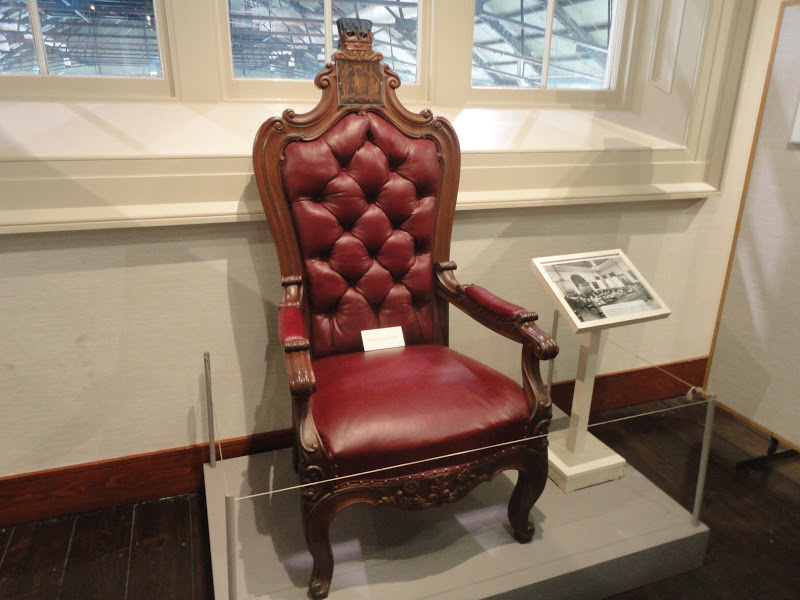
NOW : A former Mayor's Chair, on permanent display in the Market Gallery.
THEN : Between 1900 and 1904, the great iron structure that encloses the South Market, between the old City Hall structure down to the Esplanade, was built.  This is where all the stalls and vendors in the South Market are located today.  It was a bit of an engineering marvel back in the day.  There are no pillars running down the centre of the market; that great iron roof is balanced off the brick walls, and the metal beams would have been pullied up by teams of horses.

THEN : Building the extension to the South Market, circa 1900.

NOW : The extension to the South Market today.

NOW : The South Market today.  This one tends to get more attention than it's northern neighbour, as it's open from Tuesday to Saturday.  The North Market holds the Saturday morning farmer's market, and an antique market on Sundays.

Sunday, July 8, 2012

# 31 ~ Ontario's Lieutenant-Governor, Then and Now

NOW : The modern day crest of Ontario's Lieutenant-Governor.


220 years ago today, on July 8, 1792, John Graves Simcoe was sworn in as the first Lieutenant-Governor of Upper Canada.  The swearing in ceremony was held at St. George's (Anglican) Church on King Street, in Kingston.  This was the first Anglican church - or indeed, the first church of any denomination - to be built in Kingston.  It was built on the edge of Kingston's Market Square earlier in 1792.  Constructed of wood, it stood only 12 x 10 metres, and was painted blue.  Sadly, the church was demolished in 1827 but was soon replaced by another church of the same name, which would go on to become today's Anglican cathedral for Kingston. 

THEN : Portrait of Simcoe as a young man, circa 1770, attributed to the artist Johann Joseph Zoffany.

Of course, in the last two centuries, Simcoe has fallen in amongst the most studied historical characters in the history of the Province of Ontario.  But for those of us who live here, Simcoe's life outside of what is now Ontario may be somewhat unfamiliar. He was born in Cotterstock, in England, on February 25, 1752. He was actually the third of four sons, but as was sadly all too common at the time, he was the only one of his brothers to survive into adulthood. His father, also John, served as a naval officer, and died during expedition that was of great significance to Canadians – the campaign to capture Quebec from the French. This senior John Simcoe died not of wounds received in battle, but rather, of an illness, most likely pneumonia. His widow relocated the family to Exeter, and thus it was Exeter that would become the childhood home of the young John Simcoe. 

Studying at the Exeter Grammar School and then Eton College and Merton College at Oxford University, Simcoe entertained a brief flirtation with a career in law. Soon, though, he turned away towards a career in the military, following in his father's footsteps, so to speak. Though he was a young boy when his father died, the elder Simcoe seems to have left his son with a strong impression. The virtues of loyalty, bravery, morality and diligence were all handed down, and an impression was made that an academic education should go hand in hand with military training. Thus, a posting as a military administrator was just as worthwhile as the glorious of leadership in combat. The young Simcoe would do his best to imbue himself with the qualities that he felt his father had exemplified, and Simcoe's posting as a sort of military governor of Upper Canada would be the one for which he is most remembered today.

After receiving the benefit of instruction under a military tutor, Simcoe joined the military in 1770. Not for him was his father's branch of service in the Royal Navy. Rather, the young Simcoe was aided by the influence of his mother's family, and was given a commission as an ensign. It was a busy time for the Imperial military, and Simcoe was sent with his regiment to fight against the rebellious Americans. They shipped out to Boston in 1775. His career in America would offer him advancement, and also bring him in to contact with some of the noted British commanders in North America – Lord Cornwallis, and the two brothers, Sir William Howe and Lord Richard Howe. Further, Simcoe would be wounded a total of three times through the American Revolutionary War, with his most pronounced injury received at the Battle of Brandywine in September of 1777. Simcoe would struggle with less than exuberant health for his entire life.

THEN : The Battle of Brandywine, fought in 1777, was where Simcoe received the most serious of his injuries.  Even as a young man, he never enjoyed particularly vigorous health, and his wartime wounds would stay with him for his entire life.
It was in October of 1777 that Simcoe would be given command of the regiment with which he was long associated.  Elevated to the rank of general – now, a far cry from the rank of ensign with which he was initiated in to the British Army – he led the Queen's Rangers. European military tactics were changing, and the British army recognized the need for men who knew the local terrain and who were able to live and travel ruggedly through rough land. Ranger regiments were largely made up by those who lived on the frontier and therefore knew the land. These rangers knew how to live in the wild, how to silently scout out an enemy, and how to engage in guerrilla warfare. The Queen's Rangers would become one of the few non-aboriginal units to be able to mobilize in the harshest of conditions. In many ways, the regular British Army would remain unadapted to the challenging conditions of the New World, but this wily regiments were valuable adjuncts to any army.


THEN : A familiar portrait of John Graves Simcoe, wearing the green tunic of the Queen's Rangers.


The Queen's Rangers served to gather information on the movement of enemy troops, and to move swiftly and with great stealth when called to attack. They spent less time drilled on the formality of the parade square, and had more emphasis placed on what was crucial to their light, fast and stealthy manner of warfare. A keen physical strength, the ability for speed, and drill at close-quarters hand and bayonet combat were more important to the men of the Queen's Rangers than the ability to quickly form up in rank and file. Despite the popular image of every historical British soldier dressed as a“redcoat”, the tunics of the the Queen's Rangers were green, and not red. This allowed them to blend in better in the wooded areas in which they could conceal themselves. They also often carried rifles, which held a greater range and accuracy than the muskets given to more standard troops. This was important as the men of the Queen's Rangers would be shooting from a greater distance, from within the trees in which they would conceal themselves.

 
THEN : The badge of the Queen's Rangers.

Simcoe had great success with the Queen's Rangers, which he commanded until shortly after the signing of the Treaty of Paris, on September 3, 1783. The colonies had been lost to the Crown, but Simcoe had personally gained a celebrated military career. There were few regimental commanders who could claim more frequent success than Simcoe, and he soon earned the respect of military authorities for his grasp of good tactics. Simcoe in turn gave much credit to the men of the Queen's Rangers. He bragged of their performance and good conduct, their abstaining from the plundering and destruction of civilian property, their alertness in battle and their never having a sentry surprised. After the Treaty of Paris, the Queen's Rangers was disbanded, with many of its members settling in the Atlantic regions, where in fact a number of the regiment's former members received land grants in Queensbury, New Brunswick. Simcoe left North America and travelled home to England, and although the Queen's Rangers were disbanded, the regiment would be mustered up again when Simcoe returned. When they were called back in to service, after the foundation of the Province of Upper Canada in 1791, it's easy to think of these rugged men clearing the forest to build the roads, town and fortifications around the old Town of York.

NOW : A reenactment group of Queen's Rangers.  For more information visit http://thequeensrangers.org/


After the war, Simcoe returned to England.  While recuperating from his wartime injuries, he stayed at the home of his godfather, Admiral Samuel Graves. It was here that Simcoe entered into marriage with Elizabeth Posthuma Gwillim, a young ward of Admiral Graves. She was the daughter of Lieutenant-Colonel Thomas Gwillim and Elizabeth Spinkes. Born in 1762, she was a full decade younger than Simcoe, and her infancy had been full of tragedy. Her father, Lieutenant-Colonel Thomas Gwillim, died before she was born, which explains her curious middle name of “Posthuma”. Her mother, Elizabeth Spinkes, died in childbirth. Young Elizabeth was baptized on September 22, 1762, and her mother's funeral was held the next day. Elizabeth was raised by her aunt, Margaret, who became the wife of Admiral Graves, and together the couple raised Elizabeth as their very own child. Elizabeth and John Graves Simcoe were married on December 30, 1762, and would be nearly inseparable for the next two-dozen years, right up until the time of Simcoe's death. But for the tragedy in the early death of Elizabeth's parents, the story of her upbringing, and her introduction to her future husband, might have been lifted from the scores of a comic Victorian operetta.


THEN : Elizabeth Simcoe.  She was an incredible woman, venturing across the Atlantic with her husband, to live with him in the wilderness, at a time when most women would have happily remained at home.  John and Elizabeth had a daughter, Katherine, born in Upper Canada - one of the first European children to be born in the province - but sadly, Katherine died shortly after.  Katherine Simcoe was laid to rest in the cemetery near Fort York.  Over time, the cemetery has evolved into today's Victoria Memorial Square.

While back in England, Simcoe had a brief career in the House of Commons, but his real yearning was for an appointment as governor in the colonies. Plans to establish Upper Canada as a new province had been underway for sometime before it was created in 1791. Simcoe was of course chosen to be the first viceroy for the new province. There were several significant dates in Simcoe's early career as such. The appointment was made official on September 12, 1791. Shortly thereafter Simcoe departed England and spent two months crossing the Atlantic. Wintering in Quebec, he first arrived across the borders of Upper Canada in June 24, 1792. Finally, it was on July 8, 1792, that an investiture ceremony was held, as described, at St. George's Church in Kingston.

As mentioned, the few years that Simcoe spent in Upper Canada have been thoroughly chronicled. When he crossed the Atlantic, accompanied by his wife Elizabeth and three of their children, he brought with him grand schemes to plant a seed of England in the raging wilderness of Upper Canada. Simcoe left it for later generations to cultivate, and one wonders what he would have made of the society that Ontario has grown in to. Free education, accessible healthcare, an admired judicial process and overall, a general sense of liberty, have all grown out of the institutions that Simcoe implanted on the shores of our province over two centuries ago. Simcoe's time in the province was short, only lasting a few years, but there was an urgency to his planning, and they were ardent enough to outstrip the enthusiasms of his superiors. His plans were often checked by both Lord Dorchester in Quebec, and the colonial authorities back in England, simply because they were too expensive and represented a dedication and speed that went unshared by Simcoe's superiors.

Just as Upper Canada has spent more than two hundred years evolving into the modern day Province of Ontario, the role of the Lieutenant-Governor has changed, too. Simcoe was essentially a military governor, who led the reassembled men of the Queen's Rangers in exploring and settling, laying roads, building forts, and generally carving the Town of York, that primordial entity that became today's City of Toronto, out of the enormous forest that stretched north all the way from today's Front Street, at the edge of Lake Ontario. Today, the role of the Lieutenant-Governor is a more modern one. The viceroy of Ontario serves as the Queen's official representative in the province, and is an emblem of Canada's constitutional monarchy, which binds us not only with other Commonwealth communities around the world, but also serves to unite us with our own democratic heritage. Canada is one of the few nations in the world who peacefully talked its way into independence, without the real use of force or violence, and we are fortunate to carry on an association with our regal heritage. 

Constitutionally, the Lieutenant-Governor of Ontario represents the highest ranking position in the province, followed by the Premier, then the Attorney-General, and then the Speaker. However, it is as a community figure that recent Lieutenant-Governors of Ontario have really entered into the eye of the public. Viceregal representatives each take on important roles in lending their patronage to local community causes, by attending countless events and meeting Ontario's residents by the thousands. The ceremonial and community role of the Lieutenant-Governor is indeed the most prolific, and each appointed representative traditionally makes a committment towards certain special causes. Ontario's current Lieutenant-Governor, David Onley, has made it his goal to raise awareness regarding issues of accessibility. There have been several “firsts” in the Lieutenant-Governor's office over recent decades. Pauline McGibbon served as viceroy from 1974 until 1980, and became the first female Lieutenant-Governor of the Province. Lincoln Alexander, who served from 1985 until 1991, was Ontario's first viceroy of West Indian ancestry. Lincoln Alexander was used to breaking records – in 1968, he was elected to the House of Commons to represent Hamilton West, becoming Canada's first black Member of Parliament.

There were eight Lieutenant-Govenors of Upper Canada, including the first, John Graves Simcoe, between 1791 and 1841. That year, the Province of Upper Canada became the Province of Canada West, and there would be only two viceroys in office over the next twenty-six years until Canadian Confederation in 1867. Since Confederation, there have been a total of twenty-eight men and women who have held the office of Lieutenant-Governor. Onley's appointment as such was announced to the public on July 10, 2007 – another anniversary that is just a few days away.


NOW : Ontario's current Lieutenant-Governor, the Honourable David C. Onley.  The source of the photograph is the official website of Ontario's Lieutenant-Governor, listed below.


It's been a long time since Simcoe carved the British institutions of parliament, justice and freedom out of the old forests of Ontario, and we've spent more than two centuries making them our own. It's satisfying, on a certain level, to trace their origins back to a small ceremony held in a wooden church in Kingston on this day, 220 years ago.
For more extensive information on the role of today's Lieutenant-Governor, please visit :


NOW : There are various monuments to the Simcoes all across Ontario.  This one, in Niagara, commemorates the opening of the first Parliament in Upper Canada.  The inscription reads :

Here at Niagara on September 17, 1792
he presided over the first
representative assembly
of this province.

His genius foresaw the greatness of
this country and he threw himself
into its building with ardour and
enthusiasm. By his exalted aims, his
conspicuous integrity, his tireless
industry and unflagging fortitude
he brought courage to the hearts
of the early settlers and led them
to carve a civilization out of a
wilderness. In all this he was
unfailingly helped by his wife

Elizabeth Posthuma Gwillim

who like her husband has left the
impress of her spirit and her
name on the letters and locations
of this province. Her diaries and
drawings give an authentic record
of the life of the period and the
aspect of the land


Monday, July 2, 2012

# 30 ~ Toronto and the Amelia Earhart Mystery, Then and Now

THEN : Amelia and her Lockheed Electra 10E NR16020, circa 1937.


Seventy-five years ago today, Amelia Earhart embarked on her last flight, before disappeared over the central Pacific Ocean, and creating perhaps the greatest mystery in aviation history.  Any number of theories have grown up surrounding her disappearance, but few people realize that, in a way, the mystery of whatever became of her began nearly a century ago in Toronto.

Even before her disappearance, Earhart had become an iconic cultural figure in America and across the globe.  Her contributions both to aviation and to the role of women are undeniable.  She is often cited as the first female pilot to fly solo across the Atlantic, but this was just one of the many aviation records that she set.  She became involved in the womens liberation movement, joining the National Woman's Party and supporting the American Equal Rights Amendment.  In 1935, just a few short years before she died, she became a faculty member at Purdue University, and often counselled other women, advising them as to their career choices.  She helped set up an organiztion for female pilots, and was the first woman to ever receive America's Distinguished Flying Cross.

Born in Kansas on July 24, 1897, Earhart was something of a “tomboy” growing up, and had an unconventional upbringing, as her parents, particularly her mother, did not expect her to conform to the behaviour exemplified for young girls at the time. Along with her younger sister, the young Amelia Earhart would spend long hours on rambling explorations of the countryside around her home, getting into mischief, climbing trees, and even hunting rats with a rifle. It was in her childhood that she was nicknamed “Meeley”, or sometimes, “Millie”, and longtime friends often referred to her by this nickname even when Earhart grew into an adult. For the first several years of her life, Amelia Earhart was schooled at home, by her grandparents. It wasn't until she was twelve years old, and entering the seventh grade that she attended public school for the first time.

Earhart described her childhood as coming to an end in 1914. Her father's career had suffered due to alcoholism, and the family fortunes were cast in to jeopardy. The loss of a family home had a profound impact on young Amelia Earhart. With the family forced to relocate, young Amelia found herself attending high school in Chicago. By this point, she was already fascinated by the prospects of breaking down boundaries – she'd started a journal, and collected press clippings of women who had become successful and prominent in traditionally male dominated occupations. Engineering, mechanics, law, advertising, film production – they all seemed to draw Earhart's attention, simply because, nearly a century ago, they were all considered to be “jobs for men”.

The First World War years brought Amelia Earhart little stability, as she travelled, took on odd jobs, and failed to complete any post secondary academic programme. In 1919, she applied for entry at Smith College, but changed her mind and moved to Columbia University. She attended there for only a year before quitting and moving back to California, to be with her parents. It was at Long Beach, California, on December 28, 1920, that Amelia Earhart, along with her father, visited an air field. There, they met Frank Hawks, himself a renowned early pilot. Her father paid $10 and Amelia got a ten minute ride in Hawks' plane. Amelia Earhart became infatuated, and the rest is history. She worked odd jobs and did whatever she needed to, in order to put together $1,000 for flying lessons. Her lessons began in January of 1921 at Kinnear Field, which required Earhart to take a bus to the end of the line and then walk six kilometres (four miles) to the airfield. Her instructor was Anita Snook, another pioneer female pilot.

THEN : Frank Hawks charged Amelia Earhart's father $10 to take her up on her first airplane ride, which lasted ten minutes.  Hawks would go on to become a celebrity pilot himself, breaking many speed records, before dying in an experimental airplane crash in 1938, the year after Earhart vanished.

THEN : Frank Hawks as mentioned in the "Hall of Fame of the Air".
THEN : Anita Snook photographed at Kinnear Air Field in 1921.  She was a groundbreaking female pilot in her own right, but is destined to be remembered as Amelia Earhart's teacher.  She was teaching Earhart at Kinnear Field during the same year that this photograph was taken.  Snook died in 1991 at the age of 95 years old.
  

Earhart was prepared to do anything that she needed to in order to make it as a pilot. She cropped her hair short and spent three nights sleeping in her new leather aviator's jacket, in order to give it the “worn in” look, and thus pass the unofficial inspection and judgement that she knew she was bound to receive from male pilots. Her lessons continued, and on October 22, 1922, Earhart broke the first of many records, by flying to an altitude of 4,300 metres – the highest altitude a woman had ever achieved, at that point. Amelia Earhart got her pilot's license (license number 6017) on May 15, 1923, and in doing so, became the sixteenth woman to receive a license to fly. The rest was history.

Earhart's life has been well chronicled in countless biographical books and documentaries and as it the case with many iconic symbols, several biographers have built careers around studying and sharing the details of her life. After she set the record for the highest altitude flown by a woman in 1922, she would, as mentioned, set a number of other records, too. She spent the 1920s and 1930s raising the bar of aviation accomplishment and some of her other breakthroughs are listed here.

In 1928 she became the first woman to fly across the Atlantic. Charles Lindbergh had flown solo across the Atlantic the year before, in 1927, and this led the way for interest in future such expeditions. Earhart left Newfoundland on June 17, 1928, but was accompanied by two men – pilot Wilmer Stultz and mechanic Louis Gordon. Earhart is credited as the first woman to fly across the Atlantic Ocean during this voyage, but did no actual flying herself, and was essentially little more than a passenger. The trip took just under twenty-one hours, before the plane set down in Wales. Despite the fact that she contributed little to the flight, she was feted by the mayor of Southampton, England, and she returned home to a hero's welcome, attending a White House reception with American president Calvin Coolidge, and serving as the centre of attention in a ticker tape parade in New York. As for the possibilities of her making her own attempt, she quipped, “Maybe someday I'll try it alone”.

THEN : Earhart greats the Mayor of Southampton, Mrs. Foster Welch, on June 20th, 1928, after having become the first woman to be flown across the Atlantic.


In 1931, she set a speed record while transporting a cargo of 230 kilograms. That same year, she became the first woman to fly an autogyro and also set an altitude record for the same sort of aircraft, taking hers up to over 4,500 metres.

In 1932, she became the first person to cross America in an autogyro, and also in 1932, made good on her vow to cross the Atlantic again, becoming the first woman to fly across the Atlantic solo, and the first person to fly across the Atlantic twice. That same year, she became the first woman to win the Distinguished Flying Cross.


THEN : Earhart poses in front of an autogyro in Rock Springs in 1931.

In 1933, Earhart became the first woman to fly non-stop across America, and set the speed record for a transcontinental flight.

In 1935, Earhart became the first person to fly solo between Honolulu and Oakland, California, the first person to fly solo from Los Angeles to Mexico City, and the first person to fly non-stop from Mexico City to Newark, New Jersey.

It was her flight – albeit as a passenger – across the Atlantic in 1928 that secured Earhart's future and her role as a celebrity. She was already lecturing across America in 1928 and 1929, and was dubbed the “Queen of the Air”. Her lectures continued, she published a book, and she made money by endorsing several product lines, including clothes, luggage and “Lucky Strike” cigarettes. The cigarettes tarnished her image in some circles, although she donated $1,500 from that campaign to a scientific expedition to the South Pole. “Modernaire Earhart Luggage” and “A.E.” brand clothing for women – all of which was washable, wrinkle proof and made for “active living” - became popular household brands.

THEN : Earhart gave her name to "Modernaire Earhart Luggage" in one of many product lines, all of which brought in financial sponsorship.

THEN : Earhart's advertisement for Lucky Strike cigarettes, which apparently calm your nerves on long flights but don't bug your throat.
 

Early pilots like Amelia Earhart began to show the world that flying was not just for daredevils anymore, and they helped capture acceptance for the new technology. It's hard for us, who take to the concept of flying in an airplane so naturally, to understand what an exclusive club it was eighty years ago. But by the mid-1930s, one major accomplanishment remained for Amelia Earhart and other pilots : aerial circumnavigation of the globe. Amelia Earhart took up the challenge, and by the start of 1936 was planning a circumnavigation of the globe by following the equator, which represents, of course, the earth at its widest point. With expedition funding from Purdue University, a specially constructed Lockheed Electra 10E was built, and dubbed a “flying laboratory” although it contained little in the way of scientific equipment. Amelia Earhart's first attempt to fly across the world began on March 17, 1937. With her was copilot Fred Noonan, as well as two other crewmen. They flew from Oakland, California and made it as far as Honolulu, Hawaii. There, the plane required maintenance, and upon take off, a few days later, there was a malfunction on take off involving a tire and landing gear. The plane was shipped back to California for overhaul and Amelia Earhart's first attempt to fly across the world was scrapped.


THEN : The proposed route for Earhart's flight across the globe, which more or less followed the equator.
 

The plane was soon repaired and plans were made for a second attempt. This time, Earhart would be accompanied just by co-pilot Fred Noonan. They left Oakland, California and flew to Miami, Florida, and announced there plans to try again. The trip officially began when they departed Miami on June 1, 1937, and the world watched and listened as they made several stops in South America, across Africa, India, Pakistan, southeast Asia, and finally arrived at Lae, New Guinea on June 29, 1937. At this point, over two-thirds of the journey was complete. Earhart and Noonan had come 35,000 kilometres and had 11,000 kilometres left to go. But the last leg of the voyage was the most dangerous, as it was all set over the vast, remote expanse of the Pacific Ocean. In 1937, there was no such thing as radar, and the plan had to navigate by radio signal – and Amelia Earhart was known for her lack of efficiency and prowess at radio operation. Her and Noonan would rely on a single device – a battery operated radio – to help them find their way from one tiny island to the next, where they would need to land and refuel.

After their stopover at Lae, New Guinea, their next intended stop was Howland Island. They'd need to cover over 4,000 kilometres to get there, and then identify the island using radio signals and eyesight. The island was only 2,000 metres long and just 500 metres across. At it's highest point it soared less than six metres out of the water. A coast guard ship, the Itasca, was stationed near Howland Island, and the crew had orders to stay in contact with Earhart by radio, and use the plane's radio signals to help guide Earhart to the island.

The enduring mystery that has become a part of the Amelia Earhart legend stems, of course, from the fact that her and Fred Noonan never made it to Howland Island. To this day, what happened remains unclear, but it seems to hinge on failings in radio communication. Some theories claim that the antenna on Earhart's plane was lost or damaged on take off. Others cite Earhart's lack of profficiency in operating the radio equipment. It seems clear that Earhart and Noonan were unable to identify Lake Howland. It was a cloudy day, and the dark reflections of clouds over the waters would have made telling them apart from the actual island difficult. Earhart and Noonan took off from New Guinea at midnight, Greenwich Mean Time (7:00 p.m. Toronto time) on July 2, 1937. There were confirmed radio communications between their Electa airplane and the Itasca as late as 7:42 and 7:58 the next morning. The panic in her voice was building. They were running low on fuel, and running low on time. Because of the more primitive nature of radio communication, there were shadow messages, hisses and pops, that may have come from Amelia Earhart, or may not have. There was also confusion of which frequency she was broadcasting on. But according to most sources, the last known and confirmed broadcast from Amelia Earhart came at 8:43 a.m. With the panic audible in her voice, she said, "We are on the line 157 337. We will repeat this message. We will repeat this on 6210 kilocycles. Wait."

At some point shortly after, Amelia Earhart and Fred Noonan flew their Electra into thin air, and disappeared into the annals of legend and mystery. Within an hour of her last known transmission, search efforts for Earhart and Noonan began. They had an inflatable life raft and emergency provisions on board. Had they ditched in to the water of the Pacific they might have survived for some time. 390,000 km2 were covered, and $4-million were spent, on what was at the time the largest search and rescue campaign the world had ever seen. But the search was eventually fruitless, and was called off, at least officially, on July 19, 1937. Armchair historical detectives and theorists have been spent the last seventy-five years in the quest to discover what happened to Amelia Earhart.

Naturally, several theories on what actually happened to Earhart and Noonan have surfaced. The most widely accepted theory is perhaps the simplest – they crashed due to lack of fuel, and either the couple sank with the plane or they died at sea in some other circumstance. In this theory, their flight was just poorly planned and carried out. There has been decades of investigation and study that seem to hold up this theory. As it is unclear where exactly the plane would have struck the ocean, and as the floor of the Pacific lies as deep as five kilometres in some areas around Howland Island, the search and raising of Earhart's plane still evades searchers. But if it is ever discovered, the raising of the plane would be a watershed event in the annals of one of the twentieth century's most enduring mysteries.


THEN : Amelia Earhart and Fred Noonan in May of 1937, less than two months before they flew into thin air.


There are several other theories, all of which contain at least small amounts of evidence to substantiate conjecture. Some suggest that Earhart and Noonan landed on Gardner Island, about 500 kilometres from Howland Island, and later perished there. Several expeditions have been mounted to Gardner Islands, with claims of the discovery of several inexplicable artifacts. In 1937, Gardner Island was uninhabited, but there were reports in 1940 of the discovery of a skeleton on the island. An examination of the remains concluded that they were the remains of a male, but a later analysis in 1998 suggested that the bones had in fact come from a tall female of northern European ancestry. It's all conjecture, anyway, as the skeletal remains were somehow lost in Fiji sometime after 1941. Other uncovered artifacts include a metal panel, which may have come from an Electra type plane, a size nine shoe heel, and a piece of plexiglass that matches the description of one of Earhart's Electra windows. The Gardner Island theory has become the second most commonly accepted explanation of whatever happened to Earhart and Noonan, but it remains unsubstantiated.

There are a lot of popular culture myths and legends to explain what happened after Earhart and Noonan disappeared. There is generally a lack of evidence for any of these theories, and they remain largely dismissed. A theory that Earhart was spying on the Japanese for President Roosevelt made it into a 1943 movie called “Flight For Freedom”, but a search through the records of both the American and Japanese governments after the Second World War has disproved this theory. A related theory was that Earhart and Noonan were captured by Japanese military forces, and executed as spies, either on the island of Saipan (which was under Japanese occupation) or less often, the island of Tinian. Several American troops, who served in the Pacific during the Second World War, claimed to have come up against some evidence to support the Japanese prisoner theories, but none of these claims have been substantiated. Excavations of suggested grave sites have proven fruitless. Photographs of Earhart that claimed to show her in captivity were proven to either be fake or to have been taken before her final flight.

In 1990, the popular American television series, "Unsolved Mysteries", aired a segment on the Saipan theory of the disappearance of Amelia Earhart.  Claims made by those contributing to the Saipan theory have never received significant support.


Other claims that Earhart was captured and forced to make anti-American propaganda broadcasts have also been discredited. Just like her physical appearance, Earhart's voice was well known to many, and the supposed propaganda broadcasts, Earhart's voice was never identified.

There are organizations, and websites, that chronicle the Second World War era aircraft wrecks all throughout the Pacific region. Over time, there have been various claims that particular wrecks belonged to Earhart, but none of these claims have ever been substantiated.

Perhaps one of the most bizarre episodes in the quest to prove what happened to Earhart involved the supposition that she somehow survived her ordeal, moved back to New Jersey, and sought anonymity. How or why she would do such a thing was never specifically dealt with, but in 1970, and author named Joe Klaas published a book called “Amelia Earhart Lives”, and he put forward the suggestion that Earhart was actually living under an assumed identity, and was now going by the name of Irene Bolam. Professional forensic experts studied the facial structure of both Bolan and Earhart, debunking this claim. Bolam's life was thoroughly studied, and was substantially documented, proving that she was not Earhart. Most damning of all was that Bolam herself denied these claims and filed a lawsuit for $1.5-million in damages.

THEN : A book published in 1970 claimed that Earhart (left) had somehow survived, returned to New Jersey, and taken on a new identity, and was living as Irene Bolam (right).  Pretty soon, just about everyone discredited this theory, including Bolam herself, who sued for $1.5-million.

Amelia Earhart's accomplishments as an aviatrix have, in many ways, been overshadowed by her fame as a missing person. But few people seem to be aware of the early connections she had with flight while residing in Toronto. It was in those tumultuous years during and just after the First World War, when she was travelling, and prior to her 1920 return to California and her first ever ride in an airplane. In December of 1917, Earhart visited her younger sister, who was living here in Toronto. Moved by the plight of injured Canadian soldiers who were coming home from the battle front, Earhart signed up for training rom the Red Cross, and began working as a nurse at the Spadina Miltary Hospital (located at 1 Spadina Crescent, just north of College Street). There, she assisted with the preparation of meals and the handing out of medicine to the patients. 

NOW : 1 Spadina Circle, where Amelia Earhart worked as a nurse at the end of the First World War, is pictured in this contemporary and (appropriately) aerial photograph.

THEN : A seldom seen photograph of Earhart while serving as a nursing aide in Toronto.  It's often overlooked that her chance encounter with some Canadian soldiers on King Street inspired her to get into nursing in Toronto, and that her subsequent stay in Toronto inspired her to become a pilot.
 

With the outbreak of the Spanish Flu, and a world wide pandemic, Earhart soon became a patient. She developed pneumonia, and had a slow recovery, spending months convalescing. Her sinuses became infected, too, and although she received a small operation, she would experience related problems all of her life, which sometimes impacted her career as a pilot. But it was in Toronto tha she developed her love of flying. She began attending air shows put on by the pilots of the Royal Flying Corps, at the Armour Heights air field, located near today's Avenue Road and Wilson Avenue. Then, in 1919, she joined a friend in a visit to the Canadian National Exposition, where together they watched an airshow performed by a First World War flying ace. According to the stuff of legend, Earhart and her friend had a good vantage point, in a clearing away from the crowds. The pilot saw them, and dove down to “buzz” the pair. Earhart would later say, “I am sure he said to himself, 'Watch me make them scamper,'. I did not understand it at the time,but I believe that little red airplane said something to me as it swished by.” Earhart stood her ground in the face of the daredevil pilot. 

THEN : During her convalescene in Toronto from pneumonia, Earhart attending flying demonstrations put on by members of the Royal Flying Corps at Armour Heights air field, pictured here.  The airfield was located near Wilson Avenue and Avenue Road, and fell into disuse after 1921, however, it was there long enough to inspire Amelia Earhart.  The site of the old air field is now home to the Canadian Forces College.


THEN : An air show at the Canadian National Exposition, circa 1907.  A dozen years later, Earhart would attend a similar air show, and would soon be thrilled by the possibilities of flight.


It's often overlooked, but Amelia caught the “aviatrix bug” here in Toronto. In 2009, the film “Amelia”, a biopic of Earhart's life, was released. It was largely filmed in Toronto, with scenes shot around the Fairmont Royal York Hotel, Union Station, and the Elgin and Winter Garden theatre centres, amongst other locations. Toronto was a fitting back drop for the movie, as it was also the back drop for Earhart's initial love affair witht he airplane. It's hard to imagine that a chance encounter with a group of Canadian solders on King Street inspired Earhart to work as a nurse, and that her convalescence in and around Toronto included an airshow, which lay the seeds of her inspiration to become a pilot. 

THEN : Richard Gere and Hilary Swank filming the 2009 biopic "Amelia" outside Toronto's Royal York Hotel.

THEN : Richard Gere and Hilary Swank filming the 2009 biopic "Amelia" outside Toronto's Union Station.

THEN : Front Street, between Union Station and the Royal York Hotel, gets a makeover for the 2009 film "Amelia".  It's terribly appropriate that the film was made her, given Earhart's early connections with Toronto.


Earhart became a feminist icon, as well as a leading figure in aviation, and the mystery of her fate still captivates us. As Tom Crouch, a senior curator at the (American) National Air and Space Museum, said, “... the mystery is part of what keeps us interested. In part, we remember her because she's our favourite missing person.” Recently, there has been a resurgence in finding out whatever happened to Amelia, with American leaders like Hilary Clinton throwing support for stepping up the search. Seventy-five years ago tonight, Earhart embarked on her last ever voyage, but it was nearly twenty years earlier that Toronto inspired her to become a legend.

THEN : Amelia Earhart in the cockpit of her Electra in 1936.  Whatever became of you, Amelia, you have left us with one of the twentieth century's most enduring mysteries!